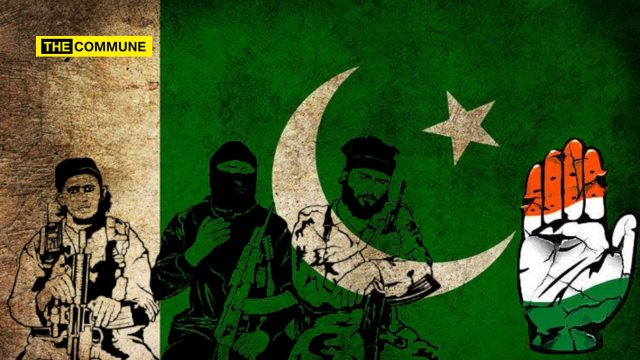
When the 2008 Mumbai attacks killed 166 people over four days, India expected its government to respond with the full weight of a sovereign state. What followed instead was a decade of letters, summits, and assurances – a sustained performance of diplomacy directed at a neighbour that had no intention of delivering justice, conducted by a government that had no intention of demanding it.
The UPA’s record on terrorism was not a story of difficult trade-offs or hard strategic choices. It was a story of deliberate abdication. Home ministers who handed propaganda to the very terrorists India was pursuing. Prime ministers who expressed “disappointment” at neighbours who harboured mass murderers and then resumed talks the following week. External Affairs ministers who welcomed Pakistani judicial commissions to India while Hafiz Saeed, the 26/11 mastermind, held press conferences in Lahore. Jawans beheaded on the Line of Control, their deaths explained away as an attempt to “derail the dialogue process.”
For ten years, the UPA government established one consistent principle in its response to terrorism: that the peace process was more important than the dead. What follows is the documented record of how that principle played out; entry by entry, incident by incident, statement by statement.
Terrorism Was Not Even Raised With Pakistan PM (March 2013)
External Affairs Minister Salman Khurshid confirmed that terrorism was not raised during PM Manmohan Singh’s meeting with Pakistani PM Raja Pervez Ashraf at the ECO summit in Islamabad in March 2013 – this despite the 2008 Mumbai attacks remaining the principal unresolved issue in bilateral relations. Hafiz Saeed, the Lashkar-e-Taiba chief who masterminded 26/11, was still freely roaming Pakistan. India’s longstanding position was that normalisation required Pakistani action against LeT. That position was abandoned at the negotiating table without a word.
Home Minister Gave Hafiz Saeed a Propaganda Gift (January 2013)
Home Minister Sushilkumar Shinde, speaking at a Congress conclave in Jaipur, alleged that the BJP and RSS were running “Hindu terror training camps.”
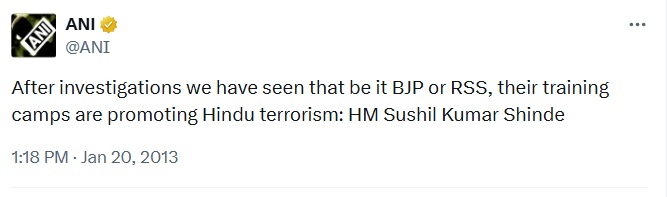
Hafiz Saeed, the 26/11 mastermind, wanted by India, carrying a $10 million American bounty, immediately seized on the statement to publicly declare India a “terror state.”
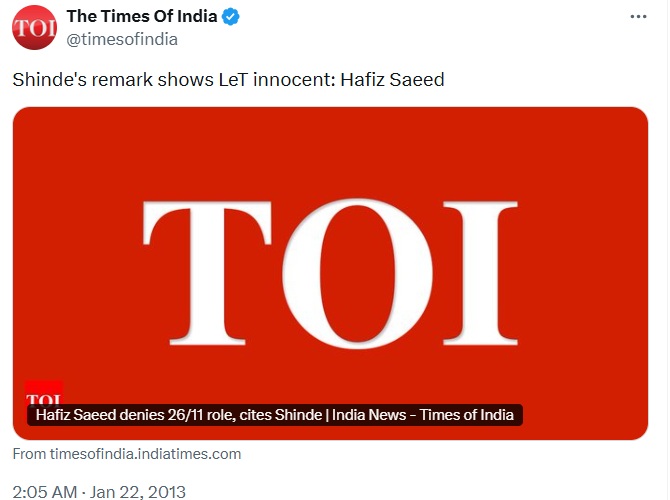
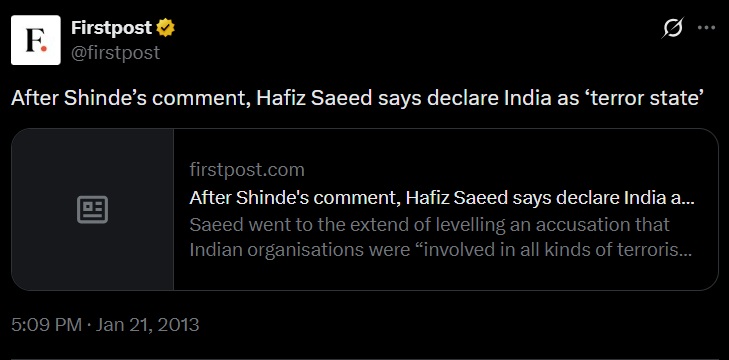
A serving Indian Home Minister had handed one of South Asia’s most wanted terrorists a ready-made international propaganda instrument. No substantive action was taken against Shinde. He was not asked to resign.
India Outsourced Its Own Security Concerns to Washington (September 2013)
On the sidelines of the UN General Assembly in September 2013, PM Manmohan Singh met President Obama. According to reports, Obama assured Singh that he would personally tell Pakistan PM Nawaz Sharif to curb terror groups.
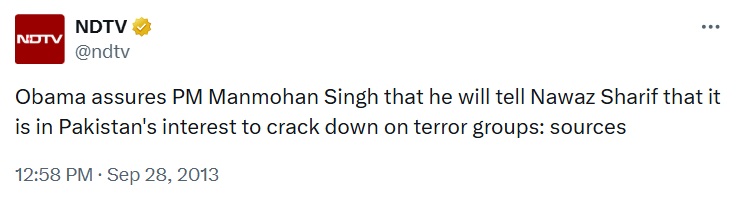
India, a country sharing a direct border with Pakistan, was depending on the United States to communicate its central security concern to its own neighbour in a third country. No subsequent outcome was reported.
India Cooperated With Pakistan’s Sham Mumbai Inquiry (September 2013)
In September 2013, a Pakistani judicial commission arrived in India to record statements as part of Pakistan’s domestic inquiry into the 2008 Mumbai attacks. EAM Salman Khurshid welcomed the visit. At this point: Hafiz Saeed was still free, still leading public rallies, still appearing on television. India had already convicted and executed Ajmal Kasab. Pakistan’s internal inquiry had stalled repeatedly. India’s cooperation produced no new charges, no extraditions, no prosecutions. Hafiz Saeed remained free.
Jawans Beheaded – Government Said: Protect the Dialogue (January 2013)
In January 2013, Pakistani soldiers crossed the LoC in the Mendhar sector of J&K, killed two Indian Army soldiers, Lance Naik Hemraj and Lance Naik Sudhakar Singh and mutilated one of the bodies. The nation demanded a firm response. Salman Khurshid told news media the incident appeared designed to “derail the dialogue process.” In other words: Pakistani soldiers beheaded Indian jawans, and the government’s response was to say the real victim was the peace process. The Indian Army’s demand for a firm response was overridden by the logic of diplomacy. Dialogue continued. Pakistan faced no cost.
PM Manmohan Singh Called Pakistan’s Inaction Merely “Regrettable” – As Indian National Died in Pakistani Custody (May 2013)
Sarabjit Singh, an Indian national who had spent over 22 years in Pakistani prison on disputed charges, was beaten to death by fellow prisoners at Lahore’s Kot Lakhpat jail in May 2013. India had submitted multiple mercy petitions over the years. All were ignored. After his death in Pakistani custody, PM Manmohan Singh called it “regrettable.” That was the full extent of India’s response.
Manmohan Singh Publicly “Disappointed” in Nawaz Sharif – Then Did Nothing (October 2013)
In October 2013, PM Singh told reporters he was “disappointed” in Nawaz Sharif, after an agreement on LoC peace reached in New York was not implemented by Pakistan. LoC ceasefire violations were rising through 2013 – India recorded hundreds of incidents that year. The public expression of disappointment did not change the government’s posture. Engagement with Pakistan continued. Violations continued alongside it.
The “Dehati Aurat” Insult – And Congress Accepted It (September 2013)
After Manmohan Singh’s meeting with Nawaz Sharif on the sidelines of the UNGA in September 2013, reports emerged that Sharif had reportedly described Manmohan Singh to Pakistani journalists as a “dehati aurat”, a village woman connoting timidity and submissiveness. Pakistan issued a denial through back-channel sources. Whether or not the remark was made, the speed with which it gained credibility in India reflected the accumulated public scepticism about the UPA’s posture toward Pakistan. The UPA’s only response was to accept the denial and move on.
Salman Khurshid’s “Conditional Unconditional” Talks (August 2013)
After Pakistani soldiers crossed the LoC and killed five Indian Army soldiers in the Poonch sector in August 2013, EAM Salman Khurshid told India Today that talks with Pakistan could not be “unconditional” while simultaneously insisting that dialogue could not be stopped.
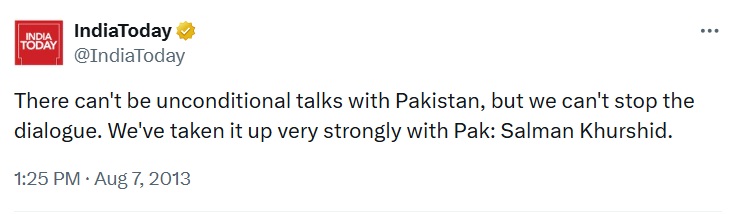
What “taking it up very strongly” had actually produced was left unspecified. The UPA’s two terms were defined by this cycle: attack → strong language → return to table. Islamabad had learnt the pattern was predictable and costless.
Manmohan’s “Genuine Feeling” Test for Pakistan – That Was Never Applied (August 2012)
PM Manmohan Singh stated in August 2012 that for India-Pakistan dialogue to proceed meaningfully, there must be a “genuine feeling” that Pakistan was doing all it could to deal with terrorism.
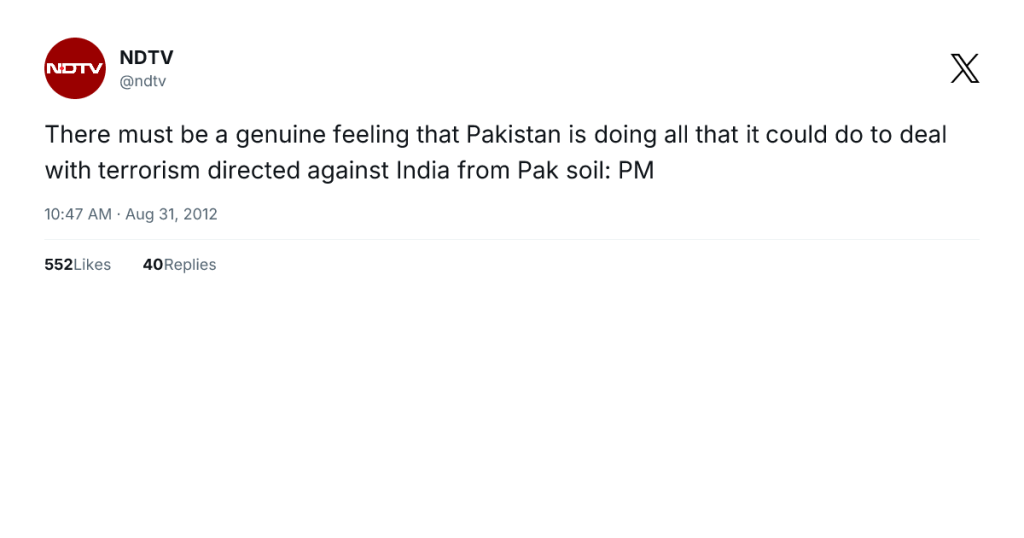
No definition of what constituted that “genuine feeling” was ever provided. No threshold was set. No point at which Pakistan would have been deemed to have failed the test was specified. Dialogue continued regardless of Pakistani actions or inactions. Critics described it as a condition designed never to be triggered.
Wikileaks Confirmed Pakistan Did Nothing on Mumbai – Congress Kept Talking Anyway (December 2010)
In December 2010, Wikileaks published US diplomatic cables confirming that Pakistan had done nothing of substance to prosecute those responsible for 26/11 corroborating India’s official position. Both India and the United States privately agreed Pakistan was acting in bad faith. The UPA’s response to this third-party confirmation of its own stated position: continue dialogue. Hafiz Saeed remained free. Engagement continued.
India Could Not Reach Hafiz Saeed – But He Was Publicly Shaping Pakistan’s Energy Policy (July 2013)
In July 2013, Hafiz Saeed, wanted by India, carrying a $10 million US bounty publicly urged the Pakistani government not to buy electricity from India. He was freely operating, addressing press, leading rallies, and influencing state policy. The UPA’s case for sustained dialogue rested on the assumption that Pakistan’s civilian leadership could restrain such actors. Saeed’s continued public prominence made that assumption indefensible.
Indian Mujahideen Was Radicalising Engineering Students – UPA Did Not Contain It (March 2014)
NDTV reported in March 2014 that among Indian Mujahideen recruits were engineering students with IIT aspirations. The IM had carried out multiple bombings across Indian cities throughout the UPA years: Ahmedabad (2008), Delhi (2008), Pune German Bakery (2010), Mumbai (2011), Hyderabad (2013). The Home Ministry faced sustained criticism for insufficient firmness against domestic Islamist terror while simultaneously being accused of applying the “Hindu terror” label to RSS/BJP to placate its constituency.
Afzal Guru – Executed After Years of Political Delay, PM MM Singh Was Worried His Family Was Not Informed (February 2013)
Afzal Guru, convicted for the December 2001 Parliament attack, was hanged on 9 February 2013 nearly 8 years after the Supreme Court upheld the death sentence in August 2005. The execution was delayed for years, widely attributed to political calculation. After the execution of Afzal Guru, then Prime Minister Manmohan Singh reportedly focused on whether the government had adequately informed the convict’s family. Instead of centering the political response on the victims of the Parliament attack, Singh is said to have sought explanations from Home Minister Sushil Kumar Shinde regarding the communication process.
What Options Do We Have, Said Chidambaram, After 26/11 Attacks
During a 2009 NDTV interview after the 26/11 attacks, P. Chidambaram responded to criticism over inaction against Pakistan by questioning alternatives, asking what others would have done in his position. He emphasised that India had chosen to suspend dialogue until Pakistan acted against those responsible and dismantled terror infrastructure. Defending the government’s approach, he argued that options like war were neither practical nor prudent in the prevailing geopolitical context. Chidambaram maintained that India would rely on diplomatic pressure and international support, cautioning against any “adventurous” or escalatory measures beyond diplomacy.
In the good old days of the UPA,
when a frustrated young Indian questioned Home Minister P. Chidambaram about what his government had done after 26/11, Chidambaram and Barkha mockingly asked in return:
“What options do we have?” pic.twitter.com/7YMjkV9yid
— shashi (@devzoy) March 25, 2026
November, 2009:
“Saaar we can’t do anything agains Pakistan, saaar. It would be rash, saaar. We have brought pressure on Pakistan saaar. Cant do anything beyond that saaaaar.”
And this was our Home Minister.
Absolutely shameful. pic.twitter.com/9uffBqZZxa— Sensei Kraken Zero (@YearOfTheKraken) March 26, 2026
Homegrown Terror – Chidambaram
In a statement that drew significant attention, P. Chidambaram told the Rajya Sabha on 4 August 2011, that the Mumbai serial blasts could have been carried out by an “Indian module,” similar to the Pune attack. He said, “Pune was by an Indian module and it seems that even the Mumbai serial blasts could have been perpetrated by an Indian module… Maybe both blasts were by the same module.” He further remarked that terrorism was no longer solely cross-border and highlighted the rise of right-wing extremism globally, stating that India was not immune to such trends.
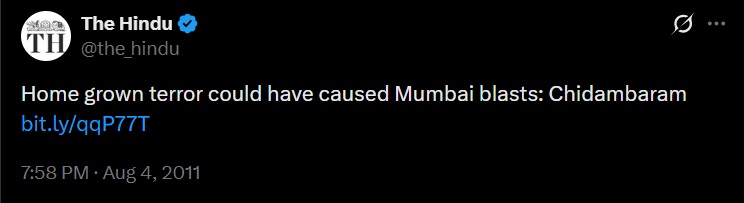
After the Delhi High Court bombing two months later in September 2011, Chidambaram told BBC: “We can no longer point to cross-border terrorism as a source of terror attacks in India.”
This statement to international media is the fullest expression of what the UPA’s “homegrown terror” framing was doing diplomatically. Chidambaram was telling the BBC, and through the BBC, the world that India could “no longer point to cross-border terrorism.” This was stated at the precise moment when Indian Mujahideen, directed by Riaz and Iqbal Bhatkal from Pakistan, was carrying out bombings on Indian soil.
Rahul Gandhi Shamelessly Said: “Can’t Stop Terror Attacks All the Time”
On 14 July 2011, as India was still counting its dead from serial bombings, Rahul Gandhi told the nation: “Difficult to stop terror attacks all the time.”
Revisiting Rahul Gandhi’s statement on terrorism:
Today, he is asking why the government is not catching terrorists. Rahul Baba, New India eliminates them, not serve biryani like UPA. pic.twitter.com/914VBiF2Yl
— Political Kida (@PoliticalKida) June 12, 2024
The leader of the country’s ruling party, responding to a terror attack, publicly declared that the government could not be expected to stop terrorism consistently. This was not a slip. It was a worldview – one that had already produced 26/11, the Delhi blasts, the Pune blasts, and the Hyderabad blasts on Congress’s watch.
Manmohan Singh After 26/11 – “Determined To Avoid War”
US Secretary of State Condoleezza Rice has, in her own writings and statements, confirmed that after 26/11, Prime Minister Manmohan Singh was “determined to avoid war” and that the MEA conveyed the same reluctance. Her summary of the Indian government’s position: “But you’ve got to get Pakistan to do something.”
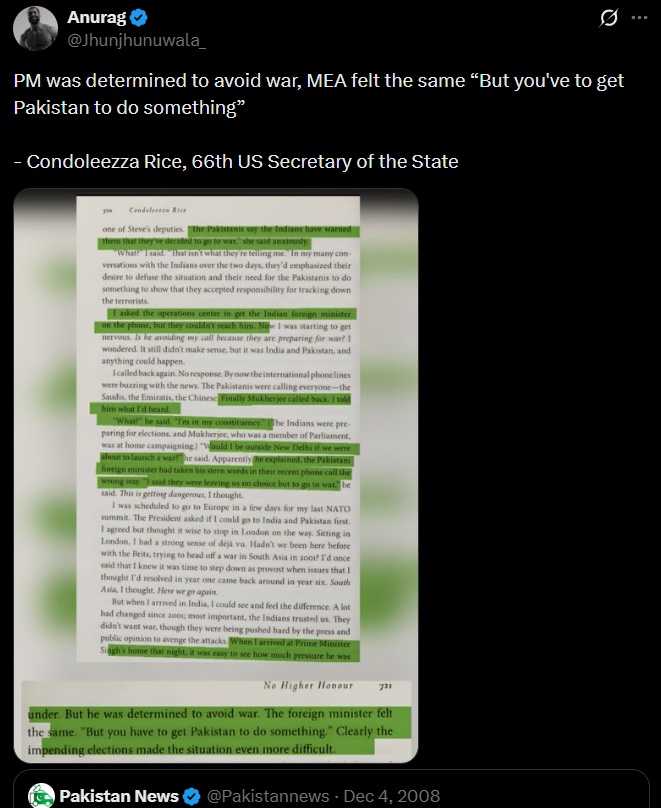
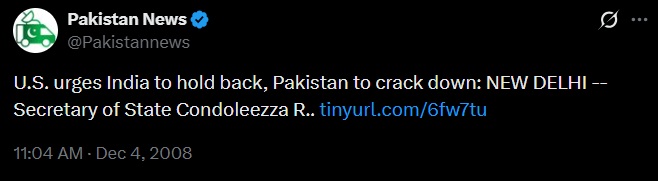
That was India’s response to the massacre of 166 of its citizens by a state-sponsored Pakistani terrorist organisation. Not a military option. Not a strategic cost imposed. A polite request to Washington to pressure Islamabad. Pakistan’s army and ISI watched this response and drew the only rational conclusion available: that Congress-led India would absorb any attack, seek dialogue, and ask the international community to mediate. That conclusion shaped Pakistani strategic calculus for years.
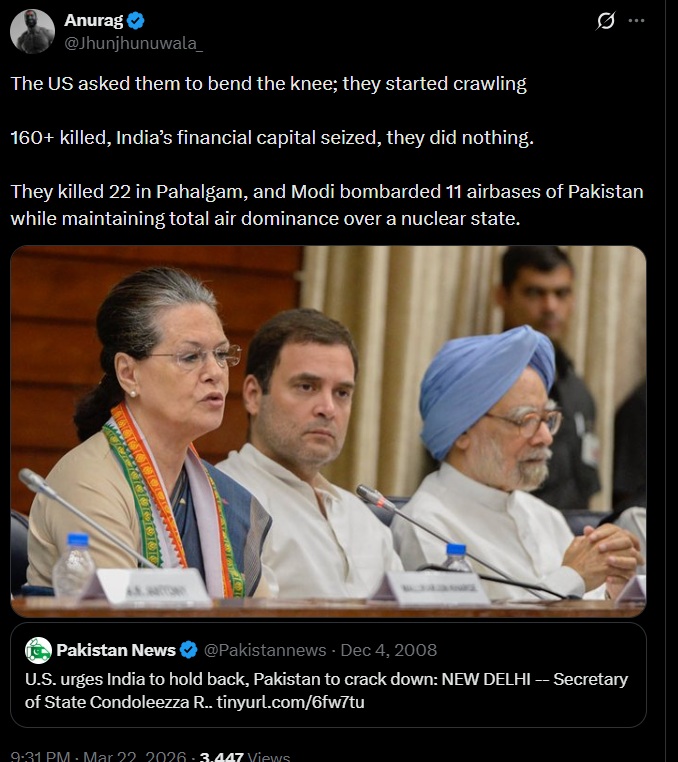
Congress Leaders Coined “Saffron Terror” and Launched Books Like “RSS Ki Saazish” to Smear Hindus
The “saffron terror” narrative was not an accident. It was a coordinated political project executed at the highest levels of government.
P. Chidambaram warned publicly of “saffron terror” as Home Minister.
Chidambaram warns of ‘saffron terror’ http://toi.in/Wj-pJa
— The Times Of India (@timesofindia) August 25, 2010
Sushil Kumar Shinde declared from the AICC stage that RSS training camps promoted Hindu terrorism.
Congress home ministers conspiring against the 1.4 Billion Hindus while protecting LeT and endorsing Hafiz Saeed is just irrelevant tweets apparently
Brace yourselves, i have more in store https://t.co/ROpqQexIwv pic.twitter.com/6Mh4Zih0pb
— Anurag (@Jhunjhunuwala_) March 22, 2026
A Congress Chief Minister, after ten years in power, launched a book titled RSS Ki Saazish – designed to whitewash the crimes of the Pakistani terror state and redirect blame onto Hindus.
Those who call Dhurandhar propaganda will never tell you this: a Congress Chief Minister, after 10 years in power, launched a book whitewashing the crimes of the Pakistani terror state.
Later, it was used by their Home Minister to shift the blame onto Hindus. https://t.co/CPTlNt3HN4 pic.twitter.com/WNYbtXESEO
— Anurag (@Jhunjhunuwala_) March 22, 2026
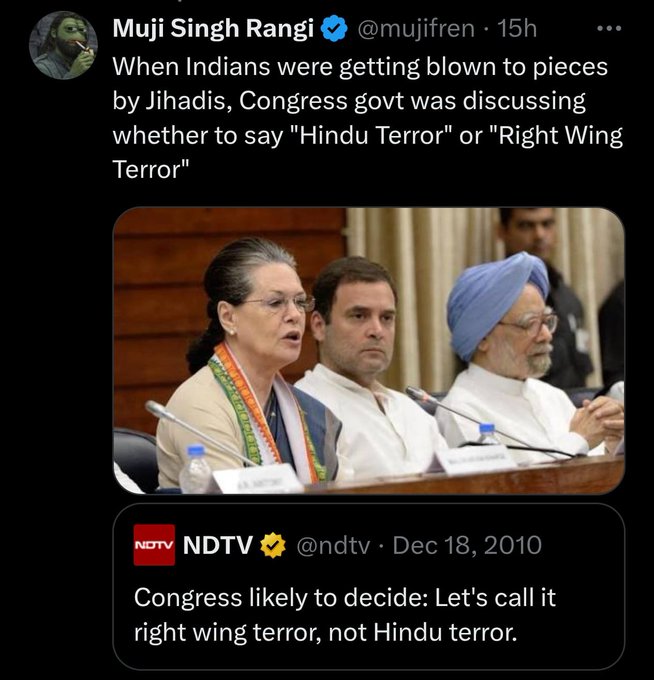
From the top of the party to the grassroot worker, the ecosystem pushed one narrative: the Hindu is the threat. LeT was the beneficiary. Hafiz Saeed was the beneficiary. Pakistan was the beneficiary.
And had Tukaram Omble not caught Ajmal Kasab alive that night in Mumbai, at the cost of his own life, the entire 26/11 story might have been turned on its head using exactly this pre-laid groundwork.
Chidambaram Intervened to Release Pakistani Singer Detained for Currency Violations – Pakistan Formally Thanked Him (February 2011)
When Pakistani qawwali singer Rahat Fateh Ali Khan was detained at IGI Airport for undeclared foreign currency, Home Minister Chidambaram personally intervened to secure his release. Pakistan’s government formally thanked Chidambaram. Ordinary travellers caught under the same law faced protracted legal proceedings. A foreign celebrity from a country that had sponsored the 26/11 attacks three years earlier got ministerial intervention.
Clean chit to Pakistan For 2025 Pahalgam Terror Attack
P. Chidambaram sparked controversy after questioning Pakistan’s role in the Pahalgam terror attack. In an interview, he asked why it was being assumed that the attackers came from Pakistan, stating that there was no conclusive evidence and suggesting the possibility of “homegrown terrorists.”
P. Chidambaram, former UPA-era Home Minister and the original proponent of the infamous “Saffron Terror” theory, covers himself with glory yet again:
“Have they (NIA) identified the terrorists or where they came from? For all we know, they could be homegrown terrorists. Why do… pic.twitter.com/c32I1KzqOg
— Amit Malviya (@amitmalviya) July 27, 2025
His remarks came despite claims of responsibility by The Resistance Front, linked to Pakistan-based Lashkar-e-Taiba, and indications of cross-border involvement by Indian agencies.
The record outlined above reflects a pattern of responses that prioritised caution, diplomacy, and political messaging over decisive deterrence. From delayed justice and contested narratives to continued engagement despite repeated provocations, the approach shaped both domestic perception and external expectations. Whether viewed as restraint or reluctance, these decisions had lasting implications for how India’s resolve against terrorism was interpreted. As debates resurface today, they raise a broader question: did this strategy strengthen India’s position, or did it signal vulnerability at a time when clarity and firmness were most needed?
Subscribe to our channels on WhatsApp, Telegram, Instagram and YouTube to get the best stories of the day delivered to you personally.