A few days ago, The Hindu Group’s Frontline magazine plastered its March 2026 cover with a grotesque anti-Brahmin caricature that recalls the darkest techniques of 20th-century racial propaganda.
Its editor Vaishna Roy has made her X handle private, we are not sure when, but it could well be after The Commune’s report went viral with several netizens sharing the article on social media.
In this report, we take a look at who Vaishna Roy is.
Vaishna Roy
Vaishna Roy is the Editor of Frontline, the fortnightly magazine published by The Hindu Group. She was appointed the editor in May 2022. Over the years, her editorial decisions and personal commentary have built a consistent, unmistakable pattern: sympathy for Islamist causes, casual contempt for certain Hindu communities, reflexive suspicion of Indian nationalism, and a readiness to find patriarchy and Hindutva in places most Indians would not think to look.
This is a record of what she said, what she published, and what it reveals.
October 2023: Defending Hamas After 7 October
On 7 October 2023, Hamas terrorists spent over eight hours massacring Israeli civilians – killing 1,400 people, including women, children, and the elderly, taking hostages, and committing acts of sexual violence documented on video. The world watched in horror. Most civilised institutions condemned it without qualification. Frontline did not.
On 30 October 2023, Vaishna Roy published an Editor’s Note that did not condemn Hamas. Instead, she contextualised the massacre as the inevitable product of Israeli oppression. She wrote: “When one hears Israeli leaders repeatedly use the word ‘Nazi’ to describe their enemies, repeatedly accuse Palestinian supporters of being anti-Semitic, repeatedly claim that their powerhouse of a nation is the victim, one sees the deep psychological displacement at play.”

The sentence was a masterclass in inversion: the Jews, history’s most systematically persecuted people, were recast as psychologically disturbed for claiming victimhood. Anti-Semitism, a hatred that built gas chambers, was dismissed as a figment of Jewish imagination.
She went further, counting dead bodies across multiple Arab Israeli wars as if numerical asymmetry settled the question of who the aggressor is. Yom Kippur. The Lebanon War. The Intifadas. Gaza. In each case, she tallied more Arab dead than Israeli dead and let the arithmetic speak as her argument. What she omitted: that in every single conflict she cited, it was Arab and Palestinian forces who initiated hostilities. Israel’s higher kill ratio was a function of military competence and defensive preparation, not aggression.

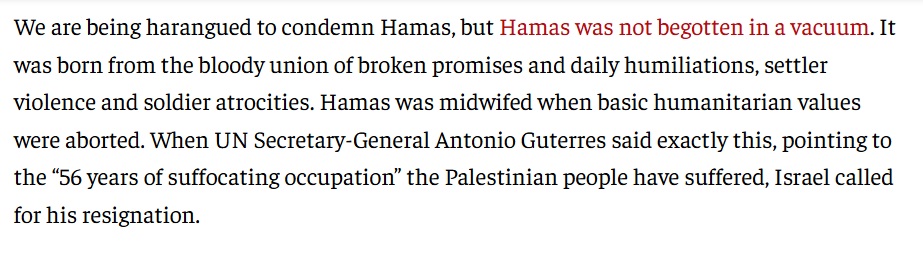
Her conclusion was the most revealing sentence of all: “We are being harangued to condemn Hamas, but Hamas was not begotten in a vacuum.” Hamas, in Roy’s framing, was not a terrorist organisation that had just murdered 1,400 civilians. It was a grievance given form. A response. Understandable, if not justified.
The Israeli Ambassador to India had already written a scathing open letter to The Hindu for interviewing a senior Hamas official. Roy’s Editor’s Note was, in effect, The Hindu Group’s formal response to that letter. They stood their ground.
In the Editor’s note in October 2024, she compares the Holocaust of the Jews by the Nazis to the ‘genocide’ of Palestinians and says history repeats itself and it came a full circle in 80 years.

February 2024: Why the South “Infuriates” the Hindu Right
In February 2024, Roy authored an Editor’s Note titled “Why the South infuriates the Hindu Right”, framing the BJP’s struggle to expand electorally in South India not as a political or organisational challenge but as evidence of the South’s intellectual and moral superiority over the Hindi heartland.

The article traced the Jana Sangh’s early failures in Kerala and Tamil Nadu, arguing that the BJP’s periodic overtures toward Southern culture, softening on Hindi imposition, amplifying welfare were calculated “doublespeak” rather than genuine political evolution. The BJP, in her reading, was a northern, upper-caste Hindutva project that the South had correctly seen through. The argument was dressed in historical detail, but its editorial purpose was clear: validate Southern resistance to the BJP as enlightened and delegitimise the party’s national mandate.
May 2025: Operation Sindoor is Patriarchy
On 7 May 2025, India launched Operation Sindoor striking nine terror camps inside Pakistan and Pakistan-Occupied Jammu and Kashmir in direct retaliation for the Pahalgam massacre, in which Pakistan-backed terrorists had singled out Hindu male tourists, made them identify their religion, and shot them dead in front of their wives.
‘The Hindu’ की एडिटर Vaishna Roy को Operation Sindoor Patriarchal और oppressive लग रहा है
अब इन woke एडिटर को जवाब Colonel Sofia Qureshi को देना चाहिए या Wing Commander Vyomika Singh को?
छोड़िए, आज @sharmasimran_ और @himanshi__bisht ही जवाब दे रही हैं, वो दोनों पाकिस्तान की… pic.twitter.com/V9DwTYgkZO
— The Pamphlet (@Pamphlet_in) May 7, 2025
India named the operation Sindoor, the red vermillion that Hindu women place in the parting of their hair as a symbol of marriage. The name was chosen deliberately: a tribute to the widows of Pahalgaw. A promise kept.
Vaishna Roy’s response was posted within hours: “On principle, I object strongly to the label Operation Sindoor. It reeks of patriarchy, ownership of women, honour killings, chastity, sacralising the institution of marriage, and similar Hindutva obsessions.”
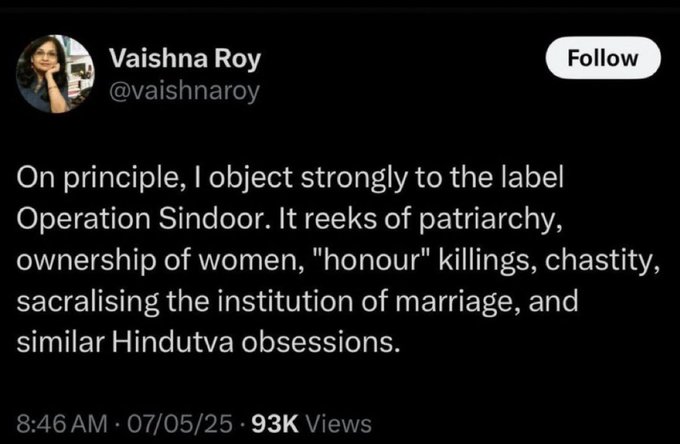
The same editor who refused to condemn Hamas for murdering women and children found it possible to condemn the Indian Army for choosing a word that Hindu women wear in their hair.
After Pahalgam: Blame India First
In what seems to be her post-Pahalgam commentary, Roy turned not to the Pakistani terror network that planned the attack, not to the handlers who gave the order, not to the gunmen who asked Hindu men their religion before shooting them, but to India’s governance of Kashmir.
Writing in Frontline, she described Kashmir as a Valley “squashed by the crushing foot of militarisation, censorship, and threatened demographic change.” She argued that India’s policy had created an “unhappiness that makes it easy for terrorists to strike” – a formulation that, read plainly, assigns partial causation for the Pahalgam massacre to the Indian state.
Vaishna Roy in Frontline.
1. Do nothing as insurgency and cross-border terrorism festers.
2. Once it reaches critical levels, use this criticality to again do nothing.
3. Continue till secession for Kashmir and civil war elsewhere. pic.twitter.com/OHjxfdiOis— Suren (@zeneraalstuff) May 28, 2025
The argument follows a familiar editorial template: every act of Islamist terror in Kashmir must be traced back to Hindu India’s oppression as its root cause. The terrorists are instruments. The real culprit is the boot on the throat. Not once in the passage did Roy name Pakistan, name Lashkar-e-Taiba, name the ISI, or name the ideology that drove 26 men to their deaths on a mountain meadow.
She closed with: “In Kashmir, a lot can be achieved with empathy than with force.” – a sentiment that might sound reasonable in a seminar room, but rings hollow when the people being asked to show empathy are the widows of Pahalgam.
January 2026: “Forget GDP”
In January 2026, Roy shared a post promoting an article by economist Ashoka Mody in Frontline: “If you want the true Indian story, ignore GDP growth rates. Focus instead on the persistent inequality that has induced the rich to exit the Indian economy.”
I was just a kid in school, struggling to learn English, when I first picked up Frontline. Why? Because they had fancy English words, also they covered ISRO, space missions, and the cryogenic engine dream that fired up my imagination in a village with no electricity, no roads, no… pic.twitter.com/FO7cd8u7Vp
— Mihir Jha (@MihirkJha) January 10, 2026
The pushback was immediate. Across social media, ordinary Indians, many from states like Bihar that had spent decades at the bottom of every development index, pointed to what GDP growth had actually meant in their lives. Round-the-clock electricity in villages that had known only darkness. Pucca roads where there had been mud tracks. Tap water, toilets, bank accounts, free grain – tangible, life-altering changes that showed up in the numbers Roy was asking readers to dismiss. Bihar’s GDP growth was among the highest in the country, and that growth had not stayed in a spreadsheet. It had reached homes, lit up classrooms, and put food on tables that had known hunger for generations.
To be told by a media establishment to ignore GDP was, for millions of Indians, to be told to ignore the evidence of their own transformed lives. The inequality angle was legitimate, but dismissing the aggregate growth story entirely, at the precise moment it was lifting the most vulnerable, revealed more about the editorial worldview than about the Indian economy.
Here is another one from her archives – how like a typical leftist, she thought of India.
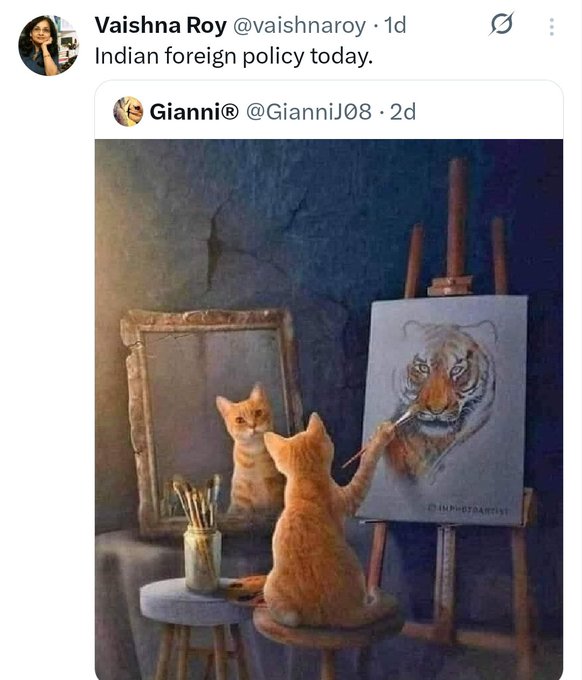
March 2026: The Brahmin Caricature Cover
Under Roy’s editorial watch, Frontline’s March 2026 cover featured a grotesque caricature of a Brahmin figure superimposed onto Edvard Munch’s famous painting The Scream, complete with exaggerated cultural markers.
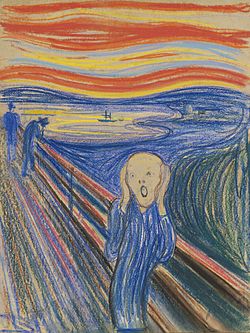
The imagery drew immediate and widespread criticism for its resemblance to early 20th-century racial propaganda – the same visual grammar used in Nazi Germany to dehumanise Jews: reduce a community to exaggerated physical and cultural stereotypes, frame them as hysterical or morally suspect, and present them as a monolithic adversary.
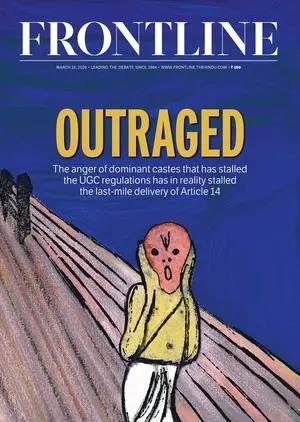
The irony was not lost on observers. This was the same editor who had invoked the spectre of the Holocaust to defend Palestinians in 2023.
History has seen this before. Anti-Jewish caricatures in Nazi Germany operated through precisely this grammar of distortion – not to argue policy, but to embed contempt in the public imagination.
The Tweets: An Obsession With Upper Caste
Roy’s X archive reveals a years-long preoccupation with upper-caste Hindus as a category of people to be held responsible for the choices of all Indians. A sample:
“Upper caste people can’t decide what others must eat.”
“They conveniently forget that white, male, hetero, upper caste etc lives have always mattered. They don’t need to fight to be seen.”
“Only a tiny percentage of upper caste Indians are veg. If govt represents all of India, it can’t choose to be veg.”
Is she suffering from “Caste diarrhea”?
Frontline Magazine’s editor @vaishnaroy is obsessed with upper caste.
Check her tweets.Hindu group has been exposed now.#BoycottTheHinduGroup pic.twitter.com/Ra4wH6MvVE
— Satyajeet Mishra (@SatyajeetM72938) March 2, 2026
In isolation, any one of these tweets could be read as a point about pluralism. In aggregate, across years, they reveal a worldview in which upper-caste Hindus are a permanent category of suspect – a group whose customs, food habits, and cultural preferences are available for public condemnation in ways that no other community’s would be.
A Pattern That Cannot Be Coincidence
Taken together, across years and across subjects, they form something more coherent: a worldview in which Hindu symbols are always suspect, Hindu grievances are never quite legitimate, Islamic terror always has a root cause worth exploring, and India’s development story is a distraction from the real narrative.
What emerges from this record is not an occasional editorial bias but a consistent worldview. Under Vaishna Roy, Frontline appears to have drifted into a familiar ideological template: Islamist violence is contextualised, India’s national security responses are moralised against, economic progress is dismissed, and Hindu symbols and communities are treated with open suspicion.
This is not journalism that interrogates power. It is journalism that begins with a predetermined narrative and arranges facts around it.
Subscribe to our channels on Telegram, WhatsApp, and Instagram and get the best stories of the day delivered to you personally.