Data from Google’s Ads Transparency Center and Meta’s Ad Library reveals a systematic, crore-scale operation running out of Chennai and mainstream media isn’t talking about it.
With Tamil Nadu Assembly elections widely expected to be announced in March 2026, a quietly incorporated Chennai company is spending crores of rupees on digital advertising at a scale that dwarfs every other political entity in India except the Central government and BJP, and its ownership trail leads straight to the Chief Minister’s family.
Populus Empowerment Network Private Limited (PEN), incorporated in November 2022, has emerged as India’s most aggressive state-level political digital advertiser, according to data drawn from Google’s Ads Transparency Center and Meta’s Ad Library. Its spending is verifiable; its ads are public and its links to the ruling DMK and Chief Minister M.K. Stalin’s son-in-law V. Sabareesan are documented.
Tamil Nadu: India’s Biggest State-Level Political Ad Spender
Start with the numbers at the state level. In a three-month window, Tamil Nadu spent ₹15.1 crore on Google ads – the highest of any state in India, according to Google’s political ad transparency data.
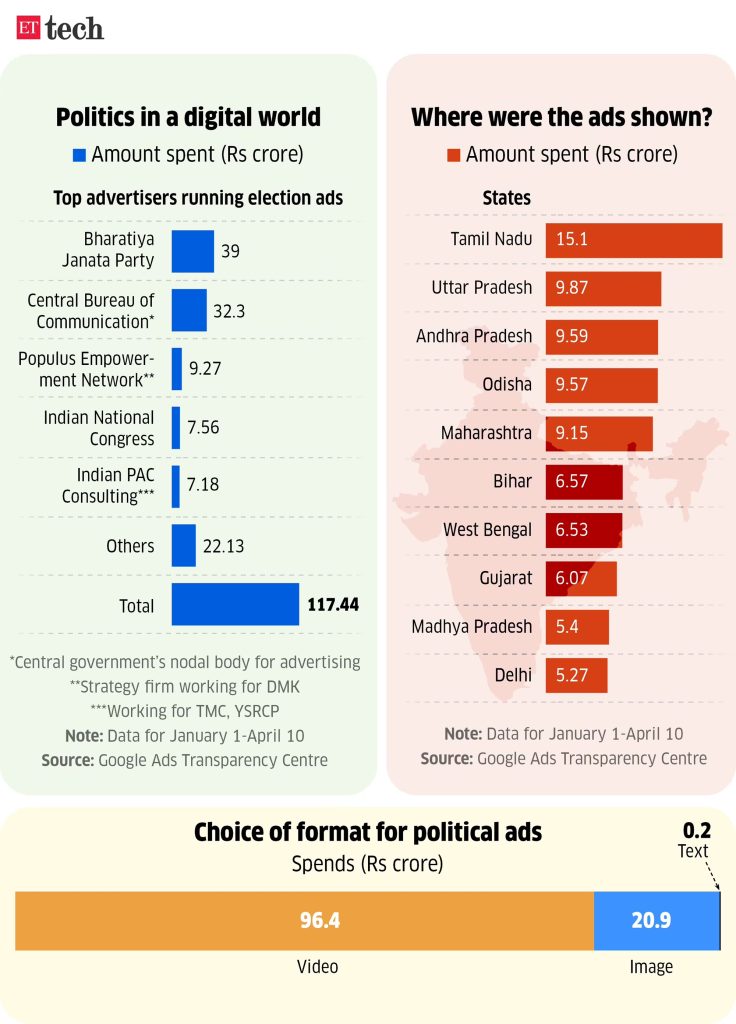
Tamil Nadu, a state with 6% of India’s population, is the spending state for political Google ads than Uttar Pradesh, India’s most populous state with a population nearly three times its size. This is not a marginal gap. Tamil Nadu spends 53% more than UP, and nearly 65% more than Maharashtra.
The reason becomes clear when you look at who is doing the spending.
Who Is PEN?
Populus Empowerment Network Private Limited is a Chennai-based political communications company incorporated in 2022. Its official directors are Manikandan Vasudevan and Prabhakaran Sekar, but V Sabareesan, son-in-law of Chief Minister MK Stalin, is said to exercise indirect control over the company.
PEN functions as DMK’s in-house digital and social media agency. It runs the Facebook page “Ellorum Nammudan” (596,000 followers), the Instagram handle “dmk_ellorumnammudan” (113,000 followers), and multiple other DMK-linked digital properties. It was also responsible for developing the “Makkalin Mudhalvar” app and game promoting the DMK’s “Dravidian Model” branding.
In 2024, then Tamil Nadu BJP president K Annamalai publicly accused DMK of spending ₹7.39 crore in social media ads through PEN, calling it “crony capitalism” and alleging that the Chief Minister’s family was directly profiting from state-funded political propaganda. The allegations, backed by public Meta Ad Library and Google Transparency Center data, triggered an Election Commission complaint but no regulatory action followed.
The Scale Of Spending: Crores On Google, Crores On Meta
PEN’s cumulative ad spend, as captured from publicly available transparency data, is staggering for a company that files returns as a small private limited firm:
Google Ads (2024 alone): ₹9.25 crore, placing PEN as India’s second-largest non-government political Google advertiser, ahead of Prashant Kishor’s I-PAC and most national party state units.
Meta (Facebook + Instagram), Jan–Oct 2025: ₹4.1 crore across 1,054 ads, primarily through the Ellorum Nammudan pages.
Google Ads, Jan–Oct 2025: ₹1.24 crore across 229 ads, with a sharp acceleration from July 2025 onwards.
Combined estimate (Google + Meta, full 2025 cycle): Discussions in digital monitoring communities put the total at approximately ₹14–17 crore, with February 2026 showing a fresh surge tied to the election campaign period.
To put this in perspective: CNBC TV18 reported that DMK’s total Google ad spend since 2018 is approximately ₹25 crore, placing it third nationally after the Central government’s advertising bureau and BJP.
The February 2026 Surge: Election Machine in Full Gear
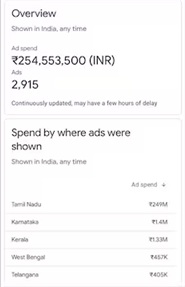
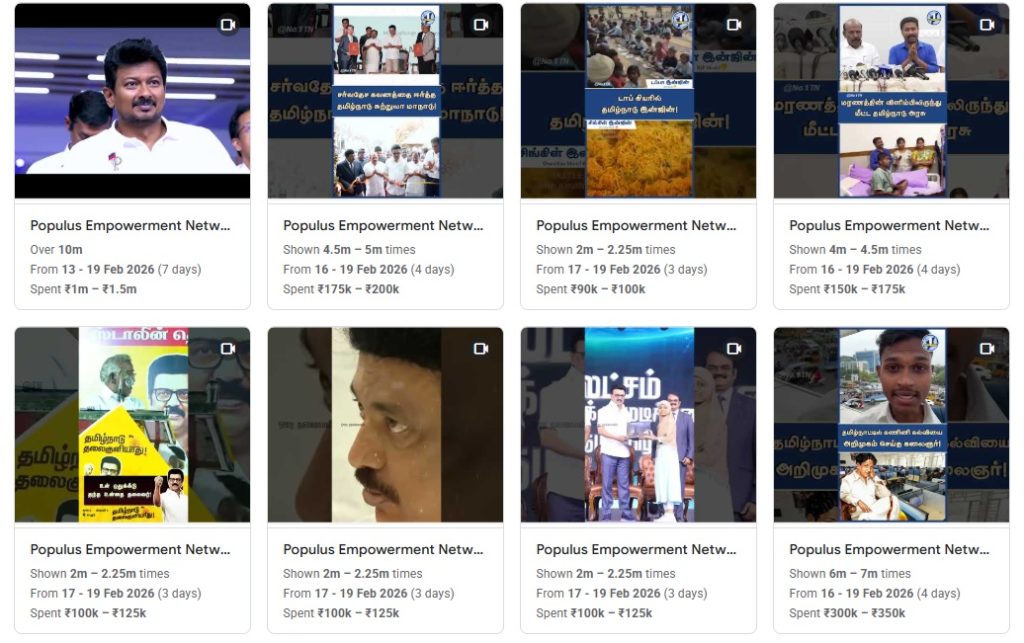
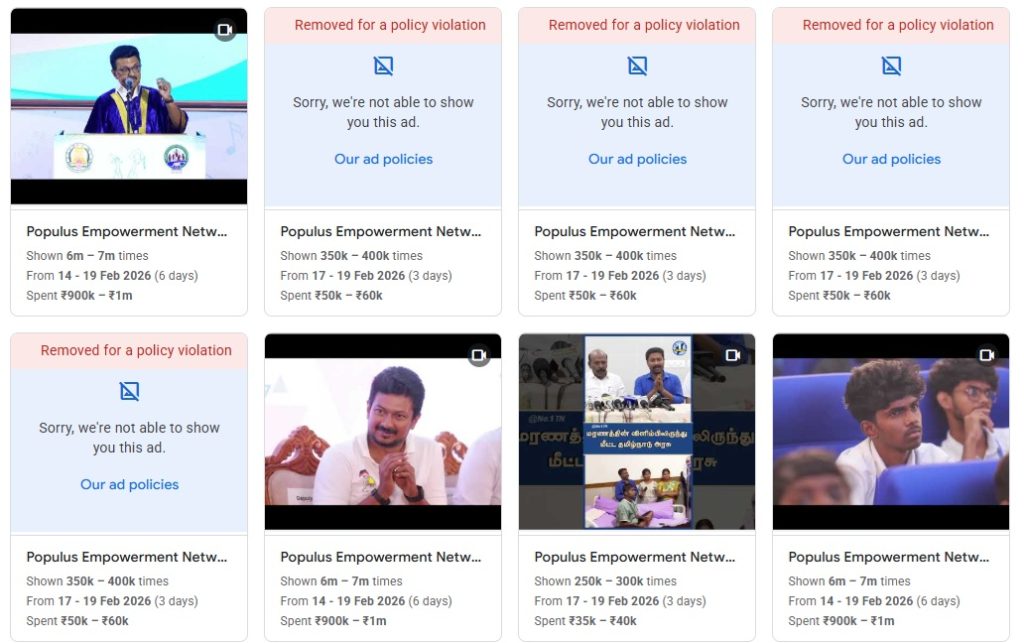
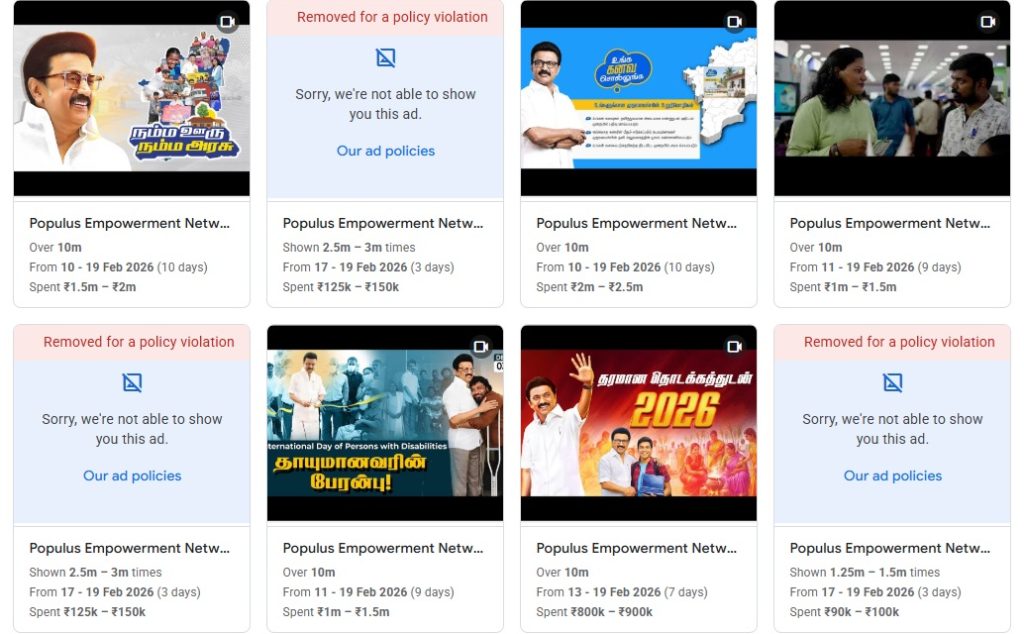
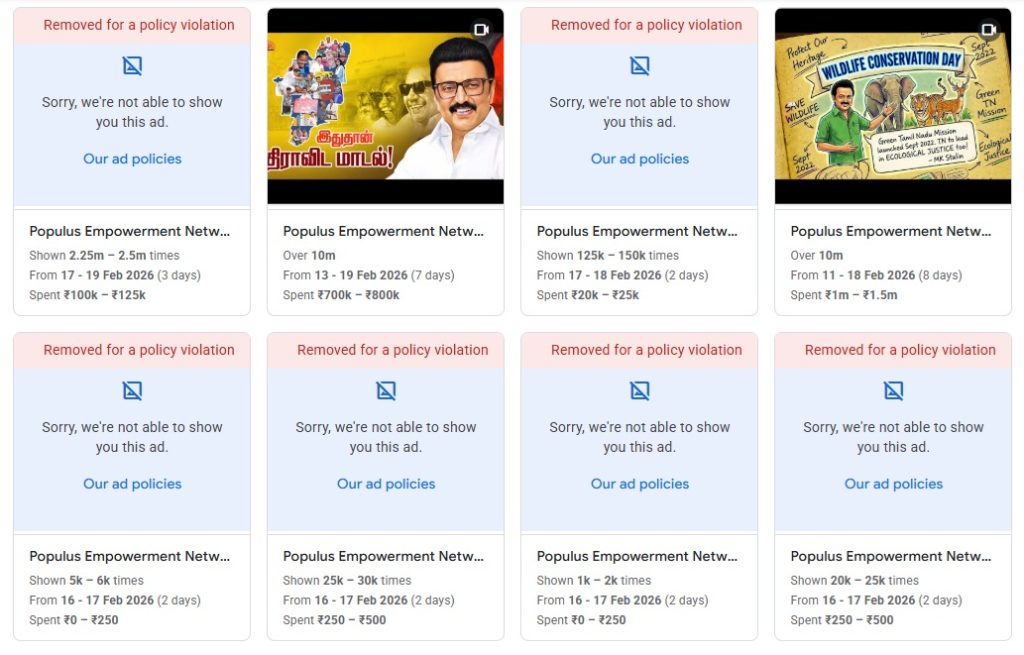
As election season accelerates, so has PEN’s spending. Data from Google’s Ads Transparency Center for the February 2026 period shows a concentrated burst of ad expenditure.
Overall, they spend approximately ₹3.6 crores for the month of February 2026 (until 26 February 2026)
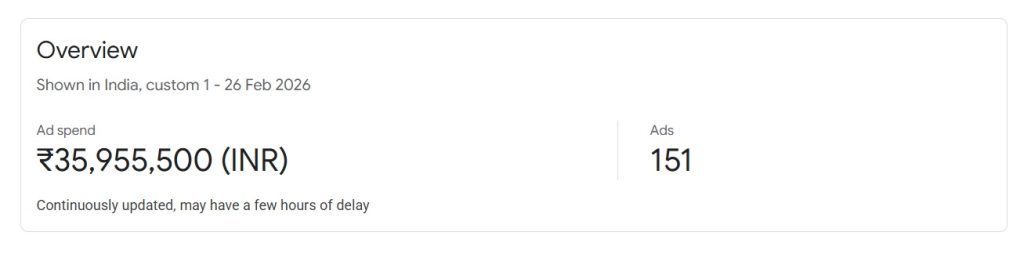
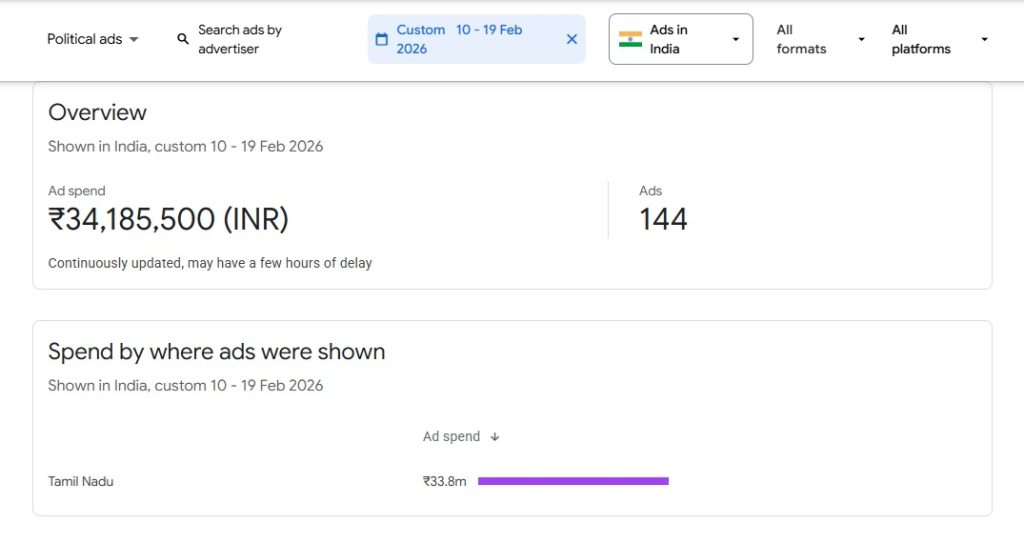
10–19 February 2026 (10 days): ₹3.41 crore on a single campaign reaching crores of viewers.
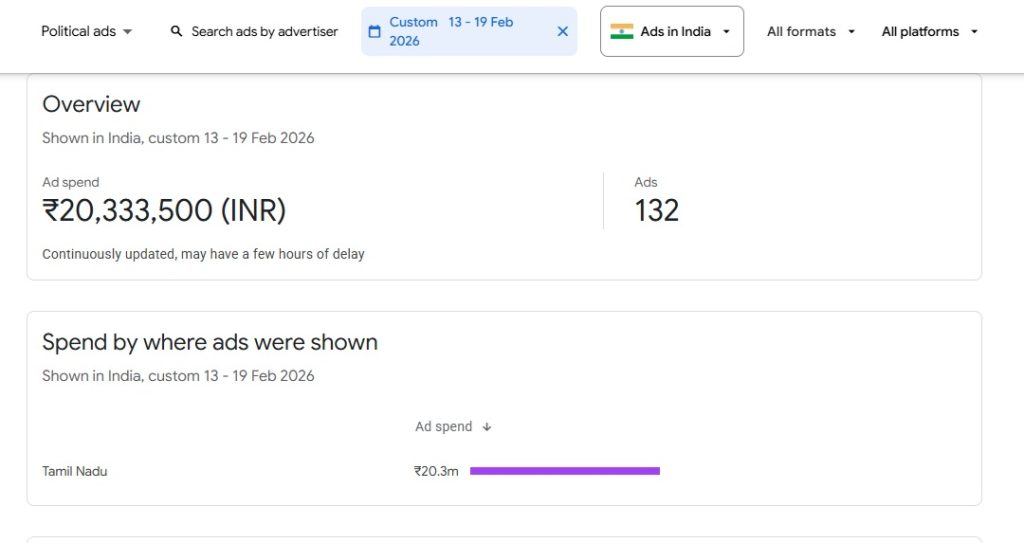
13–19 February 2026 (6 days): Ads worth about ₹2 crores were displayed
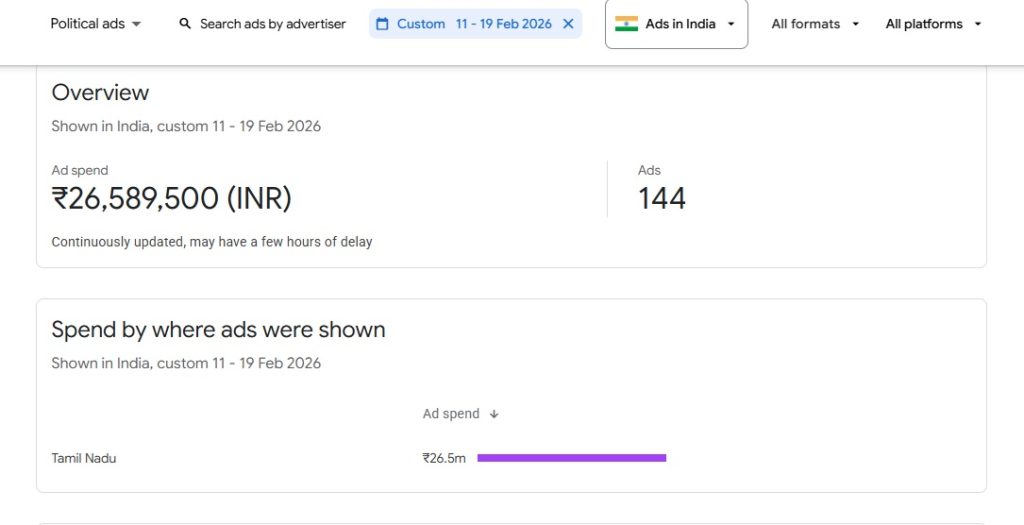
11–19 February 2026 (9 days): 144 ads were shown in this period with a spend of over ₹2.6 crores
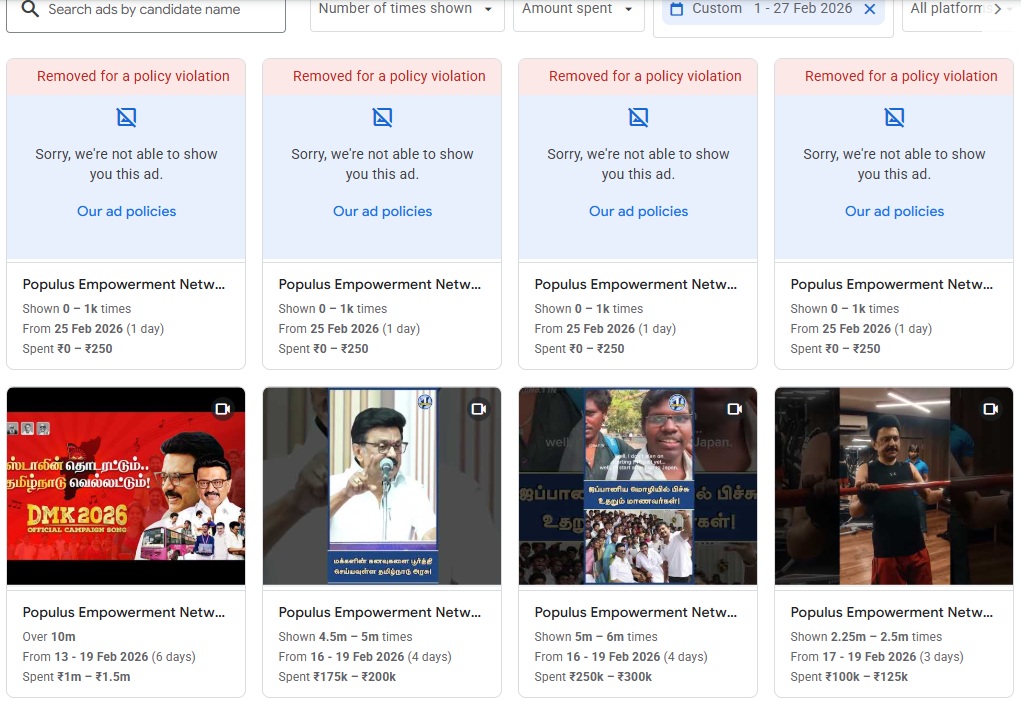
The ads shown in the above time periods are as below:
When Senthil Balaji Factor Was Used For Crisis Management Through Ad Spend
One of the most revealing patterns in PEN’s spending data is its direct correlation with negative news cycles for the DMK government.
The sharpest spending acceleration occurred in July–October 2025, when Tamil Nadu faced three consecutive political crises: the sanitation workers’ protests over caste-based discrimination, the Karur stampede tragedy on 27 September 2025 (in which 41 people died at a TVK rally, triggering political fallout for DMK ally Senthil Balaji), and the subsequent SIT inquiry.
During this period, a disproportionate share of PEN’s ad budget went towards clips of Senthil Balaji’s press conferences, attempting to shape the narrative around a minister who had become a political liability. Between October 22–24, 2025 alone, PEN poured ₹1.25–1.5 lakh per day into a single campaign pushing Balaji-related content, reaching an estimated 2–2.25 million viewers in that window.
Ads were shown just about former DMK minister Senthil Balaji who has come to be identified as ₹10 Balaji because of the allegations of scam in TASMAC popularized by Vijay during the Karur Stampede Tragedy.
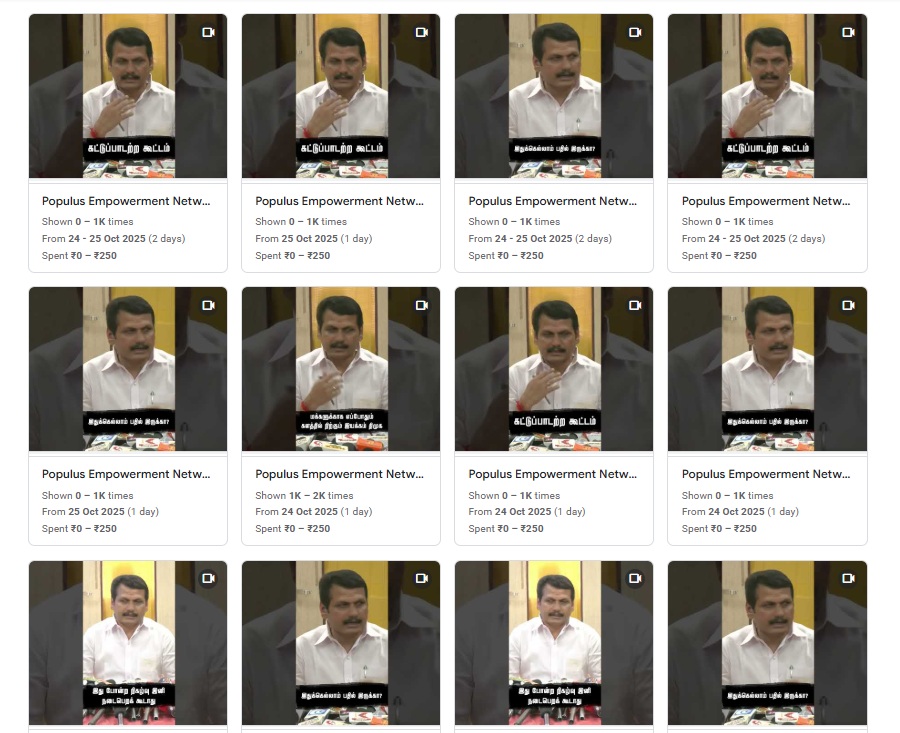
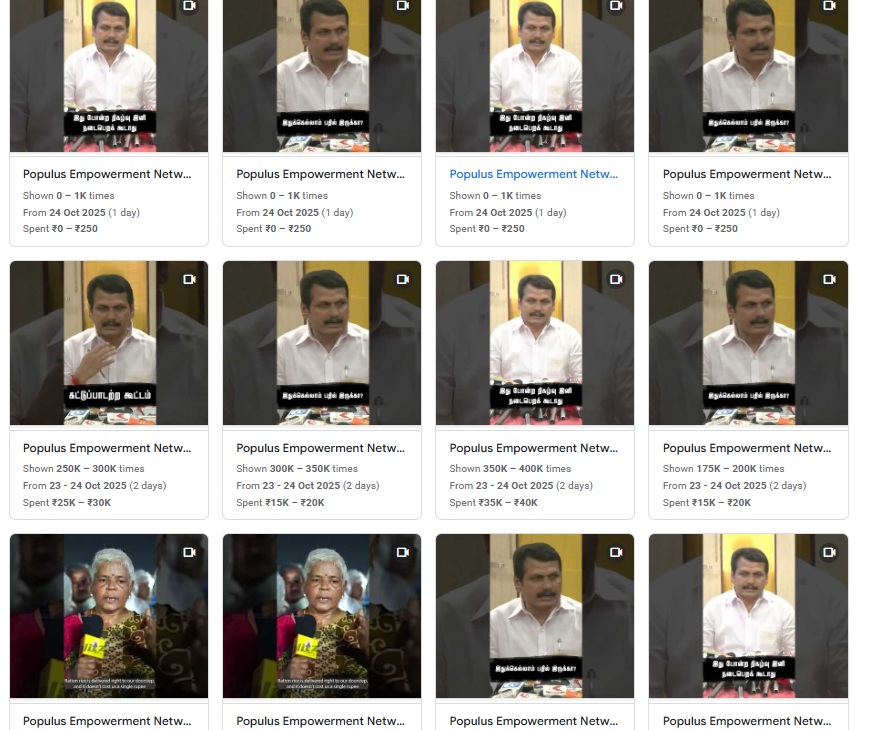
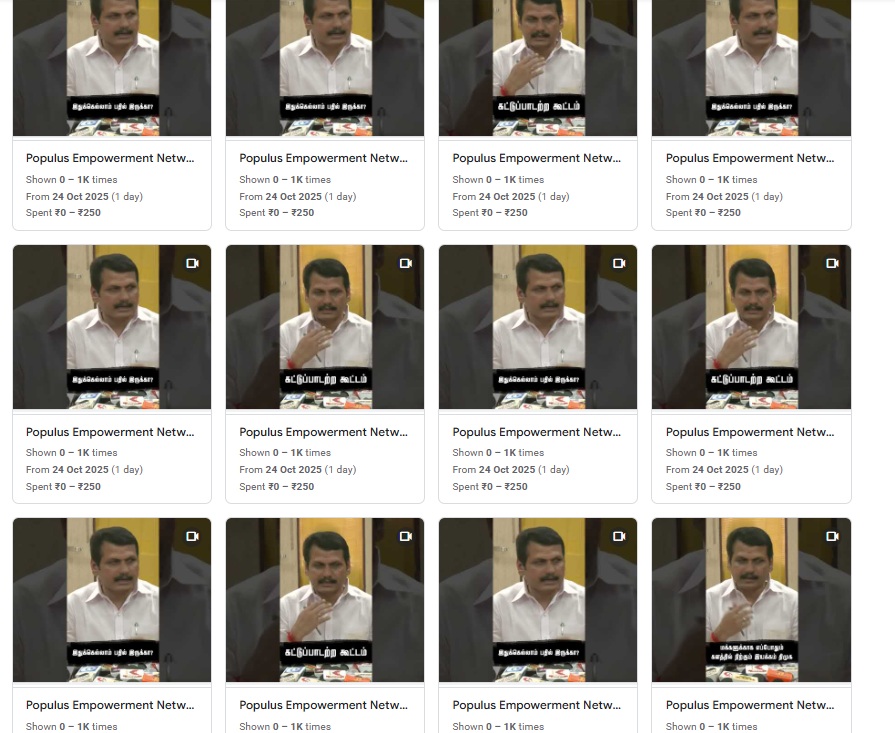
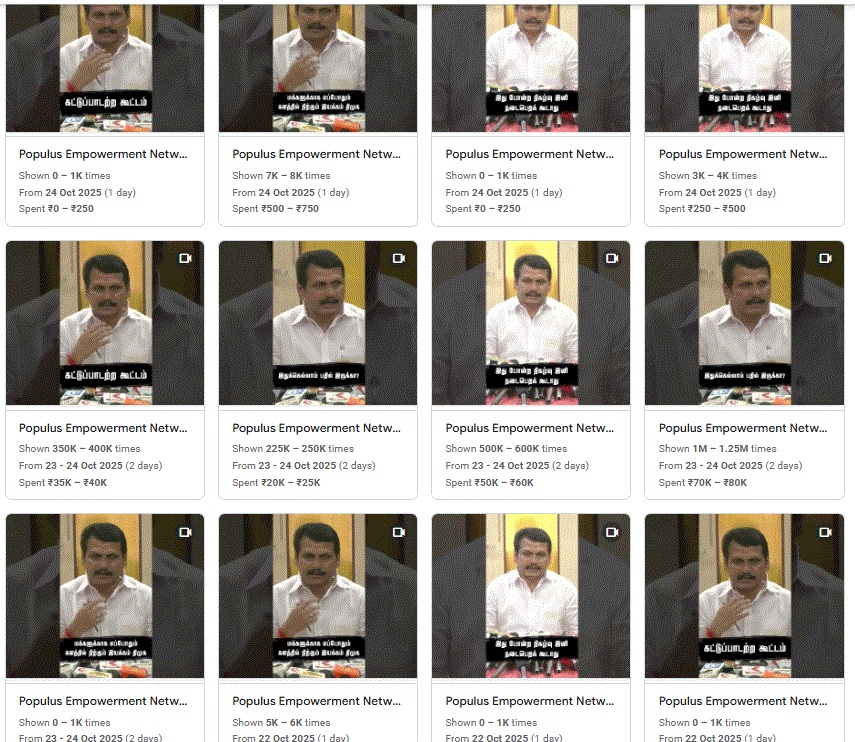
The pattern confirms what critics have long alleged: PEN functions not just as a campaign ad agency but as a real-time crisis management operation funded through undisclosed channels and directed at protecting DMK’s political position between elections.
A Company Built for One Purpose
What makes PEN structurally unique, and concerning from an electoral transparency standpoint, is its exclusivity.
Unlike conventional digital agencies that serve multiple clients across sectors, PEN has no documented commercial clients outside DMK and its allied campaigns. Every trackable ad it has published promotes DMK content, attacks DMK’s political rivals (including TVK/Vijay), or promotes the “Dravidian Model” government narrative.
This raises a fundamental question that no regulatory body has publicly answered: is PEN a private commercial company or is it an undisclosed arm of the ruling party’s political machinery? If the latter, its spending running into tens of crores should arguably be disclosed under election expenditure rules, not buried in the filings of a small Chennai private limited company linked to the Chief Minister’s family.
What The Mainstream Media Has Not Asked
The data underpinning this report is entirely public. Google publishes its political ad transparency data here. Meta’s Ad Library is accessible here. PEN’s company registration is available on the Ministry of Corporate Affairs portal. Its ads are visible to anyone who looks.
And yet, as of 27 February 2026, weeks before the Tamil Nadu elections are expected to be called, not one mainstream Tamil or English news outlet has published a comprehensive account of PEN’s ad spending, its ownership structure, or its policy violation rate on Google.
The Election Commission of India, which monitors campaign expenditure, has received at least one formal complaint about PEN’s operations (from Annamalai in 2024) but has not publicly acted on it.
With the election schedule expected to be announced in the first or second week of March 2026, the window for regulatory scrutiny is narrowing. Once the Model Code of Conduct kicks in, the question will no longer be whether PEN’s spending was transparent, but whether anyone with the authority to act was paying attention when it mattered.
Subscribe to our channels on WhatsApp, Telegram, Instagram and YouTube to get the best stories of the day delivered to you personally.