
Rabid India/Hindu-hater, casteist genocide monger and Dravidian Model propagandist R.S. Nilakantan, better known by his online alias Puram, has been sharing “data” to show how Tamil Nadu is doing well under the DMK rather than the ADMK.
A couple of charts he shared claimed Tamil Nadu’s GDSP growth rank was better under the DMK rather than the ADMK.
ADMK vs DMK on GSDP Growth Rank among large states.
I mean, you may have criticisms against the DMK. But to claim it did not generate growth or was worse in that department than the ADMK is objectively false. pic.twitter.com/EuUchwF5Up
— Puram (@puram_politics) February 23, 2026
The chart he shared showedTamil Nadu ranked 1st in GSDP growth among large states in 2024-25, topped with self-congratulatory captions about “continuous acceleration” and “Dravidian model success.” What he doesn’t tell you is that nearly every pillar of that growth story was built under ADMK rule and that DMK’s own initial track record was a disaster that they have carefully airbrushed out of the propaganda.
He shared another chart where he claimed “Tamil Nadu’s female workforce in manufacturing, famously, constituted 44% of the national female workforce in manufacturing in 2024-25. This, despite the state being 6% of India’s population”, without attrinuting it to the right party.
Tamil Nadu’s female workforce in manufacturing, famously, constituted 44% of the national female workforce in manufacturing in 2024-25. This, despite the state being 6% of India’s population.
Which industries do these women work in, and how has it changed over time? Here is how! pic.twitter.com/L6L4HzAFeu
— Puram (@puram_politics) February 25, 2026
Now let us break the truth for him.
The Nokia Foundation: ADMK’s 2005 Masterstroke
Tamil Nadu’s emergence as India’s electronics manufacturing hub begins with a single signature in July 2005: the Nokia MoU signed under CM Jayalalithaa.
What ADMK Did
Jayalalithaa’s government offered Nokia a landmark SEZ package in Sriperumbudur: VAT reimbursement for five years, land at 50% cost, complete stamp duty exemption, and power-sector support.
The MoU was signed in July 2005, when Jayalalithaa was Chief Minister (May 2001 – May 2006).
Nokia began operations in 2006, and by 2008-2010, Sriperumbudur was the world’s largest mobile phone manufacturing facility, employing over 25,000 workers directly and indirectly.
This created the skilled labour pool, supply chain vendors, and global credibility that would later attract Apple, Samsung and Foxconn.
The Nokia boom during 2001-2006 dmk tenure was because of ADMK’s effort to bring the plant to the state creating special economic zone SEZ.
EPS during his tenure of 2017-2021 brought tata electronics, pegatron, Salcomp, iphone manufacturing facility to the state, ADMK 🌱✌️😎 pic.twitter.com/6kP2x8bzTU— Niky🌱✌️ (@iamNikesh) February 25, 2026
What DMK Did
DMK inherited the operational plant when Karunanidhi became CM in May 2006. Their contribution? Labour disputes, tax administration fights, and ultimately, the plant’s decline.
Nokia workers protested in 2009-2010 under the DMK government, alleging suppression of unionisation rights and tax refund corruption.
Nokia shut down Sriperumbudur operations in 2014 (under ADMK’s watch during Microsoft’s acquisition), but the foundational electronics ecosystem – skilled workers, vendor base, logistics infrastructure remained and was inherited once again by DMK in 2021.
Bottom line: The electronics manufacturing base that today produces iPhones and employs 44% of India’s female factory workforce was seeded by Jayalalithaa’s Nokia gambit in 2005, not by DMK’s propaganda videos.
Apple And Foxconn: ADMK Brought Them In
DMK loves to take credit for Tamil Nadu becoming India’s “iPhone manufacturing capital.” The reality: Foxconn entered Tamil Nadu in 2017, four years before DMK came to power.
Timeline
2017 (Under ADMK CM Edappadi K. Palaniswami): Foxconn began assembling iPhones at the former Nokia plant in Sriperumbudur.
2016-2021 (ADMK Rule): Tamil Nadu established a dedicated Taiwan Desk under Guidance TN to attract Taiwanese electronics manufacturers. Foxconn’s initial investments and workforce training happened under this framework.
2021 onwards (DMK Rule): Foxconn’s expansion accelerated but this was driven by three factors that had nothing to do with DMK:
- Central Government’s PLI (Production-Linked Incentive) schemes launched in 2020-21 under PM Modi, offering ₹41,000 crore for electronics manufacturing.
- Apple’s global China+1 supply chain diversification post-COVID, which benefited India universally.
- The workforce and vendor ecosystem left behind by Nokia and seeded by ADMK’s 2017 Foxconn entry.
The Foxconn Supercycle Is ADMK’s Legacy
The female workforce chart shows a dramatic surge in electronics manufacturing employment post-2021. DMK points to this and says “see, we did it.”
Here’s what the data actually shows:
- The foundation was Nokia (ADMK, 2005) and the vendor base it created.
- The entry point was Foxconn’s 2017 pilot plant under ADMK.
- The policy tailwind was the 2020 Central PLI scheme (Modi government, not state government).
- The scale-up investment (₹15,000 crore committed by Foxconn in 2025) came after DMK’s 2023 Global Investors Meet, yes – but would never have happened without the 2005-2021 ADMK groundwork.
If ADMK had remained in power post-2021, the same PLI benefits, the same Apple diversification and the same Foxconn investment would have landed in Tamil Nadu. The difference: ADMK would not have wasted a year crashing to 11th rank in GSDP growth in 2022-23 before riding the rebound.
The EV Revolution: ADMK’s 2019-2020 Policy Framework
Tamil Nadu’s emergence as India’s EV hub – home to Ola Electric’s world’s largest two-wheeler factory and Ather Energy’s base, is routinely credited to DMK’s “forward-looking industrial policy.”
The actual policy that created this boom was notified under ADMK CM Edappadi K. Palaniswami in 2019-2020.
What The EV Policy Did (Under ADMK)
Tamil Nadu’s Electric Vehicles Policy 2019, released under EPS, offered:
- 100% electricity tax exemption for EV manufacturers for five years.
- 25% capital subsidy on investments up to ₹50 crore.
- Dedicated EV manufacturing zones with single-window clearance.
This policy is what attracted:
- Ola Electric (Krishnagiri mega-factory, operational from 2021 onwards)
- Ather Energy (Hosur facility expansion)
- Hyundai Motor India’s EV plans (Chennai hub)
- TVS Electric’s scale-up (Tamil Nadu base)
All of these investments were seeded between 2019 and 2021 under ADMK rule, aligned with the Central Government’s FAME-II scheme and Modi’s 2020 PLI for Advanced Chemistry Cell (battery) manufacturing.
What DMK Inherited
DMK took office in May 2021, just as these EV projects were moving from MoU stage to ground-breaking. They have presided over the execution phase, which is operationally important, yes but the policy design, the investment attraction, and the initial commitments were ADMK’s work.
The female workforce chart (as shared above by Puram) labels the EV sector’s rise starting post-2021. The timing is correct. The credit to DMK is not. The groundwork was laid in 2019-2020 under EPS, when DMK was in opposition and offering exactly zero EV policy vision.
The GSDP Growth Chart: What DMK Doesn’t Show You
Let’s dissect the propaganda chart DMK IT Wing has been circulating.
The chart Shows:
- Tamil Nadu’s GSDP growth rate in 2024-25: 9.69% (later revised to 11.19%, the first double-digit growth in 14 years).
- Rank among large states: 1st.
- Visual narrative: smooth upward acceleration from DMK’s tenure.
What the Chart Hides:
DMK’s disastrous first year. In 2022-23 (Year 2 of DMK rule), Tamil Nadu’s GSDP growth rank crashed to 11th among large states – the worst performance in over a decade. The revised figure shows Tamil Nadu’s growth that year was just 6.17%, far below the national average.
The “smooth acceleration” story is a lie. What actually happened:
- 2021-22 (DMK Year 1): Inherited post-COVID rebound, ranked 4th (decent but not exceptional).
- 2022-23 (DMK Year 2): Collapsed to 11th rank, growth slowed to 6.17%.
- 2023-24 (DMK Year 3): Rebounded to 4th rank as national economy recovered.
- 2024-25 (DMK Year 4): Hit 1st rank with 11.19% growth, driven by Foxconn/Apple supercycle (ADMK legacy), EV boom (ADMK policy), and Central PLI tailwinds (Modi government).
This is not “continuous acceleration.” This is crash → rebound, with the rebound powered by investments seeded in the 2017-2021 ADMK period.
The Broader ADMK Economic Legacy: 2011-2021
The DMK chart focuses on the 2024-25 endpoint. Let’s zoom out and look at Tamil Nadu’s growth trajectory across ADMK’s decade in power (2011-2021).
ADMK’s Track Record
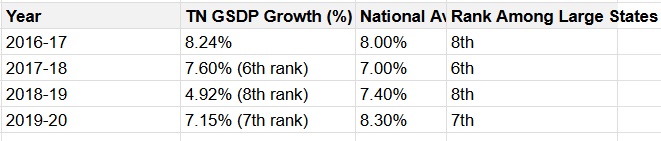
This shows that ADMK, while not consistently ranking 1st, kept Tamil Nadu above or near the national average even while navigating three massive external shocks:
- Demonetisation (November 2016) – hit cash-intensive Tamil Nadu economy hard, especially MSMEs and construction.
- GST rollout (July 2017) – disrupted state manufacturing and logistics for 12-18 months.
- COVID-19 (2020-2021) – shut down factories, tourism, and exports.
Despite this, ADMK delivered:
- Nokia’s vendor ecosystem survival post-closure (2014).
- Foxconn entry and pilot-scale iPhone assembly (2017).
- EV Policy (2019-2020), the single most important industrial policy document of the decade.
- Infrastructure: Chennai Metro Phase I completion, SIPCOT expansions, Chennai Port connectivity upgrades.
What DMK Inherited In May 2021
When DMK took power, Tamil Nadu had:
- A ready-to-scale Foxconn plant awaiting PLI approval.
- A notified EV policy with Ola, Ather, and Hyundai already committed.
- A trained electronics manufacturing workforce from the Nokia-Foxconn lineage.
- A post-COVID global supply chain pivot favouring India (Apple’s China+1).
All DMK had to do was not mess it up. Instead, they crashed Tamil Nadu to 11th rank in their second year, then rode the inevitable rebound and claimed it as their own achievement
TN’s growth usually stayed ahead of India’s. During MKS’s tenure, it slipped below twice. EPS/ADMK faced Demonetisation, GST & Covid. MKS later benefited from 2019–21 policy & investment momentum (EV, electronics supply chain ect), rebound economy & Centre’s 2020 PLI tailwinds… https://t.co/oSrgnuqAwQ pic.twitter.com/DvqUCFNuVR
— Mr Kongu (@MrKonguverse) February 23, 2026
The 44% Female Workforce Statistic: A Multi-Decade Legacy, Not DMK’s
Dravidianist propagandists love citing the stat: Tamil Nadu accounts for 44% of India’s female factory workforce in 2024-25.
Here’s the actual timeline of how that was built:
- 1991-2005: Tiruppur and Coimbatore garment clusters (liberalisation-era base, predates both parties).
- 2005-2010: Nokia Sriperumbudur employs 8,000+ women directly (ADMK’s MoU, DMK’s operational period).
- 2017-2021: Foxconn iPhone assembly begins, inherits Nokia workforce (ADMK).
- 2021-2025: Apple/Foxconn supercycle scales up (PLI-driven, ADMK policy foundation, DMK execution).
The 44% is the cumulative result of 34 years of Tamil Nadu industrial policy, with the Nokia (2005) and Foxconn (2017) milestones being the two inflection points – both under ADMK.
DMK claiming this as their achievement is like a relay runner taking credit for the entire race because they happened to be holding the baton when the team crossed the finish line.
Had EPS continued as CM post-2021, Tamil Nadu would have hit the same growth benchmarks, likely without the Year 2 crash, powered by the same Foxconn supercycle, the same EV boom, and the same PLI tailwinds. The only difference: the propaganda would have been less slick, because ADMK doesn’t have a ₹50 crore IT Wing budget.
Subscribe to our channels on WhatsApp, Telegram, Instagram and YouTube to get the best stories of the day delivered to you personally.