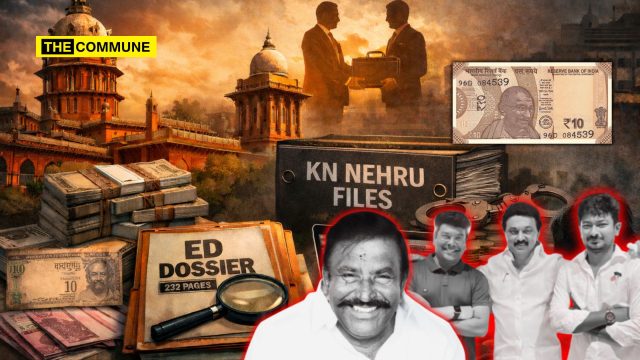
The Madras High Court, on Friday 20 February 2026, directed the Directorate of Vigilance and Anti-Corruption (DVAC) to register a criminal case based on inputs from the Enforcement Directorate (ED) alleging large-scale corruption in the Municipal Administration and Water Supply (MAWS) Department headed by DMK Minister KN Nehru.
The direction was issued by a Division Bench comprising Chief Justice Manindra Mohan Shrivastava and Justice G. Arul Murugan while hearing writ petitions seeking registration of an FIR in the alleged cash-for-jobs and transfer-posting scam. The Bench had earlier reserved orders after hearing detailed submissions from all sides.
Pulling up the State over the delay in acting on the ED’s communication, the court held that the material already on record disclosed cognisable offences warranting immediate registration of a case.
“The details shared and materials available reveal that those candidates got selected pursuant to the alleged transactions. And when a large-scale corruption stated to have happened involving several hundred crores of rupees, we find that source material is sufficient enough disclosing the commission of a cognisable offence for the purpose of registering a case,” the court observed.
The Bench noted that the ED had, on 27 October 2025, shared detailed source information with the State under Section 66(2) of the Prevention of Money Laundering Act (PMLA), along with voluminous supporting material.
“It was for the State to register a case on the detailed information shared by the Enforcement Directorate…and they could have thereafter concluded a detailed investigation to unravel the truth and bring the culprits to book,” the court said.
Rejecting the State’s stand that a preliminary or detailed inquiry should precede FIR registration, the court clarified that the ED’s communication could not be treated as a mere complaint.
“It is not a case where the authorities have received a bare complaint…it is a detailed source information provided by the Enforcement Directorate with a voluminous set of evidence…disclosing a cognisable offence,” the Bench held.
So What Was The Source Information?
A few months ago, the Enforcement Directorate (ED) formally alleged the existence of a structured tender-manipulation network inside the Municipal Administration and Water Supply (MAWS) Department. The allegations that are circulating now on social media are from a 232-page October 27 dossier submitted in a sealed cover, that was shared with the TN DGP. This information has now gained fresh momentum following the Madras High Court’s direction to the Directorate of Vigilance and Anti-Corruption (DVAC) to register a criminal case and proceed with a full investigation.
The ED did not submit before the #MadrasHighCourt any 258-page document in the cash for jobs scam case against Municipal Administration Minister K.N. Nehru. The ED had submitted, in a sealed cover, only a 232- page dossier which it had shared with the Tamil Nadu DGP on October… pic.twitter.com/80OGr4A8hA
— Mohamed Imranullah S (@imranhindu) February 21, 2026
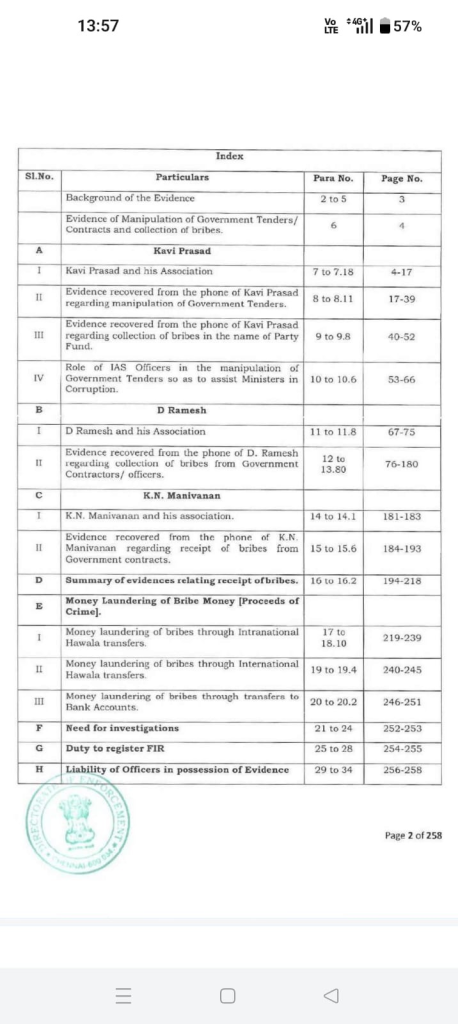
The ED’s communication, dated 3 December 2025 and issued by its Chennai Zonal Office-I under Section 66(2) of the Prevention of Money Laundering Act (PMLA), was sent to the Tamil Nadu Chief Secretary, the DGP, and the DVAC. The ED states that this dossier is backed by extensive digital forensics recovered during search operations, including WhatsApp chats, call records, photographs, financial calculations, and tender documents.
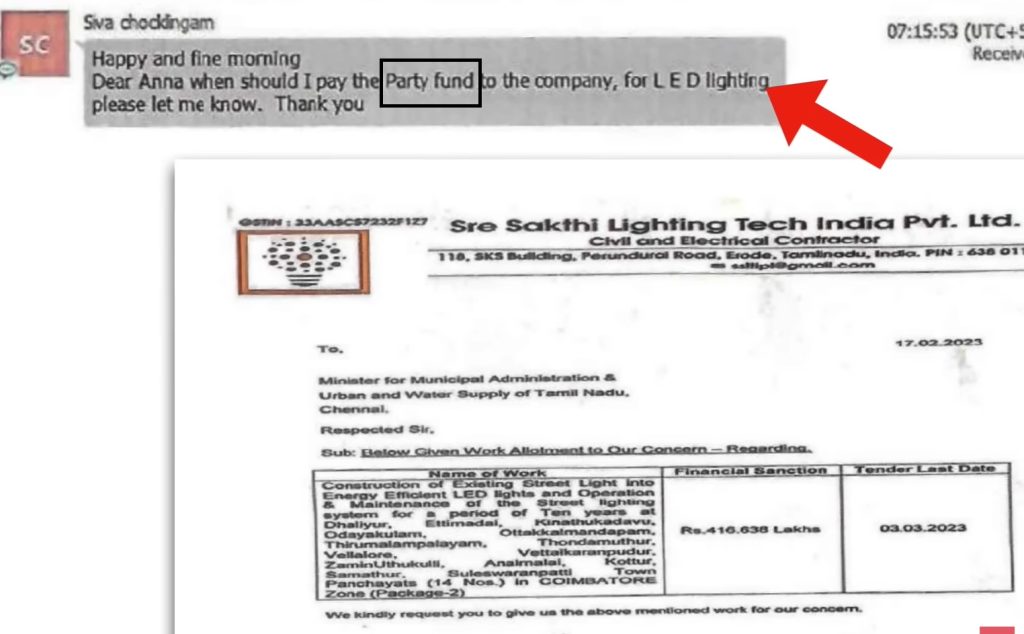
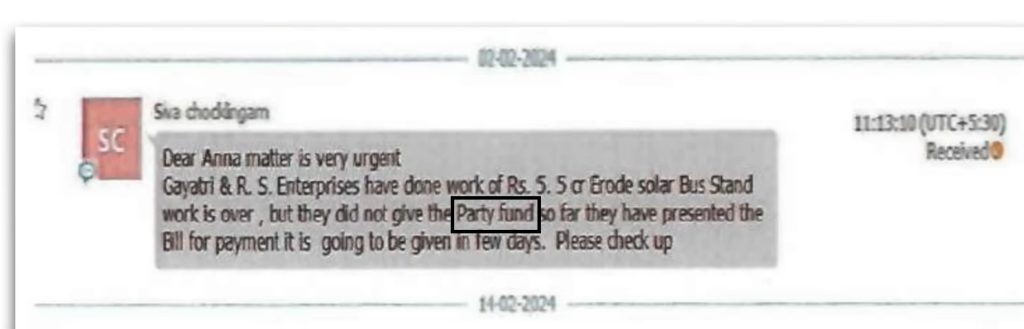
At the heart of the ED’s case is a serious allegation: that a parallel, informal system allegedly operated within MAWS through which government tenders were effectively decided in advance, with contractors required to pay a fixed percentage of project value as what was described in chats as “Party Fund.”
How The Evidence Surfaced
Important clarification: The following details on “Party Fund”, tender pre-fixing, hawala mechanisms (₹10-note photos, Dubai links), Kavi Prasad’s role, specific commission examples, ₹1,020 crore estimates, pre-allocated tenders, Stalin family references (e.g., Para 9.8), and bureaucratic/political links are drawn from the ED’s separate December 3, 2025, communication on alleged tender corruption and transfers/postings. These were not part of the 232-page dossier on which the Madras High Court based its February 20, 2026, directive to register an FIR. The court order focuses exclusively on recruitment irregularities (cash-for-jobs). Claims of Stalin family as ultimate beneficiaries remain unendorsed ED allegations from the separate dossier and are not referenced in the court order.
According to the ED, the material did not originate from a tender probe. It emerged incidentally during searches conducted in April 2025 at premises linked to MAWS Minister KN Nehru, his relatives, associates, and entities connected to the True Value Homes (TVH) Group owned by his brother KN Ravichandran.
Inside the ED’s 258 Page Note: How Tamilnadu’s MAWS Tenders Were Allegedly Fixed Before Bids Even Opened? #DMK #KNNehru #AIADMK #MKStalin #UdhayanidhiStalin
A 258 page internal communication sent by the ED to Tamilnadu’s DGP, DVAC, and the Chief Secretary has alleged the… pic.twitter.com/QZkXj7reQh
— Harish M (@chnmharish) February 20, 2026
Those searches were initially tied to a CBI-registered bank fraud case. Although that predicate case was later quashed by the Madras High Court and the related PMLA investigation closed, the ED has stated that forensic examination of seized digital devices revealed large-scale corruption in municipal contracts. The agency then compiled the material into multiple communications to the State government, culminating in the dossier.
The Alleged “Party Fund” Model
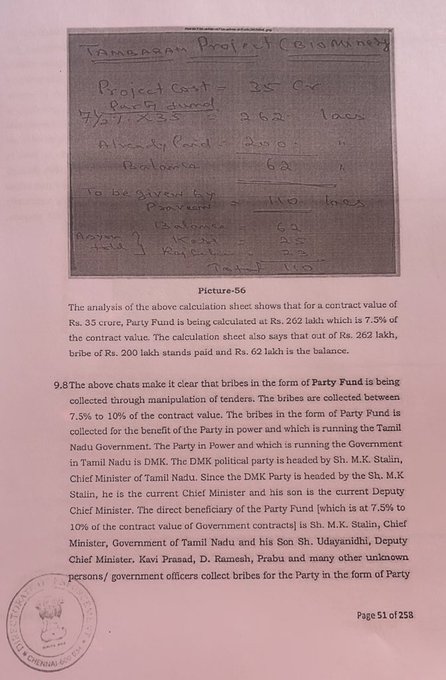
Based on the 232-page dossier, it is stated that the ED’s central claim is that MAWS contractors were allegedly required to pay between 7.5% and 10% of contract value as commission to secure or retain government works. In recovered chats, investigators say these payments were repeatedly referred to as “PF,” which the agency interprets as shorthand for “Party Fund.”
The dossier cites multiple calculation sheets recovered from phones that appear to apply this percentage formula mechanically across projects. In one example, a ₹35-crore municipal project allegedly carried a calculated “party fund” of approximately ₹2.62 crore, of which around ₹2 crore was shown as paid with a balance pending. Another sheet reportedly recorded ₹91.96 lakh as the fund component for a ₹9.19-crore work.
Investigators describe these not as isolated instances but as evidence of what they believe was a standardised commission framework operating across MAWS tenders.
Scale Of The Alleged Operation
The ED’s analysis suggests the suspected system may have operated across multiple categories of municipal works, including stormwater drains, sanitation outsourcing, community toilets, village roads, sweeper quarters, and NABARD-funded schemes. One compiled table cited in the dossier allegedly links around ₹410 crore worth of projects to commission calculations. In its formal communication, the agency has gone further, estimating that bribe collections tied to tender rigging may have touched ₹1,020 crore.
The agency says these conclusions are based on a combination of contractor statements, digital chats, financial records, and internal calculation sheets recovered during the searches.
Kavi Prasad: The Alleged Nodal Intermediary
A central figure in the ED’s narrative is Kavi Prasad, described as a long-time associate of the minister’s family and a former director in companies belonging to the TVH Group. According to the dossier, forensic extraction of his mobile phone revealed extensive communication with senior bureaucrats, police officers, elected representatives, contractors, and municipal officials.
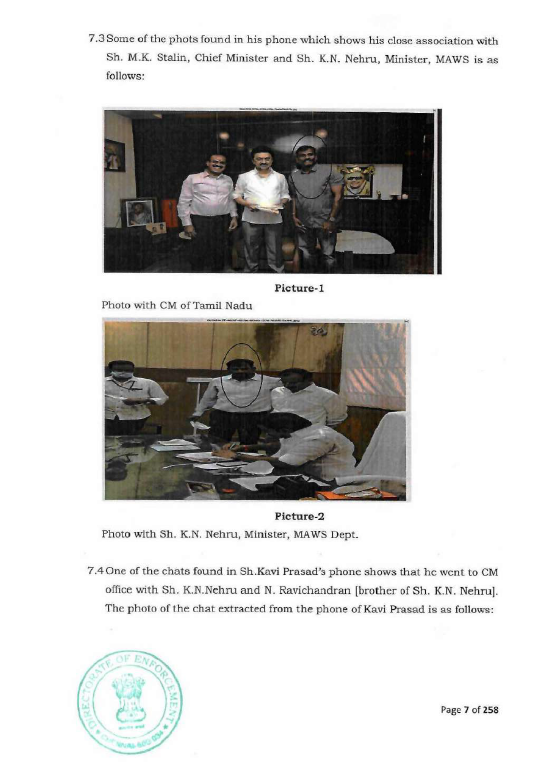
The ED alleges that Prasad functioned as a liaison between contractors seeking government work and decision-makers within the administration. In several chats cited by investigators, officials are said to have addressed him with deferential titles such as “Sir,” “Chief,” and “Respected Sir,” while allegedly seeking his assistance for arranging ministerial meetings, facilitating transfers and postings, or securing allotment of works.
Alleged ₹10-Note Hawala Trail, Points To Network Involving Nehru Associates
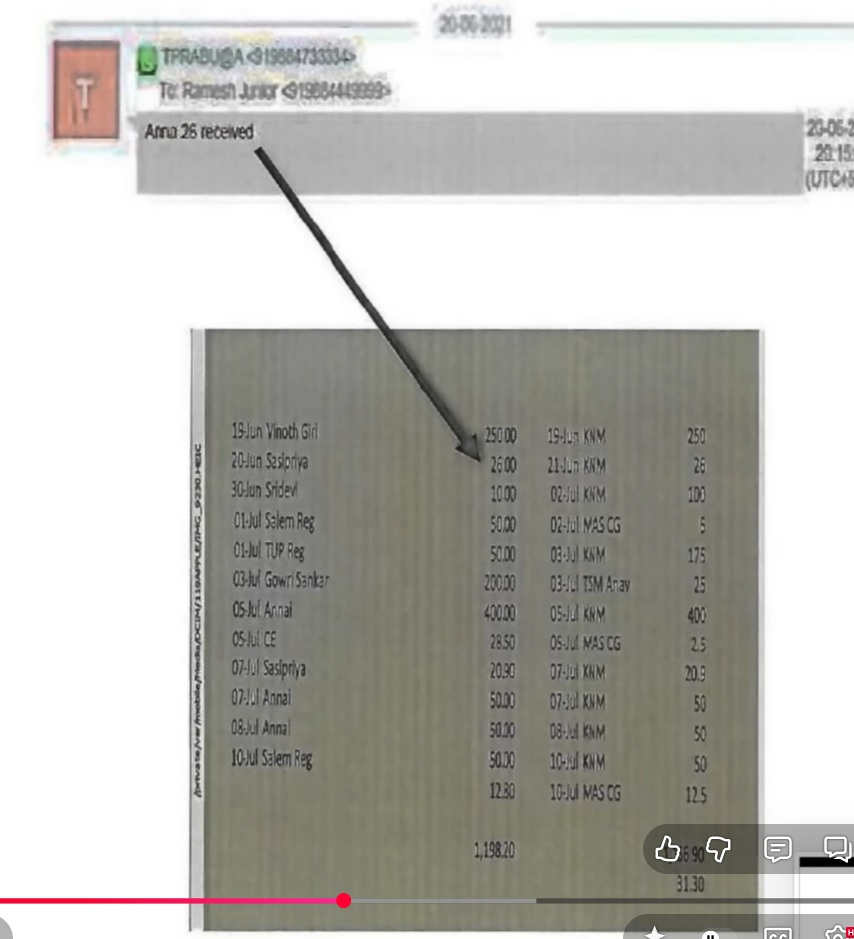
According to material cited in the Enforcement Directorate’s dossier, investigators analysed digital evidence purportedly recovered from the phone of D Ramesh, an employee linked to entities associated with Minister K. N. Nehru’s family. The agency notes that chats between Ramesh and one T Prabhu repeatedly referenced cash “hand over” entries alongside photographs of ₹10 notes, which investigators interpret as token markers in an alleged hawala settlement mechanism.
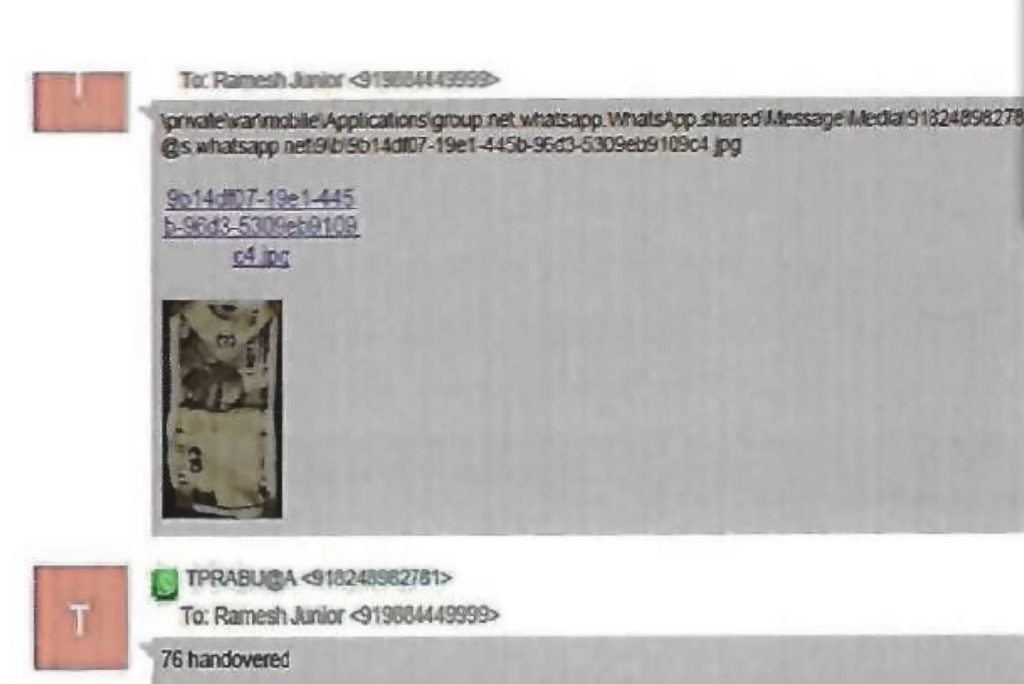
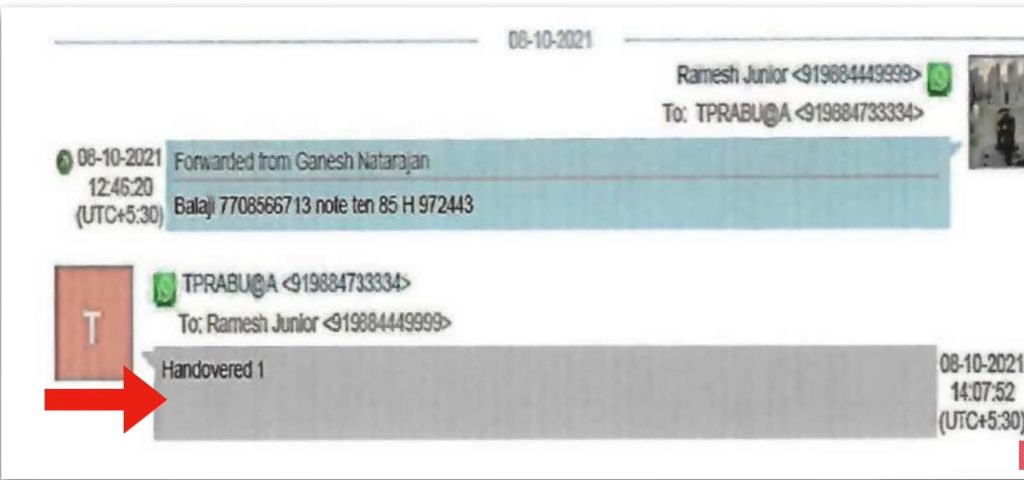
In several instances, figures such as “76” and “124” were recorded, which the ED claims correspond to ₹76 lakh and ₹1.24 crore respectively, suggesting systematic cash movement.
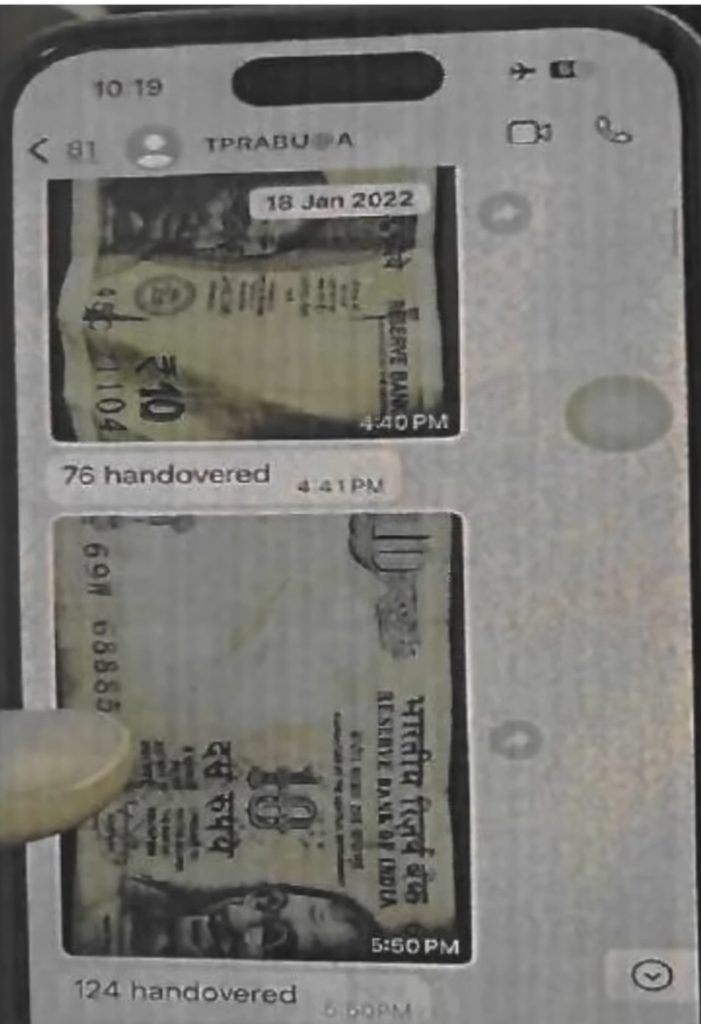
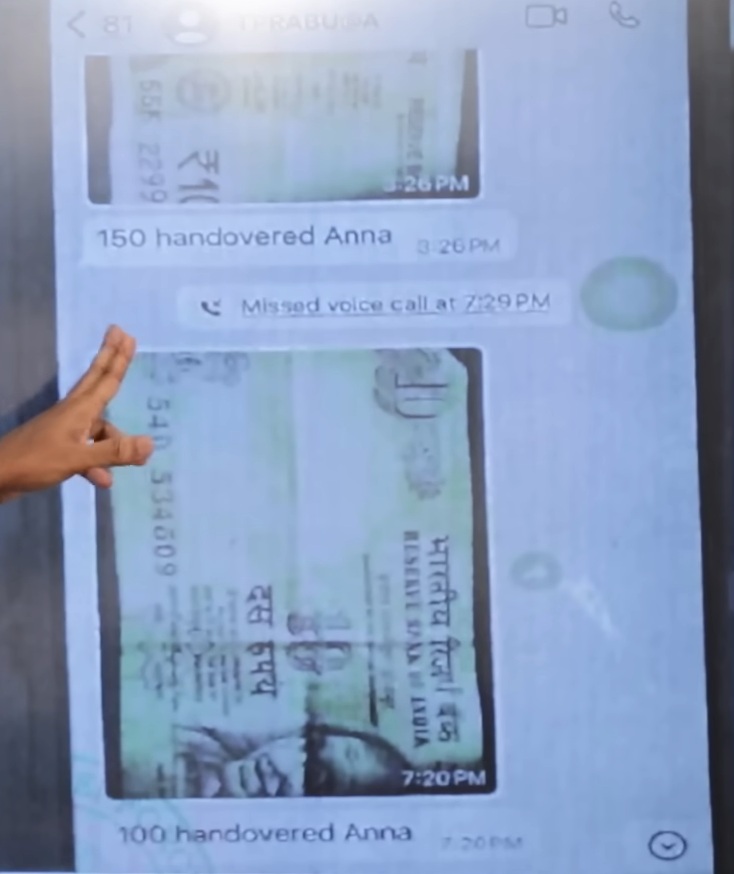
The dossier further alleges that once cash was handed to intermediaries, the photographed ₹10 note numbers were used as identifiers to facilitate settlement through overseas channels, including entities linked to Dubai. Investigators also flag deposits allegedly routed through multiple accounts, described as suspected shell entities, using party-linked operatives.
Parallel extractions from the phone of Kavi Prasad, described as a close associate of K. N. Manivannan (brother of the minister), reportedly indicate his role as a liaison point connecting contractors, officials and political functionaries.
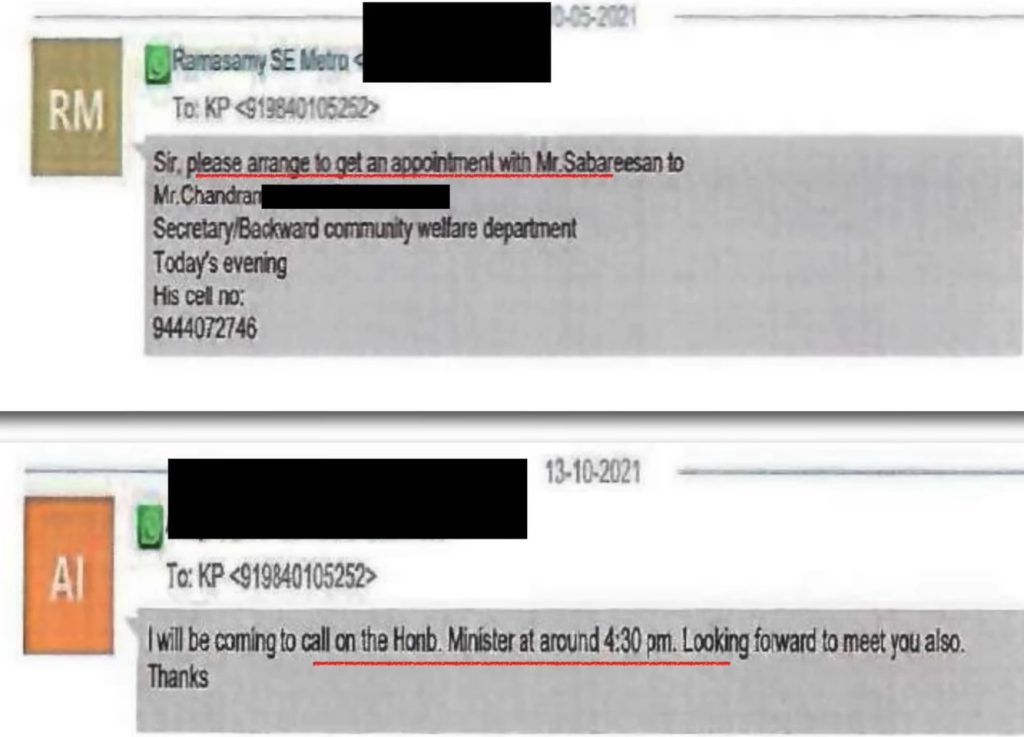
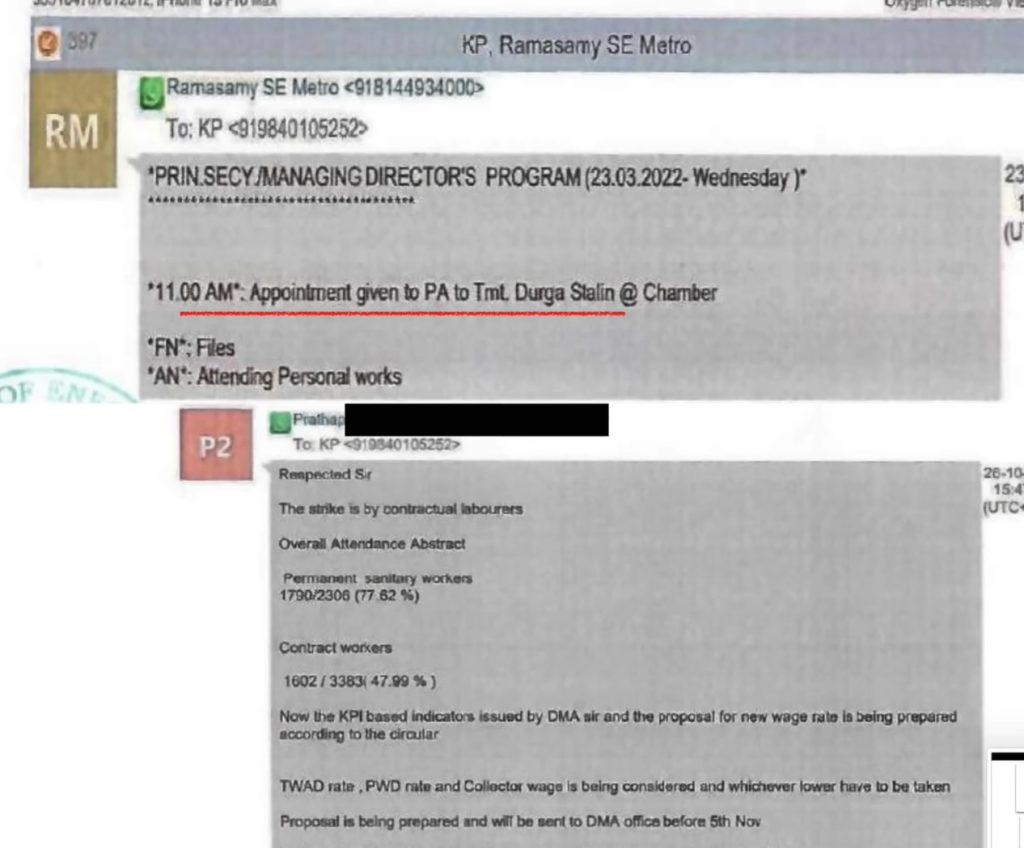
The ED notes chats referencing appointments with the DMK first family including MK Stalin’s son-in-law Sabareesan, PA of Durga Stalin, etc ad also other chats about advance-linked tender discussions.
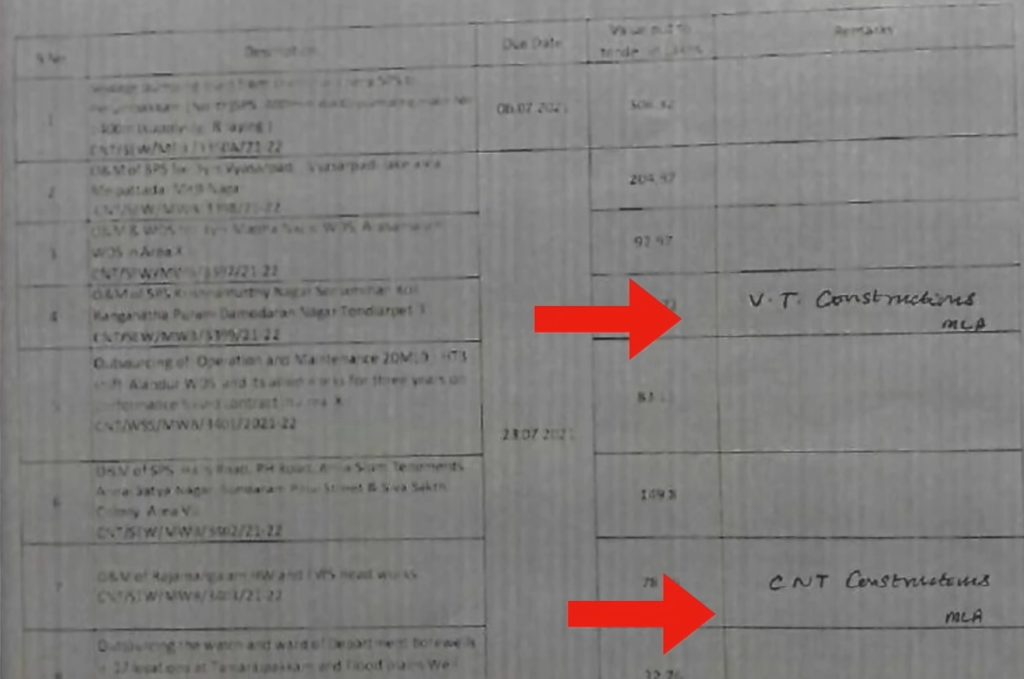
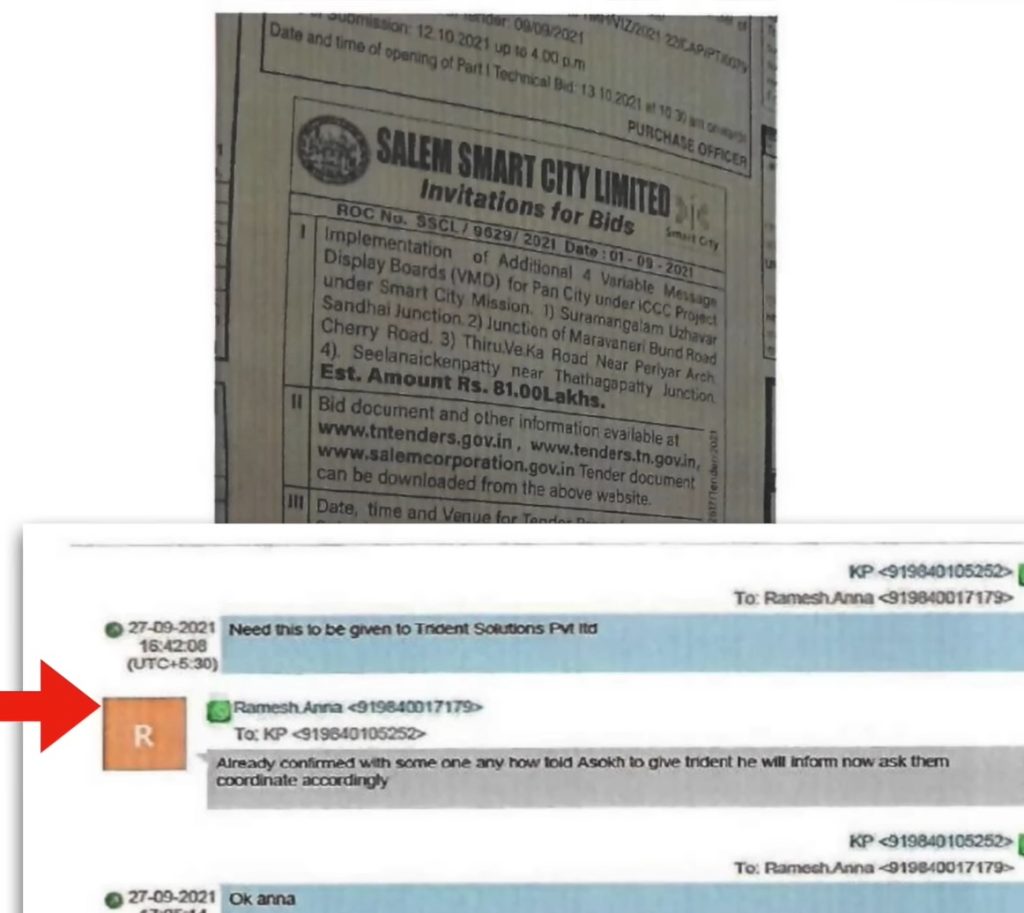
In tender-related communications, the agency claims certain works, including Smart City digital board projects, appeared to be earmarked in advance for specific firms such as VT Constructions, CNT Constructions and Trident Solutions, with alleged commission demands in the range of 10–15%.
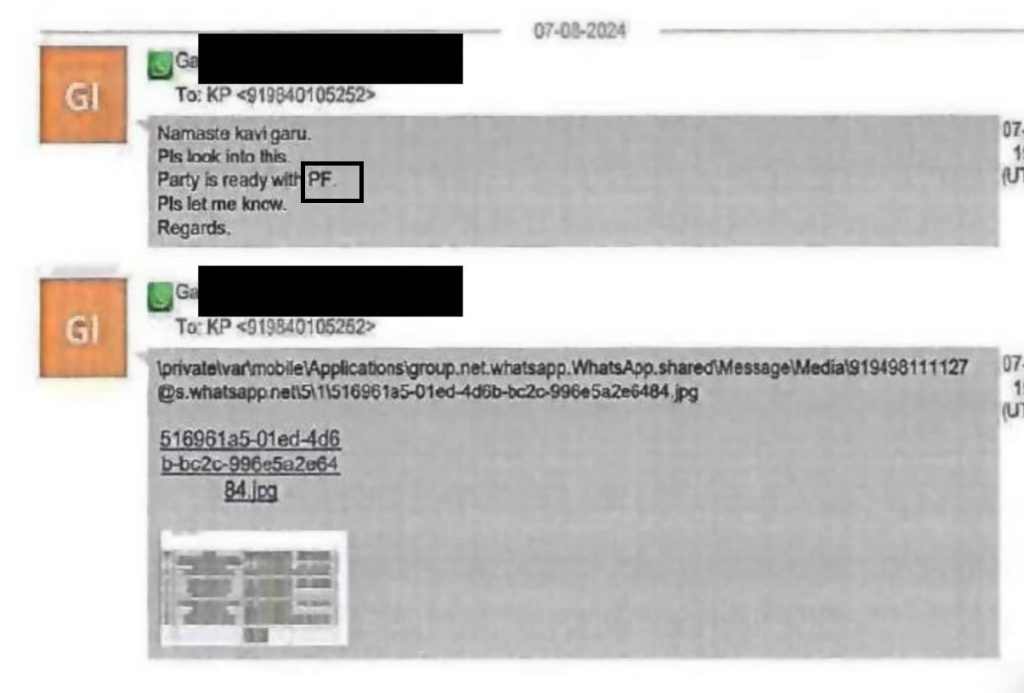
One message cited in the dossier refers to “PF” or “party fund” readiness in connection with a ₹19-crore project, which investigators interpret as a 10% cut.
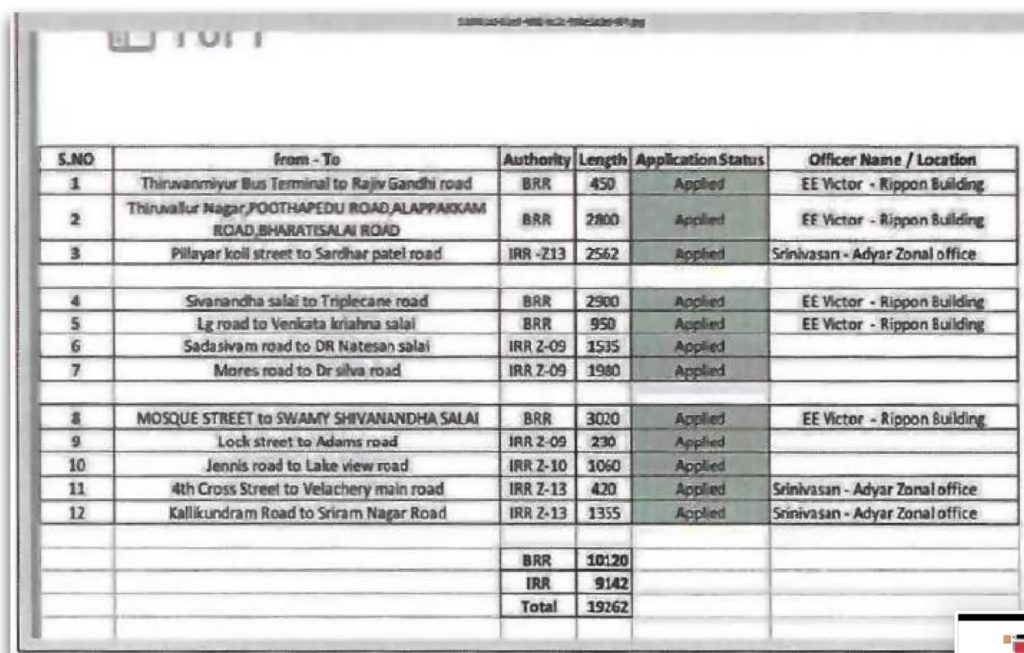
The material also references internal acknowledgements in KN Manivannan’s chats showing amounts marked “received,” which the ED says mirror earlier handover entries.
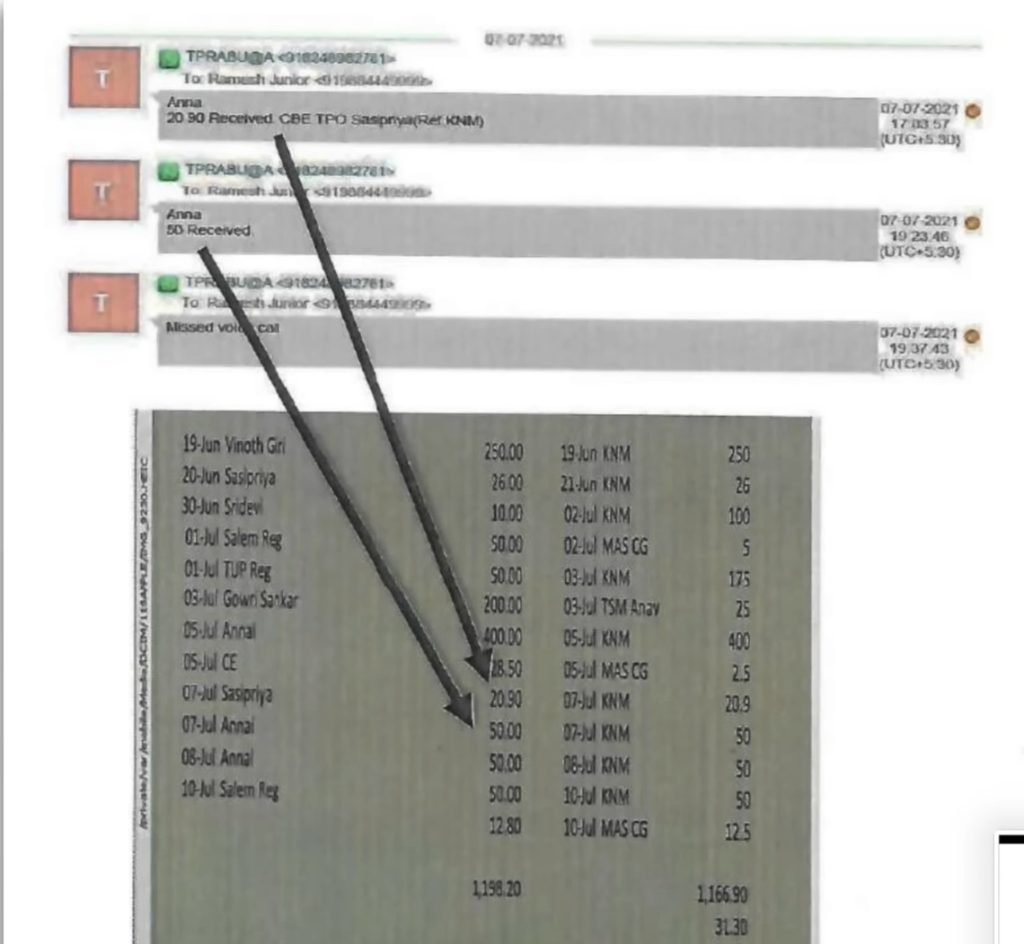
Based on a limited six-to-eight-month slice of these communications, the agency estimates that roughly ₹1,020 crore may have been moved through the suspected network, though it notes that larger financial flows linked to the department’s annual outlay, estimated in the dossier at ₹80,000 crore to ₹1 lakh crore, would require deeper forensic verification.
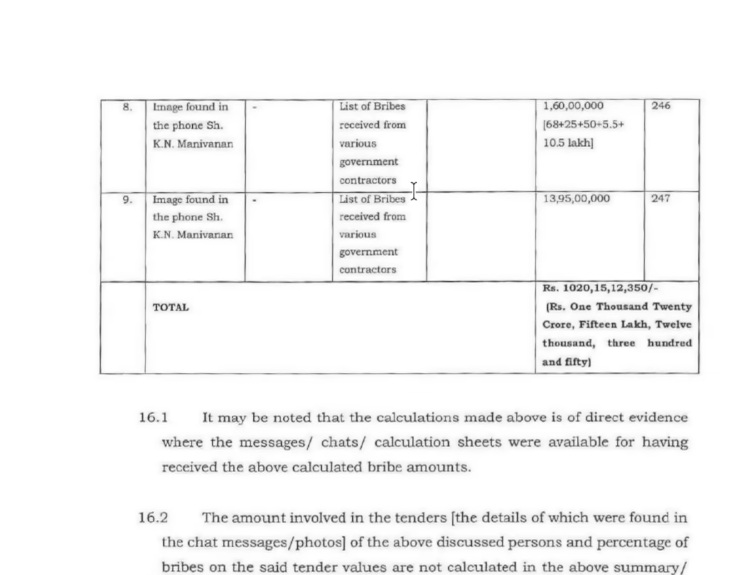
This information is based on the chats between 3 people over the above timeline alone. The chats show a pattern commonly associated with hawala transactions – an illegal value-transfer system in which physical cash is settled through parallel networks rather than formal banking channels. The repeated sharing of specific ₹10 note numbers, the “hand over” confirmations, and references to overseas settlement points such as Dubai are cited in the dossier as indicators of off-book fund movement. Investigators state that offshore movement of such funds, if established, could have broader economic implications.
Bureaucratic And Political Links Cited
The dossier references communications involving multiple IAS and IPS officers, as well as elected representatives. An IAS officer from Salem is alleged to have provided a report to Kavi Prasad in response to a complaint routed through the Chief Minister’s Office, which Prasad then relayed back to the CMO.
There are many IPS officers whose communications are referenced. The ED says these exchanges form part of the digital evidence under examination.
The note also names several elected representatives, including Sudharshan, A.P. Nandhakumar, Ebenezer (RK Nagar MLA), and DMK MP Kalanithi, who are alleged to have shared tender lists or project details via messaging platforms.
Allegations Of Pre-Fixed Tenders
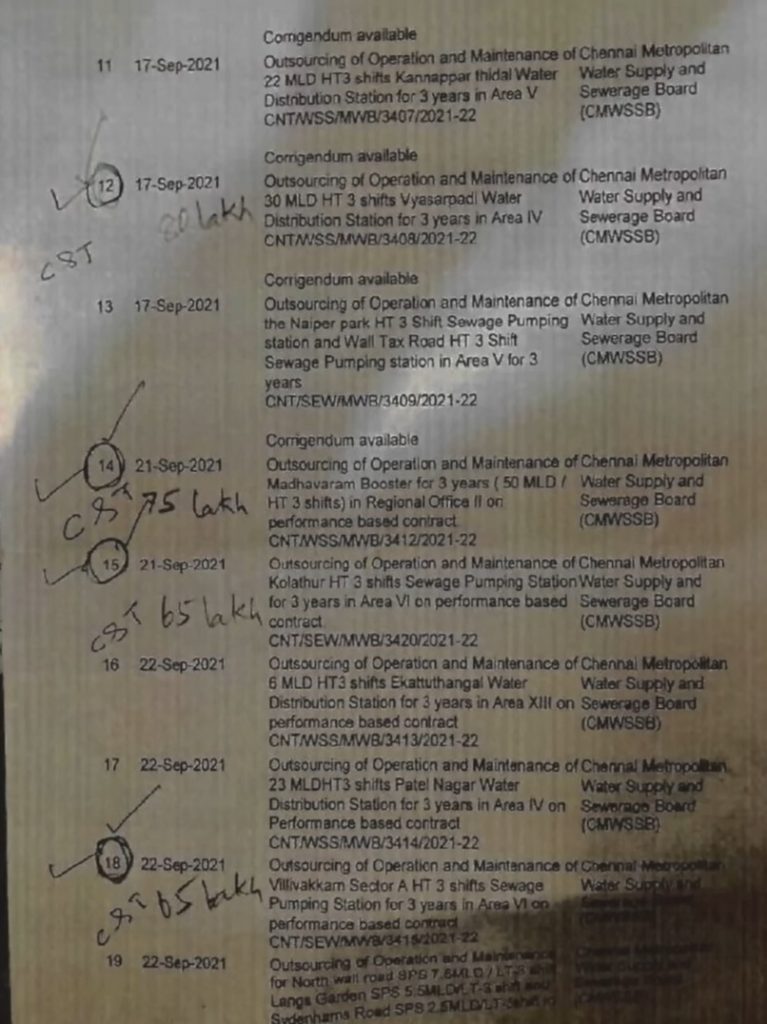
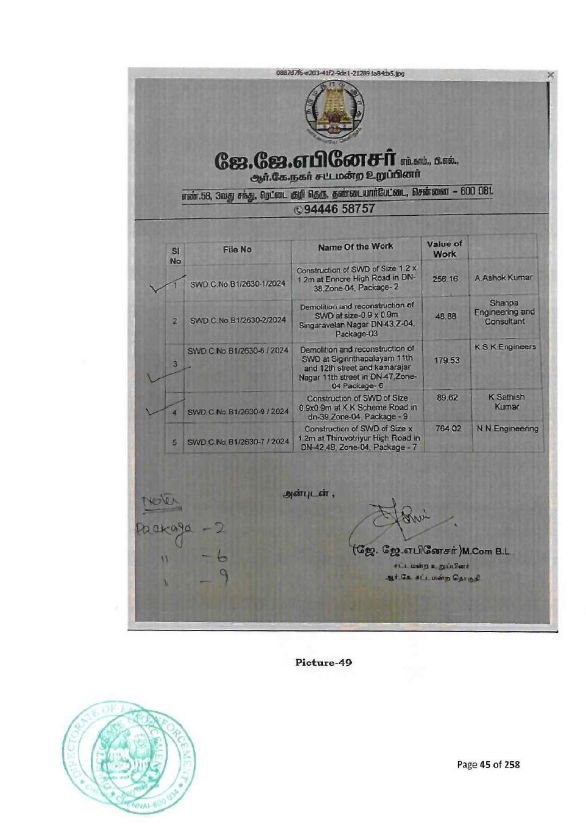
One of the most serious aspects of the ED’s findings concerns the alleged pre-allocation of works. The dossier claims investigators recovered photographs of tender lists that were circulated while bid deadlines were still open but already had contractor names handwritten next to specific projects.
In multiple chats cited by the agency, contractors allegedly asked whether particular works were available, to which the reported reply was: “All above tenders already blocked.” The ED interprets this language as indicating that certain tenders were treated as pre-decided inventory rather than competitive procurements.
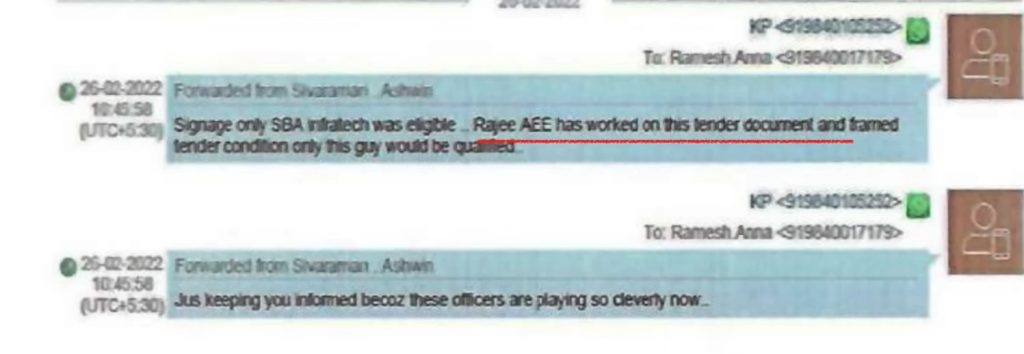
The note further alleges that eligibility criteria for some tenders were framed or modified in advance to suit particular contractors, with retired Chief Engineer Ponnambalam named as having assisted in this process.
Advance Collections And Code Language
The ED claims some chats suggest that up to 50% of the alleged commission was collected even before bid closure. Investigators also say coded financial shorthand was used in conversations, including references such as “50” for ₹50 lakh and “5 books” for ₹5 crore. In one cited exchange, an IPS officer allegedly wrote that the “Party [is] ready with PF.”
Alleged Money Trail
The dossier contains a dedicated section on suspected fund movement. According to the ED, proceeds from the alleged commission system were layered through bank transfers, domestic hawala operators, and international hawala channels before final settlement. Investigators say they recovered material indicating serial-number tracking of currency bundles, photographs of cash packets, and calculation sheets tied to specific contract values.
Stalin Family – Ultimate Beneficiary
In what is perhaps the most politically sensitive portion of the note, the ED states in Para 9.8 (pages 51–52) that the “Party Fund” referenced in communications was allegedly collected for the benefit of the ruling DMK. The document notes that the DMK is headed by Chief Minister MK Stalin and further alleges that the ultimate beneficiaries of such collections include Stalin and Deputy Chief Minister Udhayanidhi Stalin.
The agency’s reasoning, as described in the communication, is based on Stalin’s position as party chief. The dossier does not state that the ED has opened any investigation into the personal assets of either leader.
Sources close to Kavi Prasad have denied the allegations and indicated they view the action as politically motivated.
Engineers’ Contribution?
The ED also cites a message recovered from the phone of N. Ravichandran, attributed to Kavi Prasad, referring to ₹1 lakh contributions allegedly collected from 43 MAWS engineers and officers for organising an official function connected to the Chief Minister in Tirunelveli.
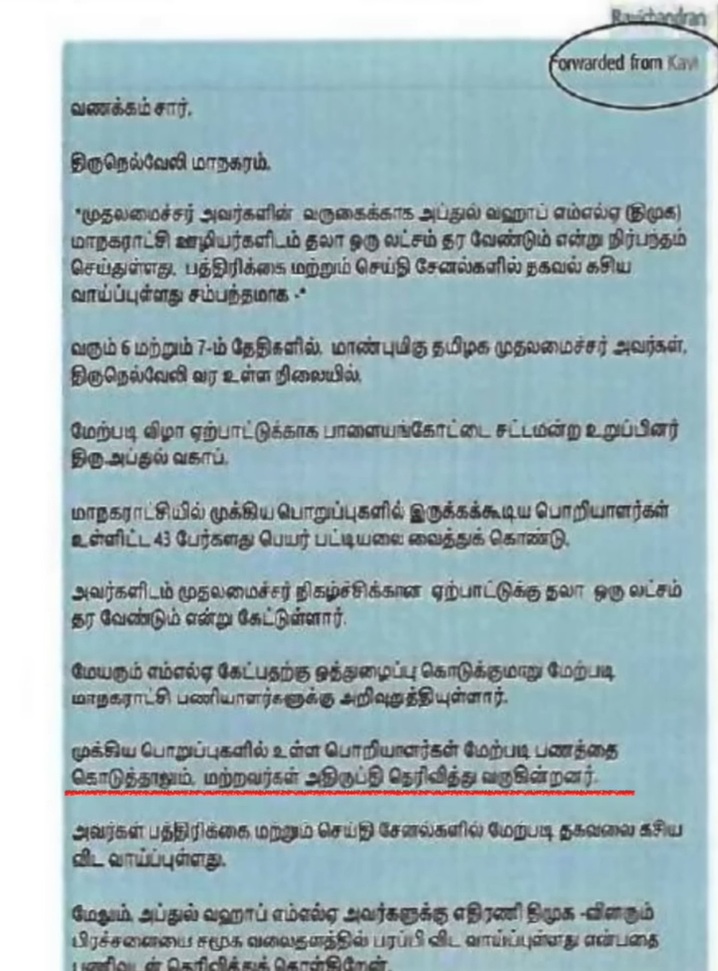
Investigators present this as further evidence of informal fund collection mechanisms.
🚨🔺Going through the ED dossier details I have as of now. (KN Nehru)
The evidences point to an alleged tender manipulation network involving municipal infrastructure contracts in Tamil Nadu.
Here’s what the proofs gathered reportedly indicate 👇 pic.twitter.com/OtK8fbbMFF
— Saikiran Kannan | 赛基兰坎南 (@saikirankannan) February 20, 2026
What Lies Ahead
With the High Court’s directive now in force, the DVAC is required to formally register a case and carry out a comprehensive probe into the alleged tender manipulation and associated financial flows. The outcome of that investigation will determine whether the ED’s explosive claims translate into prosecutable evidence.
Subscribe to our channels on Telegram, WhatsApp, and Instagram and get the best stories of the day delivered to you personally.