Pew Research Center’s Global Religious Demographics recently released a report that can come across as shocking to the Hindu population.
The Pew Research Center’s comprehensive study, “How the Global Religious Landscape Changed From 2010 to 2020,” is one of the most rigorously compiled demographic reports of our era. It maps the trajectory of billions of people across faiths, borders, and generations.
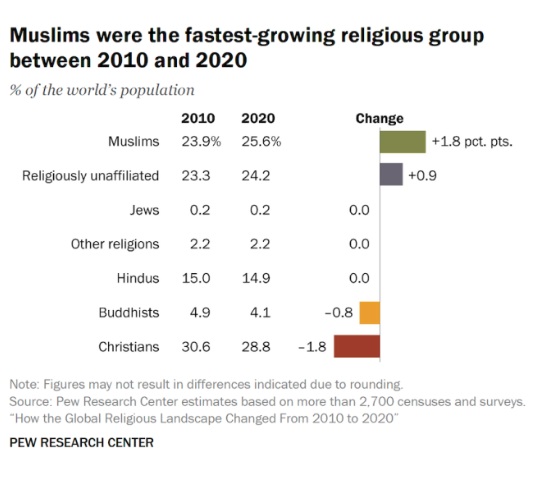
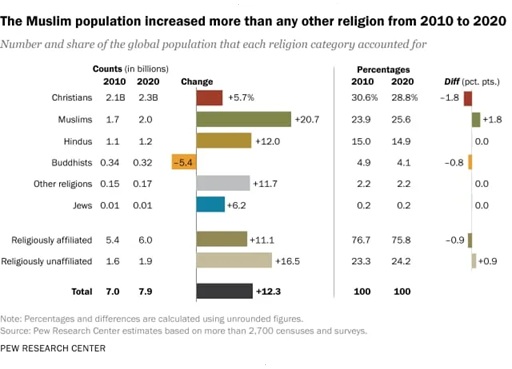
For most readers, it will pass as a routine academic exercise. For Hindus paying close attention, it should read as a civilisational alarm that mainstream discourse is deliberately muffling. The headline statistic is this: between 2010 and 2020, the global Muslim population grew by 347 million – a number larger than the combined numeric growth of Hindus (126 million), Christians (122 million), and Jews (1 million) put together.
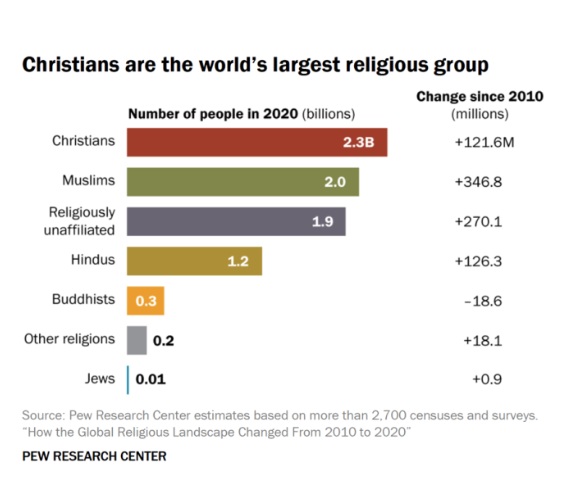
Muslims now represent 25.6% of humanity, up from 23.8%. Meanwhile, the global Hindu share edged down from 15% to 14.9%.
One tenth of a percentage point may appear trivial in isolation. Across 1.4 billion people and compounding decades, it is anything but.
A Billion-Strong Religion, Quietly Retreating
Hinduism’s demographic story is consistently described as one of “stability.” And on the surface, this is technically accurate – the Hindu population grew at roughly the same pace as the world, about 12% over the decade. But stability, when those around you are surging ahead, is another word for relative decline.
Consider what that comparison really means. Islam added nearly three times as many people as Hinduism in a single decade. Christianity, a faith spread across six continents, battered by Western secularisation, and losing followers in Europe at an unprecedented rate, still added nearly as many people as Hinduism. When the world’s oldest living civilisation is being numerically outpaced by a faith that has been in active decline in its Western strongholds, it demands serious introspection, not comfortable silence.
The Indian Reality: Where Numbers Hit Home
Hinduism’s global fate is, by design, India’s fate. Approximately 95% of the world’s Hindus live in India alone, a geographic concentration unmatched by any other major religion. This means every demographic shift inside India reverberates through Hinduism’s global numbers.
Within India, the picture is unambiguous. Pew estimates that India’s Hindu share fell from 79.8% in 2011 to approximately 79% by 2020, while the Muslim share rose from 14.2% to approximately 15.2%, adding an estimated 3.56 crore Muslims in a single decade. India added more Muslims than the entire population of several major countries combined.
By 2050, Pew projects Hindus will comprise approximately
77% of India, down from over 80% at Independence, while Muslims will rise to 18%, with projections suggesting India will surpass Indonesia to hold the world’s largest Muslim population. At that point, Hindus in India will constitute a majority, but a structurally weakened one, and a community that will still receive none of the constitutional protections reserved for “minorities.”
The Fertility Gap and Its Consequences
The engine driving this divergence is fertility. As of the last reliable data point (2015), Muslim women in India had an average of 2.6 children per woman against Hindus’2.1. The gap has narrowed significantly, from a difference of over 1.5 children per woman in 1992, and Pew notes that Muslim fertility is converging toward national averages. This is often cited as reassurance. It should not be.
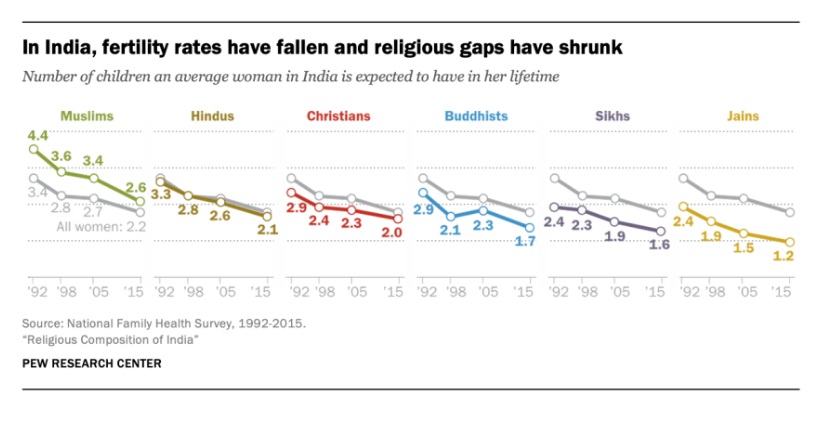
Even a modest fertility gap, compounded over decades across hundreds of millions of people, produces dramatic demographic outcomes. The convergence is real, but so is the head start. A community that maintained a higher fertility rate for seventy post-Independence years does not simply neutralise that structural advantage overnight. The demographic momentum already set in motion will reshape India’s religious composition for generations to come, regardless of future convergence.
The Policy Vacuum at Hinduism’s Core
What makes these numbers particularly urgent is the policy context in which they unfold. India’s Constitution grants minority religious communities, defined by numerical share, specific protections: the right to establish and administer educational institutions, freedom from state interference in religious affairs, access to dedicated welfare schemes. Hindus, as the majority, receive none of this.
Temple revenues across Tamil Nadu, Andhra Pradesh, Karnataka and other states are administered and often redirected by government boards. Mosques and churches operate free of such interference. Hindu educational institutions remain subject to state oversight; minority institutions do not. As Hindu demographic share contracts, these asymmetries do not diminish, they deepen.
What Hindus Must Reckon With
The Pew data is not a prophecy of doom. It is a dataset, and datasets respond to policy choices. Hinduism remains the world’s fourth-largest religion with 1.2 billion adherents, a youthful Indian base, and a growing global diaspora. Its civilisational continuity across millennia speaks to an extraordinary cultural resilience.
But resilience is not passivity. A community that built the temples of Khajuraho, codified the world’s oldest mathematical texts, and survived centuries of invasion and conversion did not do so by treating demographic signals as background noise. The question Pew’s numbers force onto the table is simple: will Hindus and their institutions treat this data as a call to informed, urgent action or allow it to be buried under reassuring narratives of “stability”?
Stability, as the data plainly shows, is not the story here. The story is trajectory. And trajectory, if unaddressed, becomes destiny.
Source: Times of India
Subscribe to our channels on Telegram, WhatsApp, and Instagram and get the best stories of the day delivered to you personally.