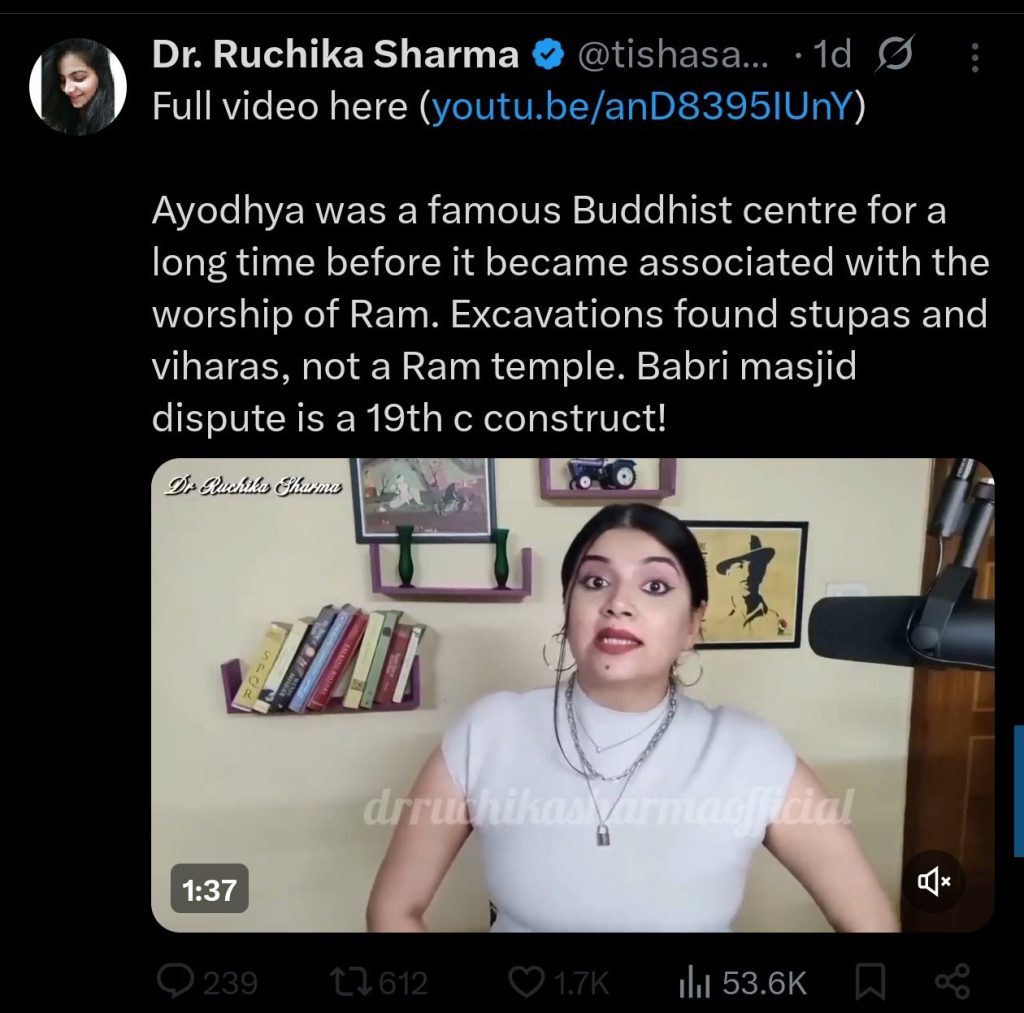
A fresh round of historical misinformation has surfaced on social media after self-styled historian “historian” and makeup artist Ruchika Sharma claimed that Ayodhya was originally a Buddhist centre and that the Ram Janmabhoomi dispute was a 19th-century construct.
Sharing a video on her X handle, Sharma wrote, “Ayodhya was a famous Buddhist centre for a long time before it became associated with the worship of Ram. Excavations found stupas and viharas, not a Ram temple. Babri masjid dispute is a 19th c construct!”
However, a closer examination of primary historical records, including Mughal chronicles, Persian texts, Islamic historians and even Buddhist literature, contradicts the narrative being circulated.
Mughal Court Records Identify Ayodhya As Rama’s Birthplace
One of the most authoritative administrative texts of the Mughal period, the Ain-i-Akbari, authored by Emperor Akbar’s court historian Abul Fazl, clearly records Ayodhya as the birthplace of Shri Rama.
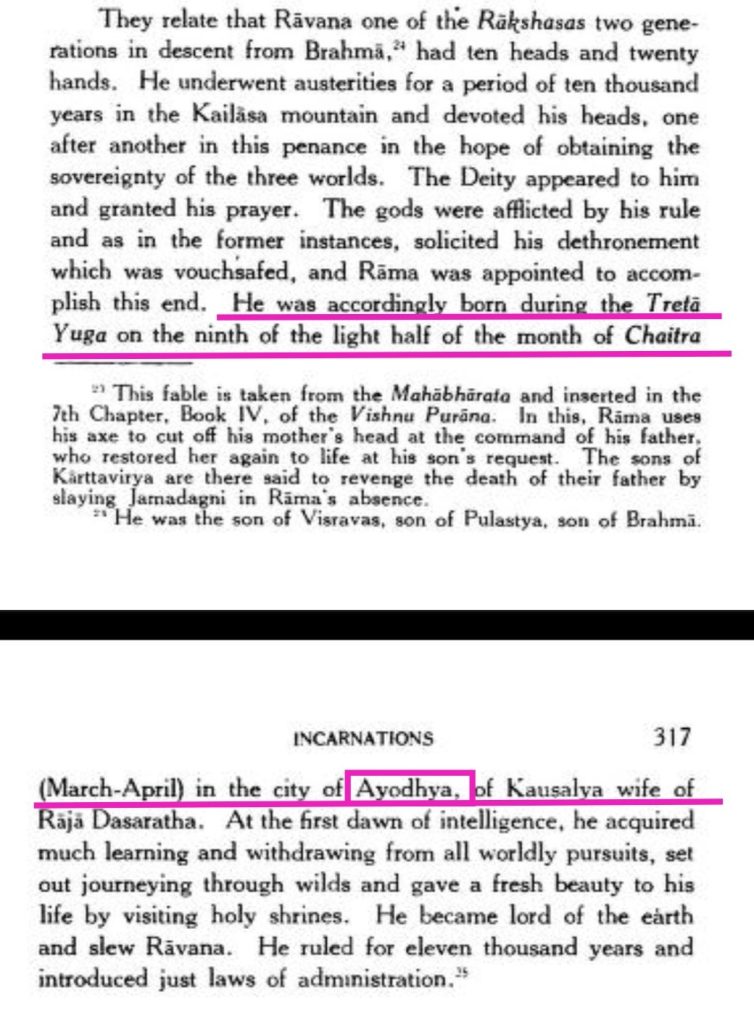
The text, produced within an Islamic imperial court, makes no reference to Ayodhya being a Buddhist civilisational centre, undermining the claim that the Ram association is a later political construct.
Islamic Usage Referred To Site As “Sita-ki-Rasoi”
Historical references also show that structures at the disputed site were locally known for centuries as “Sita-ki-Rasoi.”
One cited account notes, “…It is still known far and wide as the Sita ki Rasoi mosque…”
The continued usage of a Ramayana-linked name within Islamic descriptions reflects an acknowledgment of the site’s association with the Ram tradition, not Buddhism.
Persian Text Linked To Aurangzeb’s Lineage
A Persian manuscript attributed to Aurangzeb’s granddaughter, Sahifah-i-Chihal Nasaih-i-Bahadurshahi, similarly refers to the location as Sita-ki-Rasoi, further reinforcing the continuity of the Ramayana association even within Mughal familial records.
Muslim Chronicler Acknowledged Temple Demolition
Mirza Jan, a 19th-century Muslim chronicler linked to the Hanuman Garhi conflicts, described Ayodhya as Dasharatha’s capital and referenced the demolition of temples at the Ram Janmasthan site.
One passage records, “…Here they broke the temples and left no stone-hearted idol intact. Where there was a big temple, there they got a big mosque constructed…”
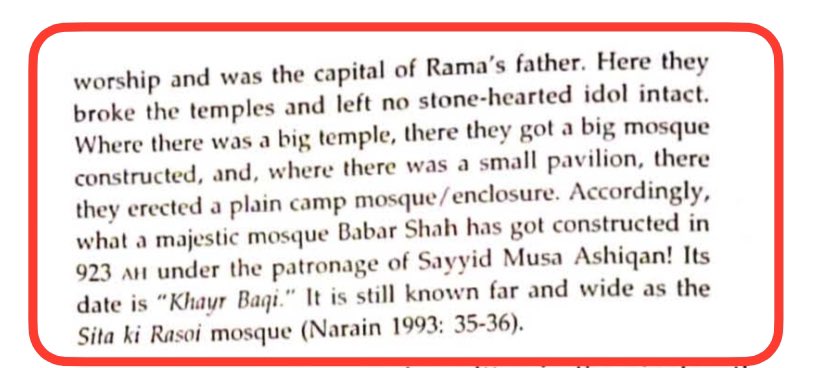
Such accounts again situate the site within the Ram Janmabhoomi tradition rather than a Buddhist institutional landscape.
Selective Use Of Buddhist Texts
Sharma’s argument relies heavily on the Dasaratha Jataka to frame Ayodhya as Buddhist. But the same text complicates that claim.
Buddhist Jataka literature portrays the Buddha in past lives — and in this narrative, he appears as Rāma-pandita, effectively a reincarnation of Rama.
A cited line states, “How Lord Buddha as a ‘Rāma-pandita’ in a past life consoled a grieving person is described in the Dasaratha Jātaka.”
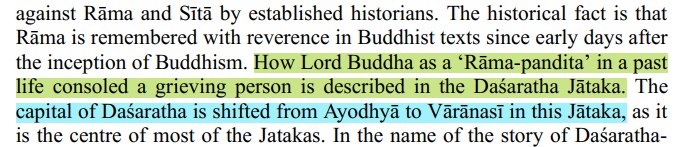
Far from displacing the Ram narrative, the text embeds it.
The Jataka shifts Dasharatha’s capital from Ayodhya to Varanasi, a detail often cited to argue Buddhist primacy.
However, scholars note that many Jataka tales are set in Varanasi, the literary centre of the corpus. The shift reflects narrative framing, not archaeological or civilisational evidence.
In peddling the line that Ayodhya was “originally” a Buddhist centre and that the Ram Janmabhoomi dispute is a mere 19th‑century construct, Ruchika Sharma is not doing history but ideological cosmetics, selectively airbrushing away Mughal‑era chronicles that identify Ayodhya as Rama’s birthplace, Islamic‑period references to “Sita‑ki‑Rasoi,” Muslim accounts of temple destruction at the Janmasthan, and even the Ram‑centred logic of the very Buddhist Jataka she brandishes as proof.
This article is based on an X thread by Sagas Of Bharat
Subscribe to our channels on WhatsApp, Telegram, Instagram and YouTube to get the best stories of the day delivered to you personally.