
Tamil Nadu is frequently cited in contemporary political discourse as one of India’s most developed states, with supporters of Dravidian parties often attributing many of its socio-economic achievements to post-1967 regional governance. However, historical data and pre-Independence records indicate that several foundational development indicators in the region pre-date the rise of Dravidian political formations.
Present-Day Development Claims
A range of widely circulated indicators place Tamil Nadu among India’s leading states on multiple fronts:
- Among the top states by Gross State Domestic Product (GSDP)
- One of India’s most urbanised states
- A leading industrial and manufacturing hub
- Highest or among the highest female workforce participation bases
- Low poverty ratios relative to national averages
- Ranked high in domestic tourism inflow
- Major exporter of electronics goods
- Higher education enrolment significantly above national average
These indicators are broadly supported by contemporary economic and social datasets.
Urbanisation: Evidence from 1901 Census
Historical census tables from the Madras Presidency (1901), which covered large parts of present-day Tamil Nadu, show that the region already had a high concentration of urban settlements compared to most of British India outside the Bombay Presidency.
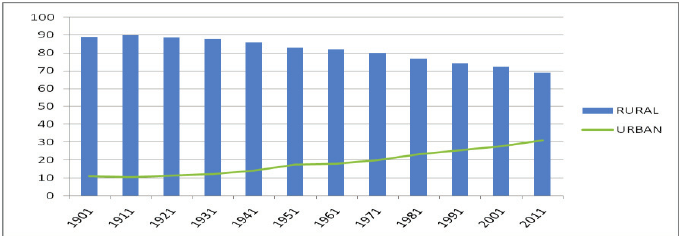
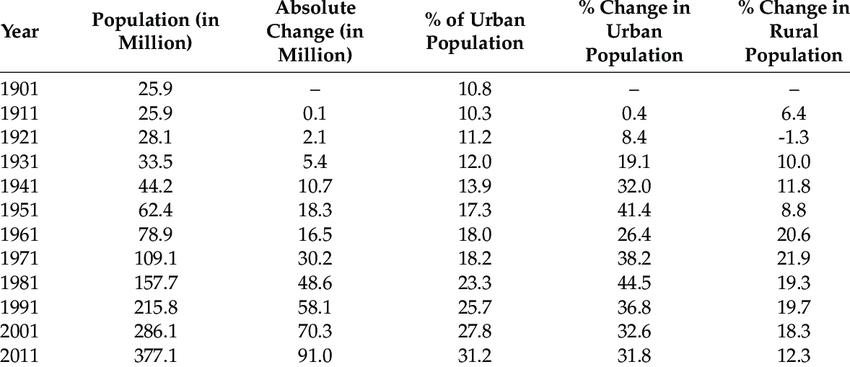
Image Source: ResearchGate
The below table titled “Distribution of Population, Madras Presidency, 1901” records significant urban population clusters across districts such as Madras City, Chingleput, Tanjore, Trichinopoly, Madura, and Tinnevelly, indicating an established urban base decades before the emergence of Dravidian parties in the mid-20th century.
This is mostly true. However, this has got nothing to do with DMK and other regional parties as you have been claiming.
Already in 1901, when Dravidian parties were not even born, Tamilnadu was the most urbanized region of India outside Bombay.
Already in 1901, Kerala and… https://t.co/BChvBJZiKJ pic.twitter.com/YTLy8yRQJg
— True Indology (@TrueIndology) August 3, 2024
This positions the Tamil region among the more urbanised parts of colonial India at the time.
Literacy and Education Before Dravidian Politics
Pre-Independence literacy studies and colonial education records show that:
The Madras Presidency, especially Tamil and Malayalam regions, ranked among the most literate in India in the early 20th century.
Missionary schooling networks, princely patronage, and early social reform movements contributed to educational spread.
Community-level literacy data from the early 20th century indicates exceptionally high literacy rates among certain social groups. For instance, Tamil Brahmin literacy rates recorded in early 20th century administrative studies were among the highest globally outside industrialised Western nations and Japan.
Early Scientific Achievement
The region’s academic ecosystem also produced globally recognised scholars prior to Dravidian party rule.
The first non-white Nobel laureate in science, physicist CV Raman (awarded the Nobel Prize in Physics in 1930), was from the Madras Presidency. His work emerged from institutional and intellectual networks that pre-dated post-Independence regional political formations.
Industrial and Urban Foundations Under Colonial Administration
Madras Presidency functioned as one of British India’s major administrative and commercial hubs, with:
- Port-based trade centred in Madras (Chennai)
- Textile and agro-processing industries
- Railway connectivity expansion
- Municipal governance institutions
These laid early foundations for later industrial expansion.
Continuity vs Political Attribution
Post-Independence and especially post-1967 governments, including Dravidian parties, operated on an already urbanised, literate, and institutionally networked social base.
Subsequent administrations expanded:
- Public sector manufacturing
- Automobile and electronics corridors
- Welfare delivery systems
- Higher education capacity
However, historical census and literacy data indicate that several baseline development indicators – urbanisation, literacy concentration, educational institutions, and early scientific output were already visible before the political rise of Dravidian parties.
Tamil Nadu’s contemporary economic and social indicators are widely acknowledged. Yet archival census records and early 20th century educational data show that many structural advantages – urban clustering, literacy penetration, and intellectual capital, were present well before regional party politics took shape.
Subscribe to our channels on WhatsApp, Telegram, Instagram and YouTube to get the best stories of the day delivered to you personally.