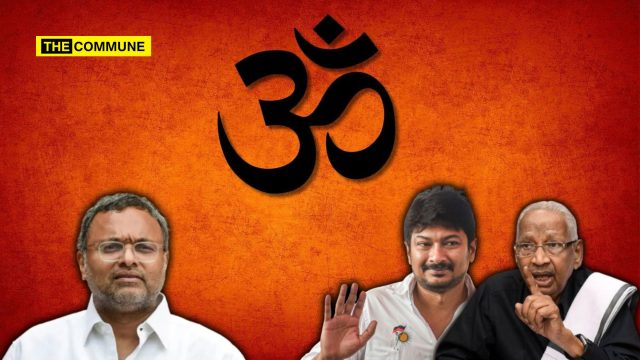
A fresh political debate has emerged over the meaning and interpretation of “Sanatana Dharma” following recent remarks by Congress MP Karti Chidambaram, who stated in an ANI podcast that the term, in Tamil Nadu’s popular parlance, refers to caste hierarchy rather than the broader spiritual framework of Hinduism.
During the interaction, Chidambaram argued that “Sanatan” or “Sanatana Dharma” is not a term commonly used in Tamil Nadu’s religious vocabulary. He maintained that Hindu practices, including temple worship, ritual observances, and the wearing of vibhuti or kumkum, remain widespread and uninhibited in the state. He further contended that political controversy around remarks made earlier by Udhayanidhi Stalin stemmed from differing contextual interpretations of the term.
Sanatana in Tamil Nadu means cast hierarchy
– Karti Chidambaram pic.twitter.com/pjXpuDTwOD
— Vije (@vijeshetty) February 16, 2026
However, one must take a look at statements made at the very same “Eradicate Sanatana” conference where Udhayanidhi Stalin delivered his controversial speech in September 2023.
At that event, Dravidar Kazhagam president K. Veeramani elaborated on what was meant by “Sanatana Dharma,” citing textual references to explain the usage of the term. He referred to the book “Sanatana Dharma: An Elementary Textbook,” published in 1916 by the Central Hindu College, Benares.
According to highlights from the publication, the text explicitly states that Sanatana Dharma came to be known in later times as the “Hindu Religion.”
In the same “Eradicate Sanatana” conference where Udhay made those remarks, DK head Veeramani clearly clarified what is meant by Sanatana Dharma, by quoting from the book “Sanatana Dharma an Elementary Textbook” published in 1916.
The very second page of the book mentions that… https://t.co/AsKpHkta8U pic.twitter.com/s0X46YeSXa
— Tamil Labs 2.0 (@labstamil) February 17, 2026
This clarification, delivered from the same conference stage, directly framed the discourse around Hinduism rather than limiting it to caste hierarchy alone. He had said, “This religion was called Hindu religion. Most importantly, the name Hindu religion and Sanatana Dharma are not different. Everyone has to understand this first.”
Madam, how long will you fool people? Remember, this is SM age. Every utterance is recorded. FYI, this is the same stage where Udhayanidhi spoke about eradication of Sanatana Dharma. https://t.co/7rNleqGqrl pic.twitter.com/pBg3x89tvv
— Living Temples Of Bharat (@Saigeet36566874) February 17, 2026
The reference was also reported in the Dravidar Kazhagam mouthpiece Viduthalai (3 September 2023 edition), which reproduced portions of the textual explanation cited during the conference.
Sanatana Dharma & Caste Hierarchy
The word Sanatanam/Sanatana means permanent, or rather eternal, referring to timeless principles of life and dharma, and not inherently caste. It is the common cultural civilizational elements – be it adhering to auspicious timings, praying to a Siva Lingam, tying a lemon or breaking a coconut – that binds Hindus as a society. It can’t be the case that Sanatana Dharma means Hinduism in north India and a “regressive” caste hierarchy practice in Tamil Nadu alone. The contextual association with caste hierarchy is nothing but an attempt to blame all social evils on one particular community.
EV Ramasamy Naicker aka Periyar used Nazi analogies, warning Brahmins to learn from Jews’ fate under Hitler and praising aspects of Nazi rise in his magazine, framing Brahmins as oppressors. His rhetoric mimicked anti-Semitic propaganda amid anti-Brahminism. British colonial policies and missionaries amplified Aryan-Dravidian divides, influencing Dravidian narratives.
Caste hierarchies persist, often perpetuated by dominant non-Brahmin castes in land and politics, while Brahmins (now ~3% of population) face historical blame despite urban migration post-independence. Blaming solely on Brahmins overlooks broader intermediate dominant landed caste power.
So, Karti Chidambaram is wrong in equating Sanatana Dharma with caste hierarchy.
Subscribe to our channels on WhatsApp, Telegram, Instagram and YouTube to get the best stories of the day delivered to you personally.