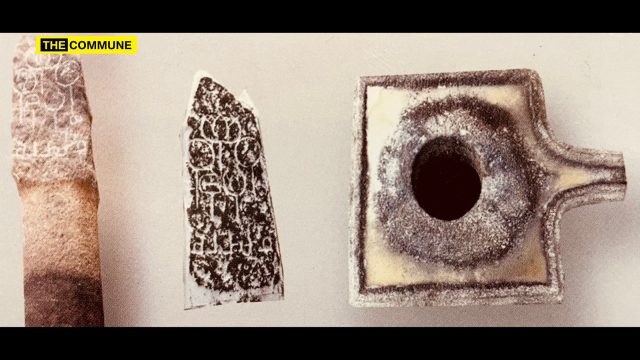
The recent excitement surrounding Tamil-Brahmi inscriptions discovered in Egypt’s Valley of the Kings has triggered global interest in the maritime reach of ancient Tamils. Scholars identified around 30 inscriptions, largely in early Tamil script, dating between the 1st and 3rd centuries CE, evidence that Tamil travellers and merchants were present in Roman Egypt. The findings have been widely celebrated as proof of Tamil civilisation’s overseas footprint.
However, even as these discoveries are being hailed, historians point out that an equally significant Tamil-Brahmi inscription from the same period exists within Tamil Nadu itself, one that has received comparatively little public attention.
The inscription was identified in 2016 on a Śiva Lingam at the Shiva temple in Netrampakkam, near Madurantakam. The Lingam, measuring about 3.4 feet in height, features a carved lotus on the Brahma-bhāga, flanked by banner-like motifs. Beneath this carving appears the Tamil-Brahmi inscription “Sēnarumāṉ,” believed to be the name of the sculptor who fashioned the Lingam.
Epigraphists date the artefact to the 2nd century CE, placing it in the same broad historical window as the Egypt inscriptions now being discussed. Significantly, this Lingam is regarded as the oldest identified Śiva Lingam in Tamil Nadu, offering material evidence for the antiquity of organised Śaiva worship in the region.
Researchers say the inscription not only reflects the evolution of Tamil script in sacred contexts but also underscores the continuity of temple traditions and artisan lineages in early historic Tamil society.
An important Tamil-Brahmi inscription from the very same period as the much-discussed Egypt Tamil-Brahmi discovery exists here as well. Yet, it receives far less attention.
It was inscribed on a Śiva Lingam discovered at the Shiva temple in Netrampakkam, near Madurantakam during… pic.twitter.com/2H2tFs9BWs
— 𑀓𑀺𑀭𑀼𑀱𑁆𑀡𑀷𑁆 🇮🇳 (@tskrishnan) February 16, 2026
While the Egypt findings highlight Tamil mobility across seas, the Netrampakkam inscription stands as a powerful reminder that equally important civilisational markers lie closer home — etched in stone, within living temples, awaiting wider recognition.
Subscribe to our channels on WhatsApp, Telegram, Instagram and YouTube to get the best stories of the day delivered to you personally.