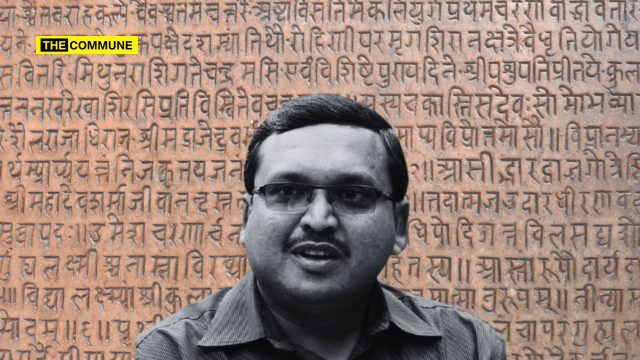
Senior Indian archaeologist and officer with the Archaeological Survey of India (ASI), Amarnath Ramakrishna, has landed himself under the spotlight for making remarks that resemble a Dravidianist hate monger.
Amarnath Ramakrishna, an ASI officer, speaking at a public programme, referred to research presented by foreign scholars claiming that inscriptions in the ancient Tamil-Brahmi (“Tamili”) script were found in nearly 30 locations inside tombs in Egypt’s Valley of the Kings, dating to the New Kingdom period.
He said, “The script called “Tamili” found in Egyptian tombs was explained to us today. Those who said it are not Indians/Tamilians; foreign scholars said it. Two foreign scholars read the first paper at that seminar. They said: In Egypt’s Valley of the Kings (New Kingdom), Tamili inscriptions are engraved in 30 places on Egyptian tombs. Especially, they read “Sikai Kottran”. That “Kottran” word is found in our Pugalur inscription near Karur in Tamil Nadu. People from here went there for trade and wrote their names. Even today, we write our names—go to any temple, old temple or old building, school; we don’t stay quiet, we write our names with charcoal whether it sticks or not.”
He continued, “Writing names like that happened 2,000 years ago. That’s the news found here in Egypt. Egyptian kings built pyramids around 1800 BCE; they used cuneiform letters. Later, traders from here wrote Greek letters too, about 2,000 Greek letters found. Studying those Greek letters, two foreign scholars discovered Tamili too. They read and showed “Tamili Tamili.” They read “Sikai Kottran.” Seeing that, media went viral calling it “Sikai.” “Sikai” is Sanskrit word, they say. Is there any instance where “Sikai” is a Sanskrit word? I don’t know. Sanskrit is an invented language; Sanskrit cannot be a mother tongue because it is a language a woman cannot speak, so it cannot possibly be a mother tongue. A language originates from a woman; only a language born from a woman goes equally to men and women. Sanskrit is a religious ritual language, compiled solely to praise God. That language can only work for man-to-man and not man-to-woman. There is no chance for it to be a mother tongue. It’s constructed from many languages, possibly including Tamil words, shining as Sanskrit today.”
He continued, “Claiming “Sikai” from that language is wrong. Tamil scholars must research if “Sikai” is Tamil. It will surely confirm as Tamil, that’s the firm answer. Starting such research will greatly help showcase Tamil’s glory worldwide, which I state here.”
#WATCH | “சமஸ்கிருத மொழி யாருக்கும் தாய்மொழியாக இருக்காது..” -அமர்நாத் ராமகிருஷ்ணன், இந்திய தொல்லியல் துறை இயக்குநர்#SunNews | #Sanskrit | #Tamil | #AmarnathRamakrishnan pic.twitter.com/BMhth0c2yo
— Sun News (@sunnewstamil) February 16, 2026
Why Amarnath Ramakrishna Speaks Like A Dravidianist Hate Monger
The Dravidianist hate for Sanskrit is well-known. By referring to Sanskrit as an ‘invented’ language and one that allegedly cannot be spoken by women, Ramakrishna has echoed the Dravidianist tropes.
Dismissing Sanskrit as “not a mother tongue” or reducing it to a purely ritual language ignores its vast literary, historical, and inscriptional corpus. It is noteworthy that:
Sanskrit possesses one of the world’s richest classical literatures spanning philosophy, science, poetics, grammar, and statecraft.
It has played a foundational role in decoding India’s ancient history through inscriptions, copper plates, and temple records.
Tamil Nadu’s Sanskrit Epigraphical Record
Historians note that Tamil Nadu itself holds one of the largest corpora of Sanskrit inscriptions in India, found alongside Tamil inscriptions on temple walls, hero stones, copper plate grants, and royal edicts.
For centuries, Tamil dynasties, including the Pallavas, Cholas, and Pandyas, patronised Sanskrit in administration, religion, and royal titulature, often using it in tandem with Tamil. Epigraphists stress that without Sanskrit proficiency, reconstructing large portions of South Indian political, social, and religious history would be severely impaired.
Ramakrishna’s remarks echo Dravidianist talking points, particularly those narratives that frame Sanskrit as alien, imposed, or exclusionary. Such binaries overlook the long history of linguistic coexistence and mutual patronage between Tamil and Sanskrit traditions. Officials occupying institutional positions, especially in archaeology, must maintain academic neutrality and avoid civilisational or linguistic denigration.
It is strange to see an @ASIGoI officer dismiss Sanskrit on the grounds that it is “not a mother tongue” of anyone and it is used only for “religious purpose”. Let alone its great literary value, the importance Sanskrit posses in understanding our history is something an ASI… https://t.co/xk8EJZpnTY
— 𑀓𑀺𑀭𑀼𑀱𑁆𑀡𑀷𑁆 🇮🇳 (@tskrishnan) February 16, 2026
Subscribe to our channels on Telegram, WhatsApp, and Instagram and get the best stories of the day delivered to you personally.