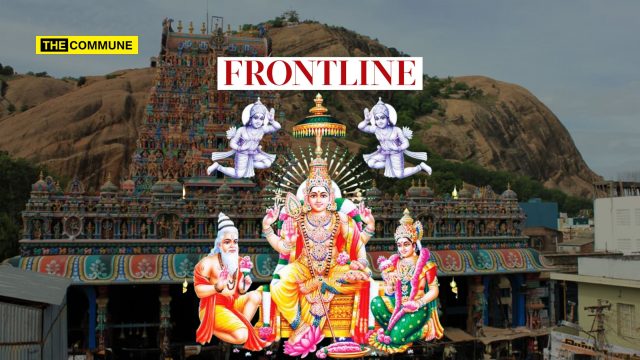
A recent article published in Frontline on the controversy surrounding the lamp-lighting (deepam) dispute at the sacred hill of Tiruparankundram near Madurai has triggered strong criticism from scholars and commentators, who have accused the magazine of presenting a historically skewed narrative on Murugan worship and the hill’s religious history.
Frontline’s Key Claims
The Frontline article situates the present dispute over lighting a deepam on a stone pillar near the Sikandar Badshah dargah within a broader historical and socio-religious framework.
According to the article:
Thirupparankundram hill has functioned for centuries as a shared sacred space, housing the Sri Subramaniya Swamy Temple, Jain relics, and the 13th-century Sikandar Badshah dargah.
The current controversy stems from demands by Hindus to light the Karthigai Deepam on the Deepathoon pillar located near the dargah, and not at the Moksha deepathoon which is a Nayak-era pillar being used currently near the Uchi Pillayar shrine.
The article stresses that the established custom of lighting the lamp on the Nayak-period pillar has been followed for over a century under the supervision of the Hindu Religious & Charitable Endowments (HR&CE) Department.
It highlights judicial intervention, including a Madurai Bench order permitting the lighting of the lamp on the contested pillar and subsequent legal escalation between the State government and the judiciary.
Beyond the immediate dispute, the article advances a larger civilisational thesis on Murugan worship. Drawing on academic voices such as Czech Indologist Kamil Zvelebil, it argues that:
Murugan originated as a tribal/Dravidian hill deity known as “Murukan” or “Velan.”
The deity was later absorbed into Sanskritised Hindu polytheism through processes described as “Sanskritisation” and “Brahminisation.”
This integration is portrayed as part of a broader shift that allegedly contributed to the decline of Jainism and Buddhism in Tamil regions.
The article characterises the evolution of Murugan into Skanda/Kartikeya as a “happy blend of two cultures,” symbolised through mythology, ritual transformation, and temple institutionalisation.
Busting The Lies Peddled By Frontline
In reality, the civilisational framing of the article rests on selective scholarship and ideologically loaded terminology.
Reliance on frameworks popularised by figures such as Kamil Zvelebil, particularly terms like “Sanskritisation,” “Hindu appropriation,” and “Vedic influence”, has led to a misreading of primary Tamil sources.
Even a basic reading of Sangam literature undermines the claim that Murugan and Skanda/Kartikeya were historically separate theological constructs.
Textual Evidence From Sangam Sources
There are multiple references from classical Tamil works that disprove the Frontline article. Here are a few:
Thirumurugatrupadai describes Murugan being worshipped through Vedic ritual procedures, stating:
“மந்திர விதியின் மரபுளி வழாஅ அந்தணர் வேள்வி ஓர்க்கும்மே” – interpreted as indicating worship through established Vedic mantras without procedural deviation.
Iconographic and theological attributes in Sangam literature align with pan-Indian Skanda traditions, including:
- Six faces – referenced in Thirumurugatrupadai
- Vel (spear) as primary weapon – noted in Paripadal
- Peacock mount – “விரை மயில் மேல் ஞாயிறு” (Paripadal)
- Rooster emblem – “சேவல் அம் கொடியன்” (Thirumurugatrupadai)
These features correspond closely with sculptural and numismatic depictions of Skanda across northern India such as:
- Yaudheya coinage from pre-Common Era centuries
- Kushan-period iconography
- Gupta-era sculptural traditions
– all of which depict Skanda with similar attributes, suggesting civilisational continuity rather than later assimilation.
Pan-Indian Presence Vs Regional Framing
Let us further disprove the portrayal of Murugan as an exclusively tribal or regional deity.
While Murugan’s association with the kurinji (hill) landscape in Tamil poetic convention is known, it is also noteworthy that Sangam texts reference structured sacred centres such as:
- Thirupparankundram
- Tiruchendur
- Swamimalai
These functioned as organised pilgrimage and worship sites even in the early historic period, contradicting the depiction of a purely tribal cult later institutionalised.
Counter-Framing The “Appropriation” Thesis
Now if the term “appropriation” must be invoked, it may be more applicable to modern academic attempts to confine a widely attested pan-Indian deity within a narrowly regional or racial framework.
Murugan/Skanda/Kartikeya traditions are evidenced across:
- Multiple linguistic canons
- Diverse dynastic patronage networks
- Pan-subcontinental textual traditions
thus, indicating theological continuity rather than cultural absorption.
When an article relies heavily on frameworks derived from persons like Kamil Zvelebil — employing terms such as “Sanskritisation,” “Hindu appropriation,” or “Vedic influence” — without the readings of primary Sangam sources, this is how it will look like.
Even a cursory… https://t.co/vxIUoietL7
— 𑀓𑀺𑀭𑀼𑀱𑁆𑀡𑀷𑁆 🇮🇳 (@tskrishnan) February 15, 2026
Subscribe to our channels on Telegram, WhatsApp, and Instagram and get the best stories of the day delivered to you personally.