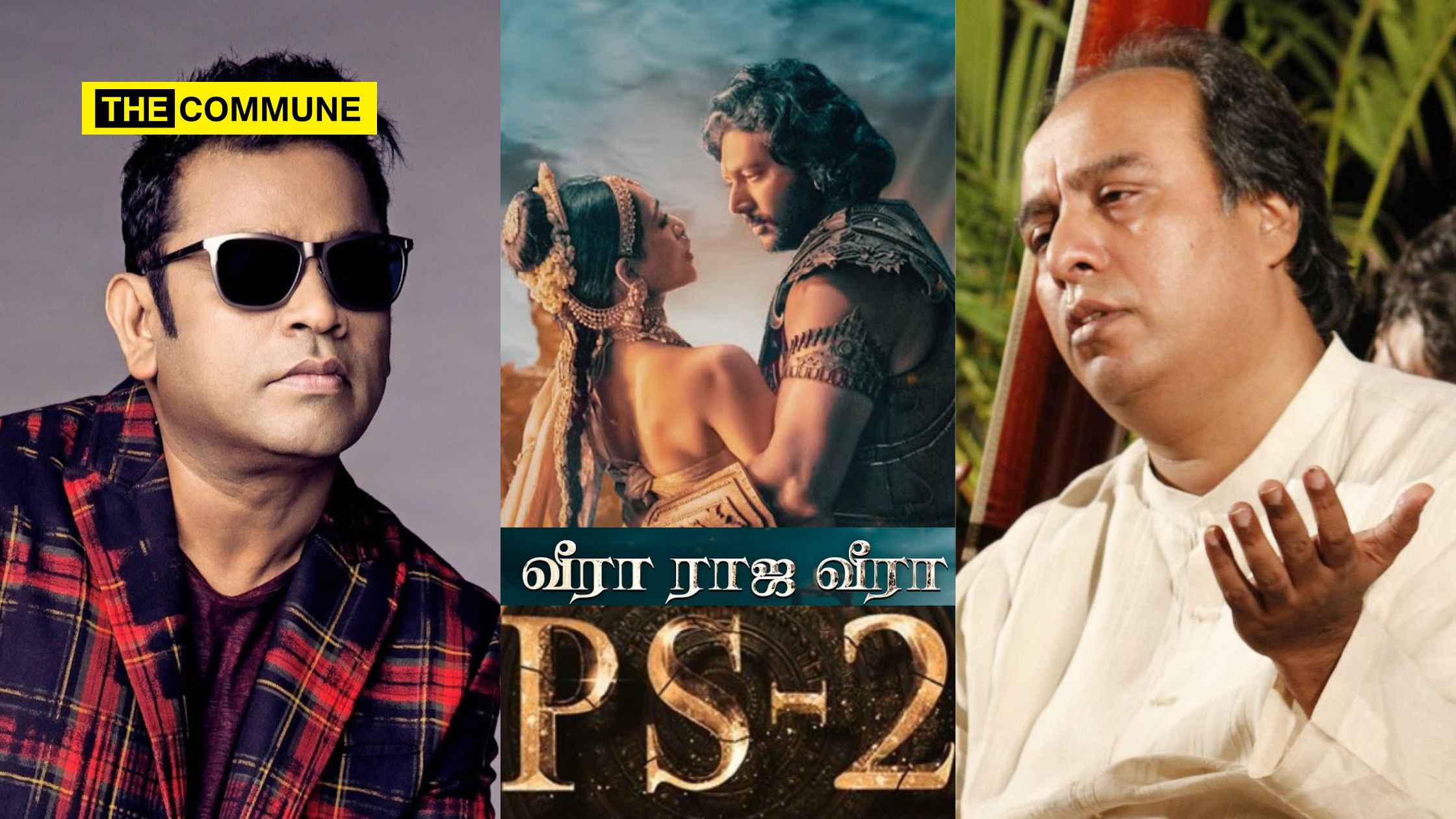
The Supreme Court of India has urged composer A.R. Rahman and the producers of Ponniyin Selvan II to formally acknowledge the contribution of the Dagarvani musical tradition to the song “Veera Raja Veera.” The request comes amid a larger legal battle over originality, authorship, and moral rights in a case that probes deeply into how traditional art forms are incorporated into contemporary creativity.
At its core, the dispute revolves around a claim by Faiyaz Wasifuddin Dagar, a Dhrupad vocalist and custodian of the Dagarvani lineage, that “Veera Raja Veera” draws substantially from a classical composition titled “Shiva Stuti” performed and fixed in recording by his late father and uncle — the Junior Dagar Brothers — in the 1970s. Dagar asserts that his family holds the copyright and moral rights in that work, and that Rahman’s track uses protectable elements without adequate acknowledgement or permission.
The bench, led by Chief Justice Surya Kant and Justice Joymalya Bagchi, made an observation that has now become central to the controversy: while establishing authorship requires careful legal examination, mere incorporation of stylistic influence or first performance does not automatically confer ownership. The court clarified that evidence must show whether the composition as used in Veera Raja Veera was independently created or derived from the Dagar tradition’s version.
Yet the court also underscored an important cultural argument. It questioned why, if the Dagarvani lineage had not nurtured and preserved this classical idiom, modern musicians and composers would not have had the material to draw upon. In that vein, the bench suggested that some form of acknowledgement — beyond generic credit to a tradition — ought to be considered, not as an admission of legal liability, but as recognition of cultural debt and artistic lineage. “There should be some acknowledgement… They want respect and recognition,” the court observed.
Rahman’s legal team, led by senior counsel Abhishek Manu Singhvi, defended the originality of “Veera Raja Veera,” arguing that the piece blends multiple musical influences and that reliance on public-domain classical idioms does not establish exclusive rights. They have contended that even if the Dagarvani tradition shaped the track, the song incorporates Western harmonic frameworks and layered orchestration that make it a distinct work.
This hearing builds on earlier twists in the case. In 2025, a single-judge bench of the Delhi High Court had found a prima facie case of infringement, ordered changes to the song’s credits, and directed Rahman and the producers to deposit ₹2 crore as security. A later division bench of that court set aside parts of the interim relief, holding that a prima facie case of authorship had not been demonstrated at that stage. Dagar’s appeal from that decision brought the matter to the Supreme Court.
The bench has now adjourned the matter to February 20 for further arguments, including detailed consideration of issues like originality, fixation, and the scope of copyright protection in works influenced by centuries-old artistic traditions.
What this case highlights — beyond the legal technicalities — is a deeper tension in cultural production today: how to reconcile collective traditional heritage with individual creative expression and proprietary rights. In a media landscape where classical forms are continually reinterpreted and repurposed, the judiciary is being called upon to navigate not just statutes, but the ethics of honouring artistic lineage without stifling innovation.
Subscribe to our channels on Telegram, WhatsApp, and Instagram and get the best stories of the day delivered to you personally.