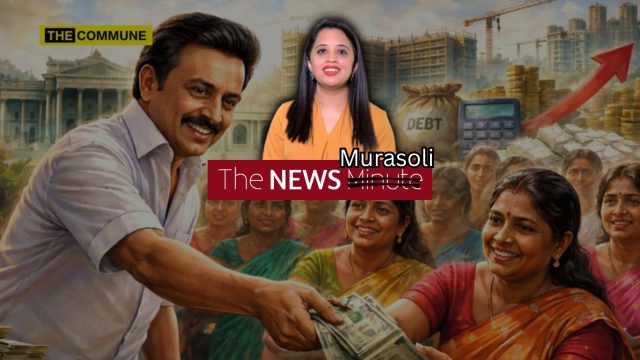
The News Minute (TNM), the digital mouthpiece of Dravidian politics in Tamil Nadu, has outdone itself.
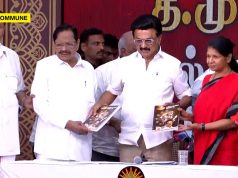
In a fawning article published on February 13, 2026, TNM went above and beyond to explain why Tamil Nadu Chief Minister MK Stalin’s decision to transfer Rs 5,000 each to 1.3 crore women in one go is a shining example of women empowerment.
The headline? A straight-faced: “Why TN CM Stalin decided to release Rs 5000 each to 1.3 crore women in one go.”
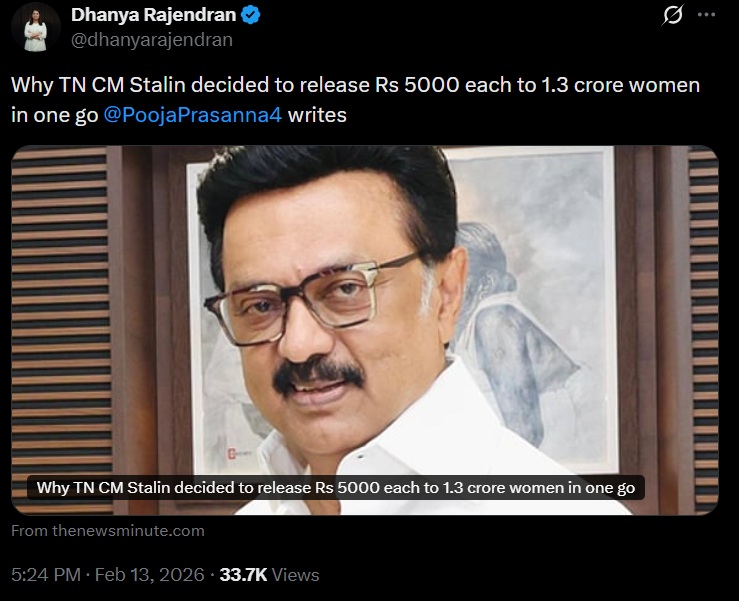
The explanation? Stalin had to “thwart” the evil BJP’s attempts to “halt the scheme” by hiding behind elections. The move, we’re told, was necessary to ensure women don’t face hardship in meeting expenses for medicines, children’s education, and household needs.
All very noble. All very heartwarming.
Except for one small problem.
The Bihar Template: When Nitish Did It
In October 2025, Bihar CM Nitish Kumar (NDA) transferred Rs 10,000 each to 25 lakh women (totaling 1 crore beneficiaries) under Mukhyamantri Mahila Rojgar Yojana for self-employment startups. Launched pre-elections with PM Modi’s involvement, it offered initial grants plus up to Rs 2 lakh follow-up, positioned as empowerment via Jeevika self-help groups.
The leftist ecosystem that TNM inhabits branded the move as “electoral bribes,” “vote-buying,” and “fiscally irresponsible giveaways.” The headlines didn’t ask “Why Bihar CM decided to release funds to women in one go” with sympathetic explanations. They asked pointed questions about timing, motives, and electoral manipulation.
The double standard is so glaring it’s almost comical.
Same action.
Same timing – both ahead of elections.
Same demographic – women voters.
Same mechanism – direct benefit transfers.
But diametrically opposite coverage.
Why?
Because TNM isn’t a news organization. It’s a propaganda outfit with a simple rule:
- If a non-DMK, non-Dravidian government does it → it’s a bribe.
- If the DMK does it → it’s empowerment.
This time, they use the examples of NDA-led governments in other states – Assam, Maharashtra, Bihar, MP, Haryana to justify DMK’s move to transfer the cash. This creates a normalization effect: If others do DBTs, Tamil Nadu’s move isn’t exceptional.
That indirectly supports Stalin’s justification.
The “Election Code” Dodging: Clever or Corrupt?
TNM’s article proudly explains how Stalin “thwarted” the BJP’s attempts to halt the scheme: “The advance disbursal of funds was therefore seen as a preemptive step to avoid any interruption.”
Translation: We rushed to give money before the election code of conduct kicks in, because once it does, we can’t.
Now imagine if a BJP-led government did this.
Imagine the headlines: “BJP govt in mad rush to distribute funds before code kicks in” — “Election Commission urged to investigate pre-code cash transfers” — “Opposition cries foul over timing of welfare payouts.”
TNM would be leading the charge.
But when the DMK does it? It’s “ensuring women don’t face hardship.”
The mental gymnastics required to maintain this position would win Olympic gold.
The Numbers Game: 1.3 Crore Women
Let’s do the math TNM doesn’t want you to do:
1.3 crore women = 13 million voters (or potential voter influencers in their households)
Rs 5,000 each = Rs 6,500 crore of public money
Disbursed in one go, weeks before elections
Justified as “advance payment” for three months
Now ask yourself: If this were a BJP government in any state, would TNM be writing sympathetic articles explaining why it was necessary to give 1.3 crore women Rs 5,000 each right before elections?
Would the headline be “Why BJP CM decided to release funds to women in one go” with a helpful video message from the CM?
Or would it be “BJP’s pre-election cash splash: Freebie or empowerment?”
We all know the answer.
The “Women Empowerment” Card
TNM’s article leans heavily on the “women empowerment” framing: “Beneficiaries would face hardship in meeting expenses for medicines, children’s education, and household needs if the Rs 1,000 monthly assistance was interrupted.”
This is genuinely touching.
But here’s the problem: This argument applies to every state.
Bihar’s women also have expenses for medicines, children’s education, and household needs. So do Assam’s women. So do Madhya Pradesh’s women. So do Maharashtra’s women.
But when those governments transfer money to women, TNM doesn’t call it “empowerment.” They call it “freebies” or, at best, report it with skepticism.
The “women empowerment” framing is selectively applied based on one criterion alone: which party is in power.
TNM did not bother asking one important question to the DMK. The same portal covered the various protests going on in the state, but they failed to ask why the money was not used to settle those problems rather than “empower women”.
The Assam Irony
TNM’s article mentions Assam’s Orunodoi scheme almost as a throwaway, noting that the Assam government is “looking at an early disbursement” to “circumvent the stay on DBT if the SC orders so in March.”
The tone? Disapproving. Skeptical. It’s presented as evidence of BJP “double-speak.”
But this is exactly what the DMK just did.
The Assam government is considering early disbursement to protect beneficiaries from potential interruption.
The DMK just did early disbursement to protect beneficiaries from potential interruption.
Same logic. Same mechanism. Same timing concerns.
But TNM reports one with skepticism and the other with sympathy.
The hypocrisy isn’t even subtle anymore.
The Credibility Question
Welfare transfers are legitimate policy tools.
They can empower.
They can relieve hardship.
They can stimulate local economies.
But they can also be electorally timed instruments.
Which interpretation prevails should depend on fiscal data, timing, and policy design, not party affiliation.
Consistency is the foundation of journalistic credibility.
When identical policy instruments receive opposite moral framing based solely on who implements them, the reporting platform transforms into a mouthpiece. And that is what TNM has become – The New Murasoli.
Subscribe to our channels on Telegram, WhatsApp, and Instagram and get the best stories of the day delivered to you personally.