On 13 February 2026, Tamil Nadu Chief Minister MK Stalin announced the disbursal of ₹5,000 to women beneficiaries under the Kalaignar Women’s Rights Scheme, projecting the transfer as part of his government’s continued commitment to women’s welfare ahead of the upcoming Assembly elections.
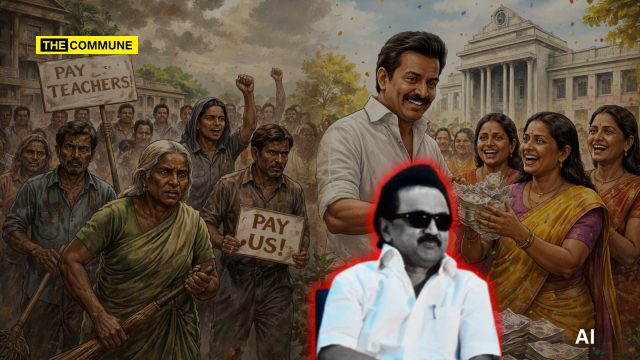
This move to transfer ₹5,000 to over 1 crore women under the Kalaignar Magalir Urimai Thogai scheme is being projected as a landmark welfare gesture. But behind the celebratory messaging lies a deeper and more uncomfortable question: how does a government that pleads financial distress when it comes to paying teachers, sanitation workers, and civic staff suddenly mobilise ₹6,500 crore overnight?
The arithmetic itself is staggering.
With 1.31 crore beneficiaries receiving ₹5,000 each, the single-day outflow amounts to roughly ₹6500 crore. This comes even as DMK leaders have repeatedly accused the Union government of withholding funds, including claims that thousands of crores meant for education have not been released.
If the state exchequer is indeed under such strain, critics ask, where did ₹6500 crore materialise from so swiftly?
Welfare Or Election Optics?
The timing of the transfer, bundled as three months’ dues plus a “summer special” incentive, has intensified the perception that the payout is less administrative continuity and more electoral optics.
For nearly 28 months, opposition voices allege, the promised ₹1,000 monthly assistance saw delays, eligibility exclusions, and phased implementation. Now, weeks ahead of elections, a lump-sum disbursal framed as summer season bonanza has appeared.
The question being raised politically is blunt: if this is truly a seasonal grant, “Did summer not come in 2024 and 2025?”
Cash In Hand vs Structural Neglect
The sharper criticism, however, lies in fiscal prioritisation.
Secondary Grade Teachers (SGTs) appointed after June 2009 are paid ₹3,170 less per month than teachers appointed earlier, even though they do the same work, teach the same students, and hold the same qualifications. Over a career, this amounts to more than ₹6.4 lakh stolen from each teacher.
By December 2025, thousands of teachers were back on the streets. Demonstrations spread across districts, accusing the government of institutionalising discrimination inside public education. Many teachers are now approaching retirement without ever receiving pay parity.
Around 8,000 contract nurses employed by the government earn less than permanent nurses, lack job security, and are denied full maternity benefits.
Community Health Officers (CHOs) are paid just ₹18,900 per month, less than half of what their counterparts earn in Kerala and Haryana. In December 2025, CHOs marched on Chennai demanding salary parity, maternity leave, and permanent status. They called off their protest after the government acknowledged their demands but offered no timeline.
From pensioners to nurses, from teachers to sanitation workers, Tamil Nadu’s workforce is no longer asking for favours, it is demanding what was promised.
But the DMK government points out to a precarious fiscal situation when asked to fulfil its promises.
Yet, when it comes to a mass cash transfer with electoral visibility, funds appear immediately deployable.
This can be viewed as a “Dravidian Model Scam” where politically marketable welfare is prioritised over systemic workforce welfare.
Revenue Extraction Vs Redistribution
The criticism deepens when viewed against the state’s revenue model.
Households across Tamil Nadu have, over recent years, absorbed increases in:
- Electricity tariffs
- Property tax
- Water/Sewerage charges
- Land registration fees
Add to this the state’s dependence on TASMAC liquor revenue, a policy that has expanded consumption while deepening household financial distress.
What is clearly happening is this – money is first extracted from citizens through taxes and liquor sales, only to be partially redistributed as cash transfers branded as social justice.
Infrastructure & Agricultural Gaps
The fiscal contradiction extends beyond salaries. Farm groups have repeatedly flagged the lack of adequate storage infrastructure to protect produce prices. Cold storage, warehousing, and procurement buffers remain uneven.
At the same time, urban governance complaints, corruption in civic bodies, safety concerns for women and children, and policing gaps, continue to mount.
Against this governance backdrop, a one-time ₹5,000 transfer can only be seen as cosmetic relief rather than structural reform.
This is blatant pre-poll cash cushioning designed to soften anti-incumbency and secure a decisive voting bloc and cash handouts seem to be being used to cover systemic governance deficits.
The Larger Question
At the heart of the debate lies a single fiscal and moral question:
If the state truly lacked funds to settle long-pending dues of teachers, sanitation workers, and civic staff, how did ₹65,500 crore become instantly available for a politically timed transfer?
Subscribe to our channels on Telegram, WhatsApp, and Instagram and get the best stories of the day delivered to you personally.