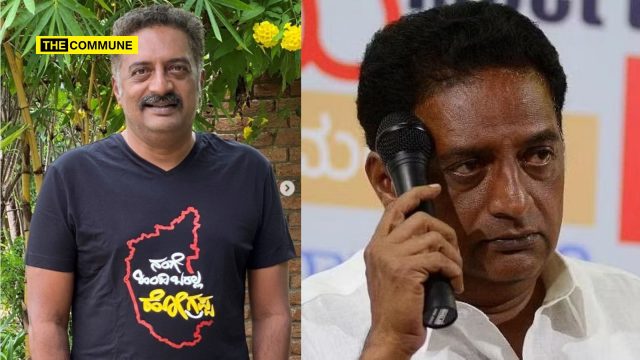
Radical leftist Prakash Raj, often seen playing up to the Dravidianist gallery, is now facing sharp scrutiny after announcing his role in the Hindi film franchise Drishyam 3, with the development being called out as starkly hypocritical given his past public posturing.
On 10 February 2026, Raj took to X to share an update about his latest project, writing: “Started shooting for this engaging franchise #Drishyam3 in hindi. With a wonderful team and a scintillating role to play. Im sure you will love it. ❤️❤️❤️ (and yes im not replacing anyone..).”
Started shooting for this engaging franchise #Drishyam3 in hindi. With a wonderful team and a scintillating role to play . Im sure you will love it . ❤️❤️❤️( and yes im not replacing anyone..) 😛😛😛
— Prakash Raj (@prakashraaj) February 10, 2026
The announcement immediately reignited debate around his earlier activism, particularly his vocal participation in anti-Hindi campaigns that framed the language as culturally and politically oppressive in southern states.
Raj had previously amplified slogans such as “Nange Hindi Baralla, Hogappa” (“I don’t know Hindi, go away”) messaging that ran parallel to the Dravidianist slogan “Hindi Theriyathu Poda.” These campaigns were positioned not merely as linguistic assertion but as political resistance to what was portrayed as Hindi “imposition.”
View this post on Instagram
In 2020, during Hindi Diwas, Raj joined other actors in publicly displaying anti-Hindi slogans on T-shirts, including “Hindi Gothilla” (“I don’t know Hindi”) – visuals that were widely circulated as symbolic protest.
That campaign ecosystem drew ideological energy from similar movements in Tamil Nadu, including those associated with DMK figures such as Kanimozhi, where slogans like “I am Indian, I don’t speak Hindi” were popularised as identity markers.
Raj himself had argued against linguistic uniformity through cultural analogies, invoking coastal cuisine diversity to suggest that imposing one language across India was akin to forcing the same masala into every regional dish.
Yet the optics of the present moment are difficult to ignore.
The same actor who built political capital opposing Hindi’s cultural footprint is now headlining a major Hindi commercial franchise – a space he once rhetorically positioned as emblematic of linguistic dominance.
The contrast has sharpened the charge that his activism was never about linguistic principle but political signalling.
Opposing Hindi in governance, education, and administration while profiting from Hindi cinema reflects selective outrage – resistance when it serves ideological theatre, participation when it serves career advancement. Acting in Drishyam 3 is not multilingual work, which is routine in Indian cinema, but the dissonance between rhetoric and conduct.
Prakash Raj’s film announcement has left people questioning whether anti-Hindi posturing in Dravidianist politics is rooted in genuine linguistic federalism or deployed as a political tool that quietly dissolves when market economics enter the frame.
Subscribe to our channels on Telegram, WhatsApp, and Instagram and get the best stories of the day delivered to you personally.