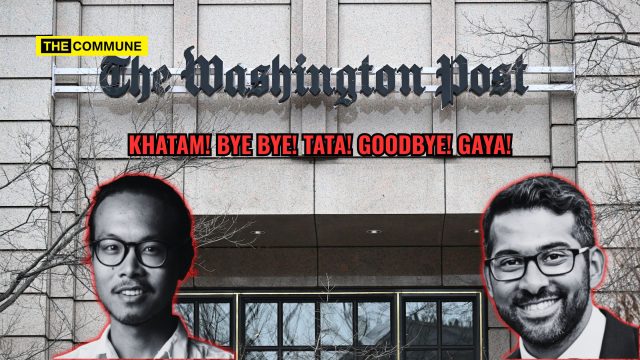
In a dramatic purge at one of America’s most influential newspapers, the Washington Post has terminated its entire India bureau and several foreign desks, dismissing over 300 staff in a brutal restructuring move announced via Zoom by owner Jeff Bezos. Among the high-profile casualties are reporters whose work has been repeatedly flagged by Indian analysts as constituting a sustained, malicious campaign to defame India’s economic rise, political sovereignty, and global standing.
Executive Editor Matt Murray described the move as a structural reset driven by technological shifts and audience changes.
Those laid off included Pranshu Verma, Gerry Shih, Ishaan Tharoor (Congress MP Shashi Tharoor’s son).
India Bureau Chief Among Those Laid Off
Among the prominent exits is Pranshu Verma, the newspaper’s India Bureau Chief. During his tenure, Verma reported extensively on India’s big business houses and billionaire wealth, India’s oil trade with Russia amid the Ukraine war, deportation drives involving illegal Bangladeshi immigrants, and tech regulation and digital governance in India.
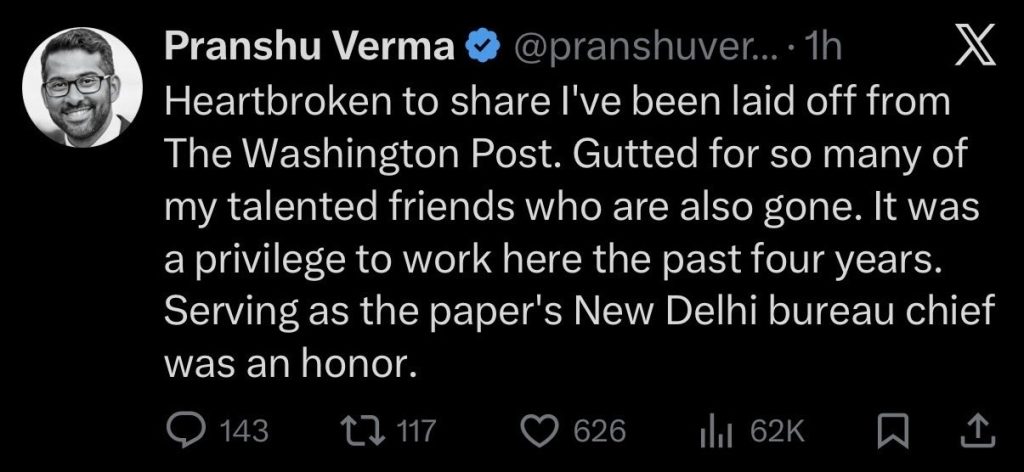
In a post on X, he wrote, “Heartbroken to share I’ve been laid off from The Washington Post. Gutted for so many of my talented friends who are also gone. It was a privilege to work here the past four years. Serving as the paper’s New Delhi bureau chief was an honor.”
It is noteworthy that a few days ago, he literally begged Jeff Bezos to exclude him from the layoffs. On 27 January 2026, he wrote, “.@JeffBezos since I came to India early last summer to be the The Post’s India bureau chief, one thing was abundantly clear: in India’s media ecosystem very few outlets can do accountability reporting without fear of government censure. The Post is one of them. Since August, we showed the ways Indian billionaires got treated far better than others; the role of Indian conglomerates in fueling Russia’s war in Ukraine; India’s draconian deportation campaign of Muslims to Bangladesh and stories unpacking the breakdown in diplomatic relations between Washington and New Delhi. We in New Delhi want to keep doing our jobs so The Post readers can understand the South Asia region better — a wish we hope you share.”
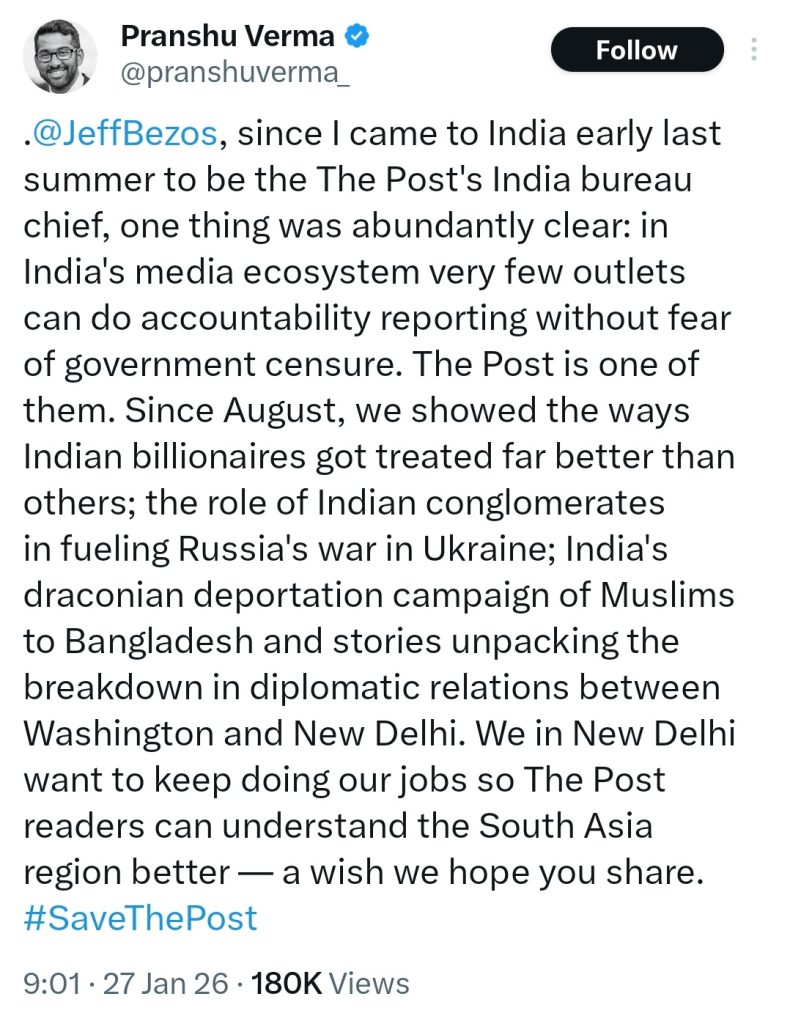
This admission lays bare the transactional nature of his journalism: his value to the Washington Post was his willingness to craft narratives that serve a geopolitical agenda hostile to India’s interests.
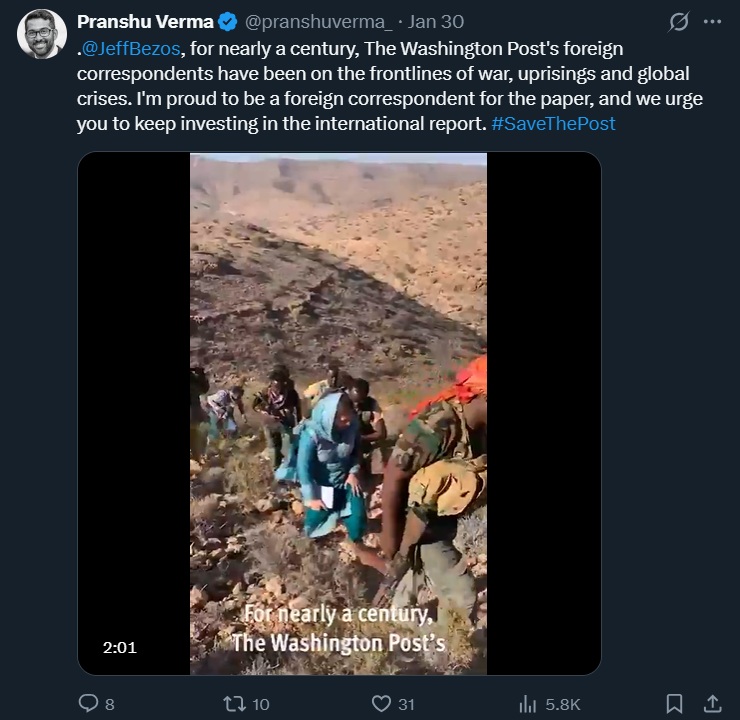
He kept tagging Jeff Bezos in every report he was sharing as if to say he was worthy of retaining.
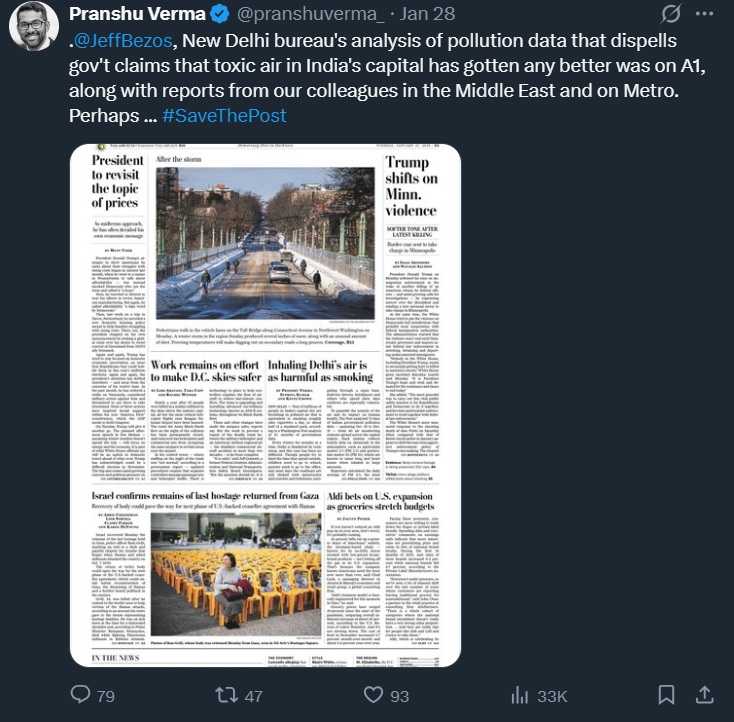
An analysis of the output from these journalists reveals a clear, disturbing pattern. Every Washington Post finalist in the 2024 Pulitzer Prize International Reporting category focused exclusively on negative stories about India. The series, co-authored by Verma and Shih, included reports accusing the Indian government of “undermining democracy,” allegedly “inflaming” social media, and “taming Twitter.” Verma’s recent article attempting to link the Adani Group and India’s state-owned LIC to unsubstantiated malfeasance is seen as the latest chapter in this orchestrated narrative.
Gerry Shih’s Reporting Also Under Spotlight
Washington Post journalist Gerry Shih, who previously served as China correspondent and later took senior editorial roles linked to India coverage, has also been at the centre of criticism from Indian strategic commentators.
His work has included reports on ‘religious polarisation, digital censorship allegations, online nationalism and political mobilisation.
This is Gerry Shih, the Washington Post reporter who is spreading Canadian propaganda against India
Can you identify the Indian journalist in the background of his bio?
Now you know what the real agendas are… pic.twitter.com/zLCla4mbtd
— Abhishek (@AbhishBanerj) October 16, 2024
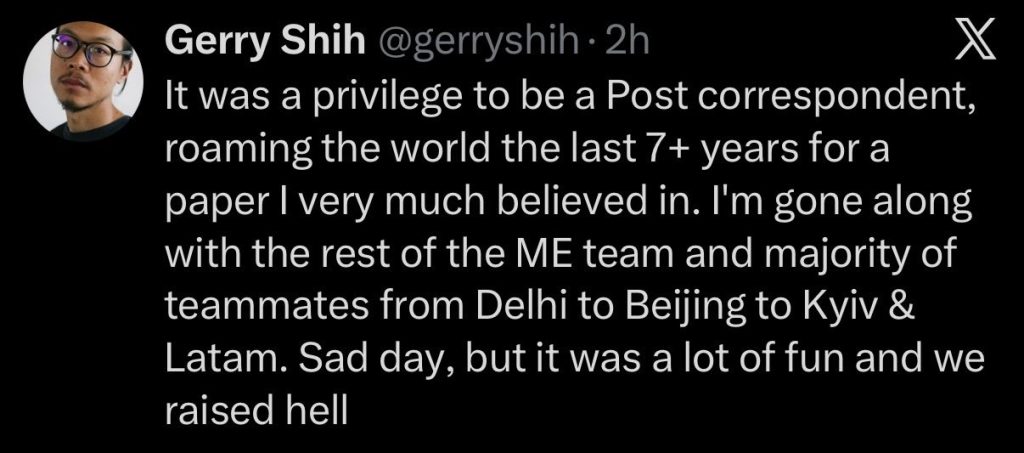
While such reporting earned international recognition and award nominations, critics in India, including former diplomats and intelligence officials, argued that it reflected a recurring negative framing of India’s democracy and social fabric.
The layoffs also claimed Ishaan Tharoor, son of Congress MP Shashi Tharoor, known for his ideological leanings.
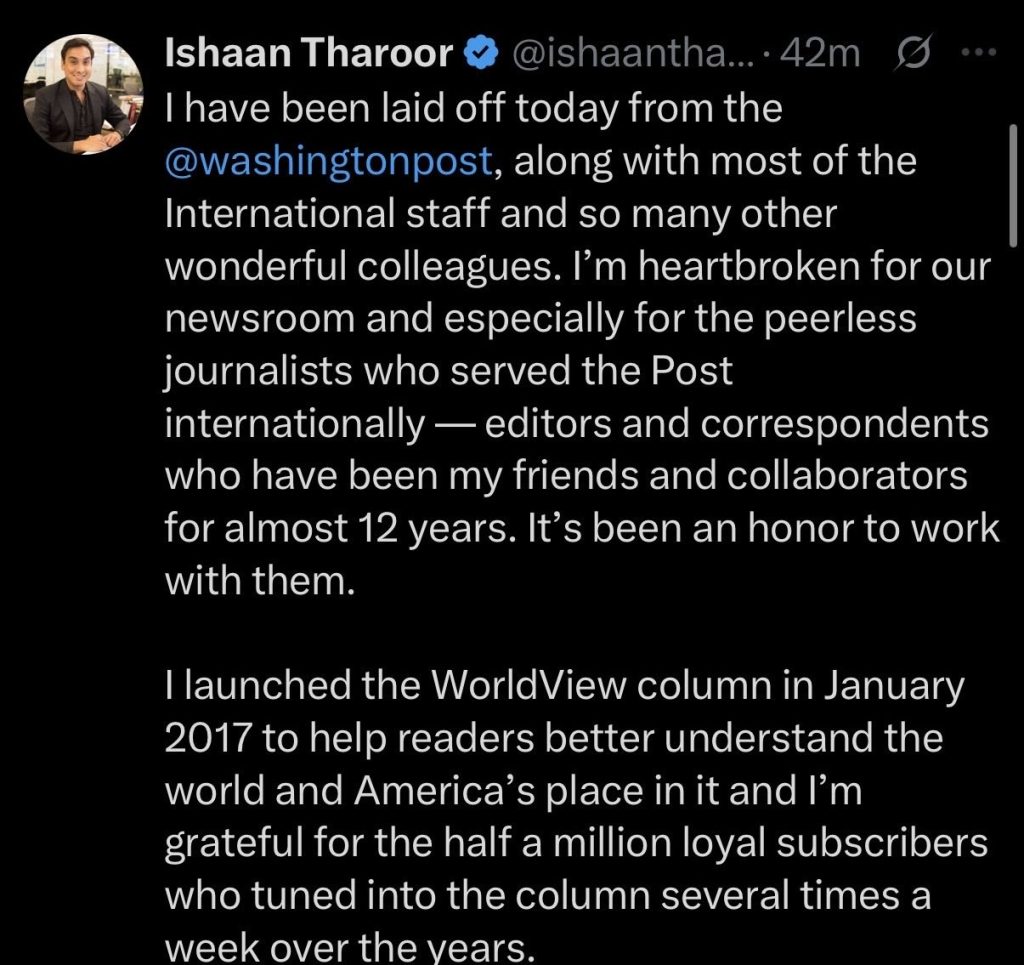
Here is a look at how Tharoor backed Islamo-fascist NYC Mayor Zohran Mamdani.
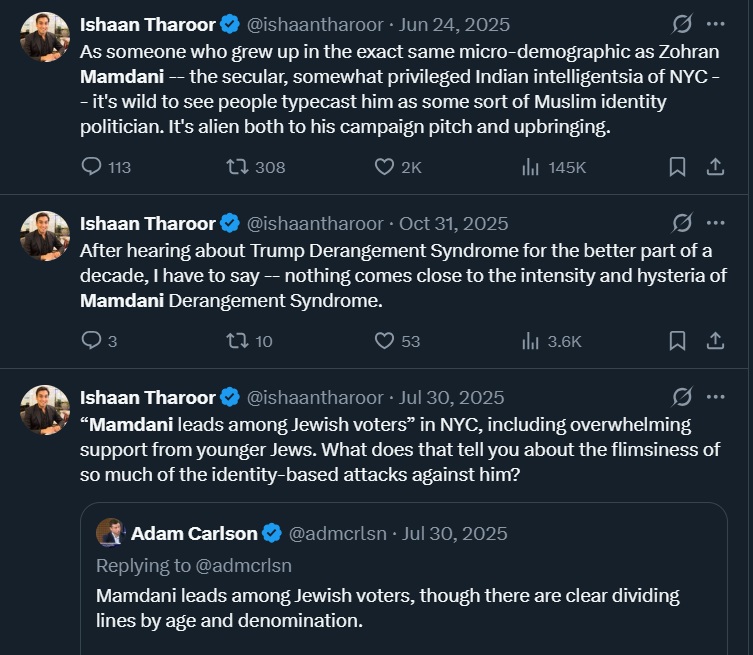
Beyond the blatant bigotry and Islamophobia, it’s lazy and dishonest to associate Mamdani — the child of secular left-leaning intellectuals — with any religious political tradition. https://t.co/hILbhSPZDU
— Ishaan Tharoor (@ishaantharoor) October 23, 2025
Claire Parker, another reporter focused on biased coverage of Kashmir and domestic Indian affairs.
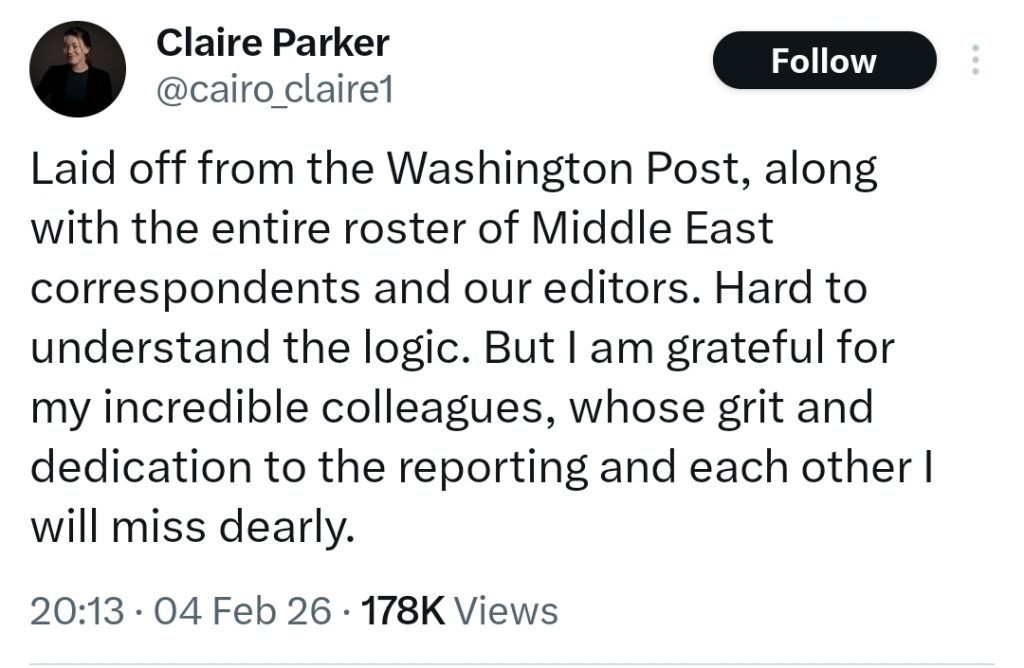
Parker wrote against India, especially on the Kashmir issue, and supported the Hijab issue.
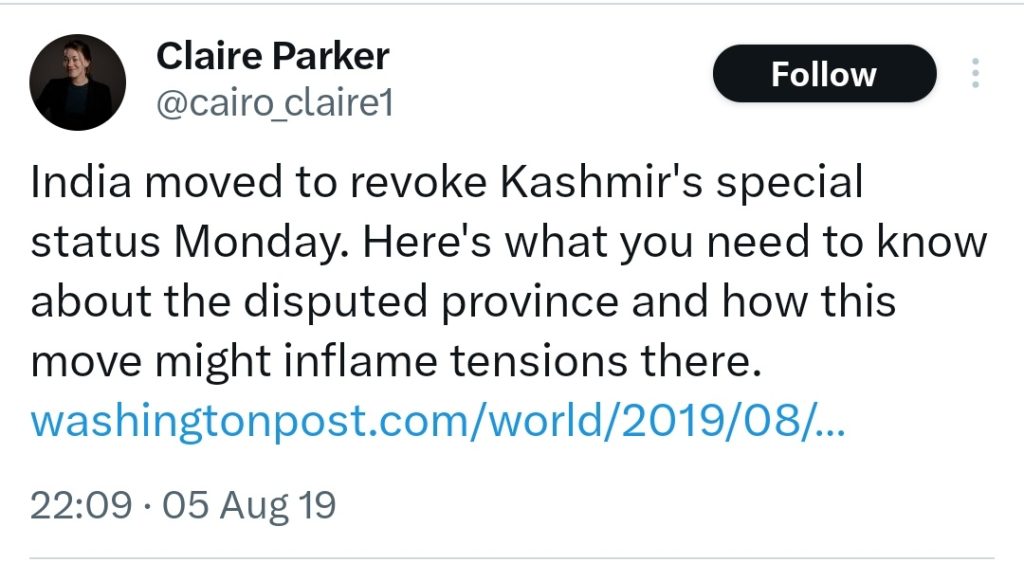
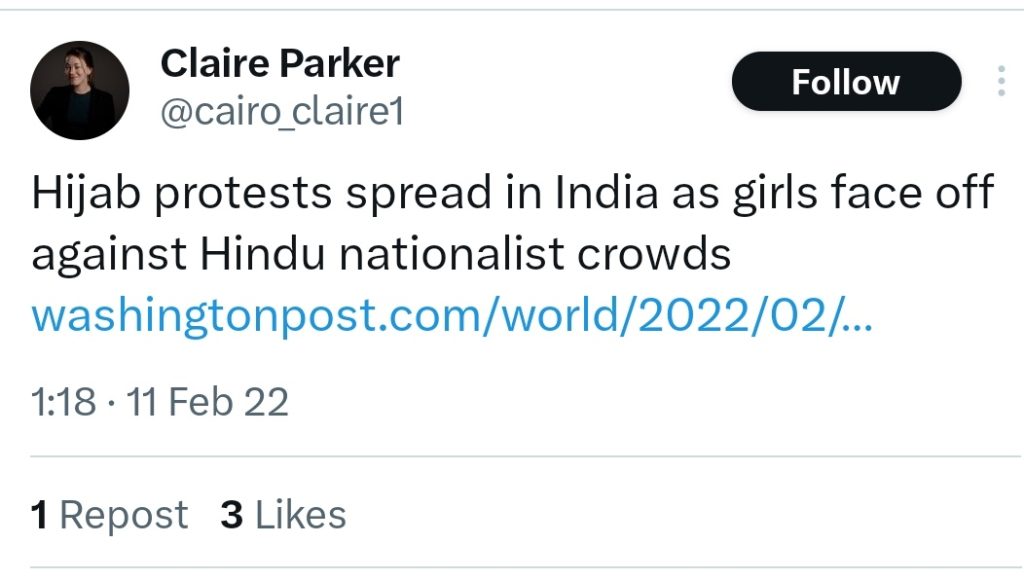
The body of work of these laid-off journalists is not coincidental criticism but as a soft-power warfare toolkit. The goal is to discredit the Modi government’s democratic mandate, instill doubt about India’s economic institutions like LIC and major corporations, and ultimately slow India’s ascent as an independent global power. The Pulitzer recognition for such one-sided reporting is nothing but evidence of a deeply entrenched institutional bias within sections of the Western media-academy complex, for whom a confident, civilizational-state India is an inconvenient truth.
The Fallout and the Future
The mass firings, while reportedly driven by the Post’s financial woes, have inadvertently validated the Indian government’s and public’s long-held skepticism about foreign media outlets. It has demonstrated that the careers of these journalists were inextricably tied to producing a specific, negative genre of India coverage that appealed to their editors and funders abroad.
Subscribe to our channels on Telegram, WhatsApp, and Instagram and get the best stories of the day delivered to you personally.