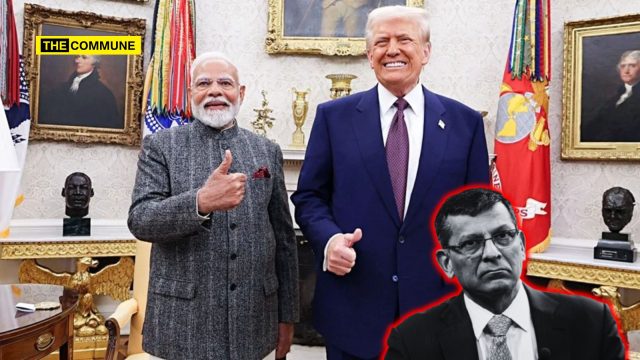
The United States has agreed to sharply reduce tariffs on Indian goods to 18% from the earlier 50%, following a trade understanding announced by US President Donald Trump after a phone conversation with Prime Minister Narendra Modi.
Trump announced the agreement on social media, stating that India would scale back purchases of Russian oil and lower trade and non-trade barriers, while increasing imports of American energy and other products. Modi welcomed the development, stating that reduced tariffs on Indian goods would benefit both economies and deepen cooperation between the world’s two largest democracies.
Prime Minister Modi also posted on his X handle stating, “Wonderful to speak with my dear friend President Trump today. Delighted that Made in India products will now have a reduced tariff of 18%. Big thanks to President Trump on behalf of the 1.4 billion people of India for this wonderful announcement. When two large economies and the world’s largest democracies work together, it benefits our people and unlocks immense opportunities for mutually beneficial cooperation. President Trump’s leadership is vital for global peace, stability, and prosperity. India fully supports his efforts for peace. I look forward to working closely with him to take our partnership to unprecedented heights.”
Wonderful to speak with my dear friend President Trump today. Delighted that Made in India products will now have a reduced tariff of 18%. Big thanks to President Trump on behalf of the 1.4 billion people of India for this wonderful announcement.
When two large economies and the…
— Narendra Modi (@narendramodi) February 2, 2026
With the revised rate, India now faces one of the lowest tariff regimes among major Asian economies trading with the US. Countries such as Pakistan, Bangladesh, Vietnam, Malaysia and Thailand continue to face tariffs ranging from 19-20%, while China remains subject to duties as high as 37%. Several countries, including Brazil and South Africa, continue to face even steeper tariffs.
The announcement comes months after comments by former Reserve Bank of India Governor Raghuram Rajan sparked debate online.
In November 2025, at a discussion conducted by The Chicago Council on Global Affairs, Raghuram Rajan reignited debate over India’s trade relationship and trust deficit with the United States, citing the sharp disparity in tariffs imposed by Washington on Indian and Pakistani goods.
Referring to the US decision to levy a 50% tariff on Indian goods while imposing only a 19% tariff on Pakistan, Rajan questioned the nature of the much-publicised personal rapport between Prime Minister Narendra Modi and former US President Donald Trump. “Where is the friendship between Modi and Trump?” he asked.
Rajan said the tariff decision amounted to a betrayal of India’s faith in the US partnership, describing it as “a slap in the face for Modi.” He cautioned that the United States “cannot be trusted,” drawing a historical parallel to the Nixon administration’s support for Pakistan during the 1971 India–Pakistan war.
Highlighting the domestic impact of the tariff regime, Rajan said India’s small and medium enterprises were bearing the brunt of the decision. He argued that smaller firms were unable to survive in a trade environment where large multinational corporations such as Apple received waivers and exemptions.
According to Rajan, the issue extended beyond trade policy to a deeper question of trust between the two countries. He said the sense of disappointment was not limited to economic considerations but reflected broader concerns about the reliability of strategic partnerships.
View this post on Instagram
Once again he made similar comments when he spoke at an academic event in Zurich in December 2025. Rajan had suggested that the Trump administration’s earlier decision to impose a 50% tariff on Indian goods was not primarily linked to India’s purchase of Russian oil.
“Russian oil wasn’t the issue… I think the central issue was more personalities, especially a personality in the White House and how they treated certain comments made by India after Trump claimed credit for stopping a conflict between India and Pakistan… Pakistan played it right…said that it was all because of Trump,” Rajan said, referring to the military standoff between India and Pakistan following the Pahalgam terror attack and India’s subsequent Operation Sindoor.
India had launched Operation Sindoor targeting terror infrastructure in Pakistan, leading to a brief military confrontation before hostilities subsided.
“India tried to argue that the two countries had reached an agreement without Trump … the truth is probably somewhere in between … But the net effect was that India got 50% tariffs, and Pakistan got 19%. I understand that there was some comment about how your leader in Switzerland tried to explain the tariffs to Trump and that didn’t go well… so we don’t know what really happened between India and the US, but hopefully in the longer run sanity prevails on all sides and we all reach reasonable deals,” Rajan said.
He reiterated the point later in the same discussion, stating:
“I don’t think that that was the central issue. I think the central issue was more personalities. And uh especially a personality in the White House and how they treated certain comments uh made by India after uh you know, um Mr. Trump claimed credit for stopping a conflict between India and Pakistan. Pakistan played it the right way, said that it was all because of Mr. Trump. India tried to argue that the two countries had reached an agreement without Mr. Trump. Uh the truth is probably somewhere in between, but uh you know, uh net effect was India got uh 50 tariffs, Pakistan got 19.”
🚨 REPORTER : India got 50% tariffs for buying Russian oil.
RAGHURAM RAJAN : “Russian oil wasn’t the issue. Pakistan credited Trump for the ceasefire, India didn’t. Pakistan has a 19% tariff, India 50%”
India chose National Interest and didn’t bend 🔥pic.twitter.com/1vhipIVBFb
— News Algebra (@NewsAlgebraIND) December 8, 2025
According to a Reuters report, the US decision involves rescinding an additional 25% punitive duty imposed earlier over India’s Russian oil imports, which had been levied on top of a reciprocal tariff. However, key aspects of the agreement remain unclear, including timelines, enforcement mechanisms, and the scope of India’s commitments on energy purchases and market access.
Subscribe to our channels on WhatsApp, Telegram, Instagram and YouTube to get the best stories of the day delivered to you personally.