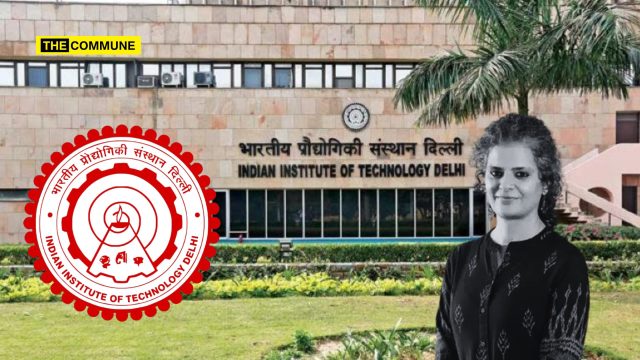
Following the controversial woke caste conference conducted by IIT Delhi’s Humanities department, scrunity has increased on the institution even further.
This time, a paper published in 2023 is under focus. The paper in question is an academic paper authored by a faculty member associated with its humanities stream, which characterises Indian nationalism in Kashmir as “tyrannical” and interprets India’s presence in the region through metaphors of violence, domination, and coercion.
The paper, titled “Tyranny of Indian Nationalism and Resistance in Kashmir: Reading a Kashmiri Narrative with Iqbal and Freud,” was published online in March 2023 in the journal Psychoanalysis, Culture & Society, brought out by Springer Nature.
The paper was authored by Nazia Amin, who was affiliated with IIT Delhi’s Department of Humanities and Social Sciences at the time of publication and is currently listed as an Assistant Professor at BML Munjal University.
IIT Delhi’s Humanities Department is also promoting separatist viewpoints on Kashmir.
“Tyranny of Indian Nationalism in Kashmir”- A Research Paper from IIT Delhi@EduMinOfIndia @dpradhanbjp pic.twitter.com/534DbBmF60
— Harshil (હર્ષિલ) (@MehHarshil) January 26, 2026
Its recent circulation on social media has triggered fresh debate on ideological bias within elite academic institutions and the responsibilities of publicly funded universities when engaging with issues of national sovereignty.
The author employs Freudian psychoanalytic frameworks, most notably the “primal horde” concept to depict the Indian state as a domineering “primal father” figure in Kashmir, allegedly demanding submission and identification from what the paper terms “non-consenting Kashmiri subjects.” Indian nationalism is described as an assimilative force that seeks to extract obedience through coercion, rather than as a constitutional or democratic framework.
Resistance in Kashmir is presented not merely as political opposition but as a psychological and existential rejection of Indian national identity. Drawing on the philosophy of Muhammad Iqbal, the paper frames Kashmiri resistance as an act of “disidentification,” suggesting that Kashmiri identity must remain separate from the Indian national imagination. While the paper briefly raises the possibility that resistance movements themselves may demand conformity, this reflection remains secondary to its sustained critique of Indian state authority.
What is being called out is the paper’s language and framing – it repeatedly deploys terms such as “tyranny,” “violent extraction,” and “mass assimilation,” portraying Indian nationalism as inherently oppressive. Such framing moves beyond scholarly critique into normative advocacy, especially given the absence of balancing perspectives grounded in constitutional law, democratic processes, or national security considerations.
The institutional context has further amplified the controversy. IIT Delhi, a premier institution funded by Indian taxpayers, has in recent years faced criticism over its humanities and social sciences ecosystem, which has increasingly hosted ideologically homogeneous discourse. That said, academic freedom does not negate the obligation to maintain balance and rigour, particularly on subjects as sensitive as Kashmir.
The paper’s resurfacing has also revived scrutiny of a broader pattern within IIT Delhi’s humanities department. Recent controversies include the hosting of the “Critical Philosophy of Caste and Race (CPCR3)” conference, which advanced activist narratives rooted in Western critical theory while offering limited engagement with Indian civilisational or constitutional traditions. The same intellectual environment that enabled CPCR3 also produces scholarship that views Indian nationalism primarily through lenses of oppression and exclusion.
Another major point of contention is the paper’s selective engagement with the Kashmir conflict. It offers minimal discussion of Pakistan-sponsored terrorism, the ethnic cleansing of Kashmiri Pandits, or decades of insurgent violence, instead framing resistance largely as an organic and morally necessary response to Indian nationalism. This omission results in a partial narrative that overlooks geopolitical realities.
The use of Freudian allegories and Iqbal’s philosophical writings to interpret contemporary political conflict has also drawn criticism. While interdisciplinary approaches are common in the humanities, reducing complex constitutional and democratic relationships to psychoanalytic symbolism risks oversimplification. Iqbal’s contested ideological legacy, particularly his influence on the intellectual foundations of Pakistan is another reason the paper’s interpretive choices have raised concern.
Source: Organiser
Subscribe to our channels on Telegram, WhatsApp, and Instagram and get the best stories of the day delivered to you personally.