The DMK government has once again found itself at the centre of controversy over its administration of temples under the Hindu Religious and Charitable Endowments (HR&CE) Department, following allegations of political propaganda at the Palani Murugan temple. The government has been reportedly commercialising temple worship through darshan and prasadam charges and now they seem to have a found a novel way to misuse religion for political messaging.
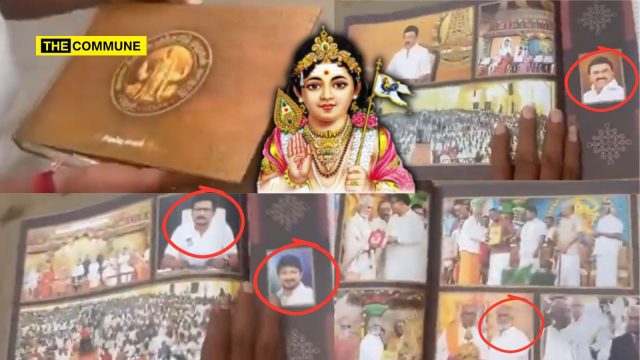
The latest controversy emerged after a devotee stated that a book sold at the Palani Murugan temple, that reportedly details the history of the deity and the temple, contained photographs of senior political leaders instead of purely religious content, raising questions about the role of the HR&CE Department in regulating temple literature.
According to the devotee who visited the Palani Murugan temple, the book was purchased during a recent visit for special darshan. The devotee said he had gone to the temple along with friends and was given a book at a temple office, which staff described as detailing the history of Lord Murugan of Palani. The book was sold for ₹2,700.
However, upon examining the contents, the devotee alleged that the book did not contain only religious or historical material related to the deity. He claimed that instead of the history of the deity and temple, the book carried photographs of the Tamil Nadu Chief Minister MK Stalin, Hindu Religious and Charitable Endowments (HR&CE) Minister PK Sekarbabu and the Deputy Chief Minister Udhayanidhi Stalin who called for eradicating Sanatana Dharma.
The devotee alleged that the inclusion of photographs of political leaders in a book presented as a religious text amounted to political propaganda within a temple setting. He said this had hurt the sentiments of Hindu devotees and accused the ruling Dravidian model government of allowing political messaging in religious spaces.
He further alleged that leaders who publicly profess disbelief in God had their photographs printed specifically in a book related to Lord Murugan, which he described as deeply objectionable. Calling for a wider response, he urged Hindu devotees to condemn the incident and express their opposition to what he described as the politicisation of temple literature.
View this post on Instagram
It is noteworthy that Deputy Chief Minister of TN and DMK scion Udhayanidhi Stalin made a speech on 2 September 2023 at a conference titled Sanathan Abolition Conference, organised by the Tamil Nadu Progressive Writers Artists Association where he said, “… only a few things can be resisted. Some have to be eliminated. In that sense, even Sanathan must be eliminated. We cannot resist mosquito, dengue, coronavirus. They must be eliminated. In that sense, even Sanathana must be eliminated…”
On 20 January 2026, the Madras High Court held that the Tamil phrase “Sanathana Ozhippu” translates to “abolish” and that its ordinary meaning implies the elimination of an existing belief system and its followers. Observing that abolishing Sanathana Dharma would necessarily mean that “the people following Sanathana Dharma should not be there,” the Court concluded that the phrase amounts to “genocide or culturicide.” It ruled that questioning such a speech could not constitute hate speech.
Referring to earlier writ proceedings, the Court noted that the minister’s remarks “spew hate against a particular community, the Hindus and constitutes dis/misinformation.” Rejecting the State’s argument of instigation, the Court termed it “absurd” and held that the minister’s speech, viewed in historical and political context, “would clearly indicate it is totally against 80% Hindus, which come within the mischief of hate speech,” thus ruling that Udhayanidhi Stalin amounts to hate speech.
Subscribe to our channels on Telegram, WhatsApp, and Instagram and get the best stories of the day delivered to you personally.