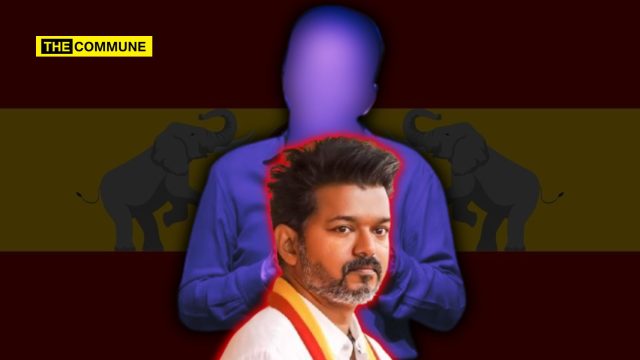
Actor Vijay’s rise to the top of Tamil cinema has been steady rather than meteoric. He did not start as the “star” he is today. His ascent in the entertainment industry resulted from several factors, most notably his transition into the action-comedy genre. By moving away from the staid “romantic family hero” trope, previously the exclusive domain of family audiences, he successfully targeted Tamil Nadu’s growing youth population. He owes his success as much to the demographic transition Tamil Nadu underwent over the past three decades as to the efforts of directors to market him as a larger-than-life icon.
From Cinema Spotlight To Political Dogfight
Vijay’s rise in political circles has been nothing short of meteoric, and this has occurred even before an election has been contested or a single vote cast. Rarely has any Indian state seen such a phenomenon, where a new political entrant stands on the cusp of a tectonic shift. The great MGR was active in politics from the late 1930s before venturing out to set up his own party in the 1970s. Similarly, the “Captain” of Tamil cinema, Vijayakanth, saw a slow and steady entry into politics, reaching his peak in 2011 before eventually fading away.
Among more recent instances, the Aam Aadmi Party (AAP) reached power more rapidly than most. Yet Arvind Kejriwal’s transformation from an award-winning activist to a politician did not happen overnight; it was a calculated, carefully calibrated process that unfolded over years. (It perhaps requires a separate article to discuss why almost all Ramon Magsaysay awardees eventually align against India’s interests or if that alignment is a precondition for the award.)
The closest historical parallel to Vijay is N.T. Rama Rao (NTR) and his sudden formation of a party to win the 1983 election. However, that rise occurred on the back of what was perceived as the abject humiliation of the Telugu people by then-PM Rajiv Gandhi.
The Curious Case Of Being Everyone’s “B-Team”
Vijay’s case is entirely different. His launch has led critics to label him the “B-Team” of the BJP or the “B-Team” of the DMK, depending on the observer’s own camp. Those who call him the DMK’s B-Team argue that he targets only the DMK’s rivals, thereby splitting the anti-incumbency vote. Conversely, those who label him a BJP proxy point to his attempt to usurp the legacy of a particular “bearded feudal playboy” – a figure notorious for foul-mouthing Brahmins and insulting Tamil poets and leaders.
These attempts to brand Vijay’s TVK as a “B-Team” are essentially efforts to identify who is actually funding his political escapade. In doing so, I believe we have missed an angle that, while seemingly outlandish, possesses a more solid logic than any other theory.
The Case Of Mir Jafar And His Financial Architect
To understand my suggestion, one must look at Mir Jafar (1691-1755). His story is the ultimate historical blueprint for how a commander’s personal greed can be leveraged to dismantle a kingdom. While he is often remembered simply as a “traitor,” the mechanics of his betrayal involved a sophisticated financial arrangement between an ambitious general, a colonial corporation, and a powerful banking house.
It is important to remember that his reign marked the starting point for the expansion of British control over the Indian subcontinent. I am not interested in his betrayal of Nawab Siraj-ud-Daulah at the infamous Battle of Plassey itself that was the result. I am interested in the event that preceded it: the collusion and the financial backers who empowered Mir Jafar to do what he did.
The Financial Architect: Jagat Seth
Mir Jafar did not act alone; he was bankrolled by the Jagat Seths, the “Bankers of the World.” This Jain Marwari family was so wealthy they functioned as the central bank of the Mughal Empire’s richest province, Bengal. The Nawab, Siraj-ud-Daulah, had alienated the Seths by reportedly insulting them and demanding a massive contribution of ₹30 million. Consequently, the Jagat Seths effectively “invested” in regime change. They helped Robert Clive bribe Mir Jafar and other disgruntled nobles, viewing the British East India Company (EIC) as a more reliable business partner than the volatile Nawab.
In effect, a business house threatened by an overzealous and greedy ruler fueled a regime change by joining hands with whoever could oust that ruler. To reduce this to a simple matter of “treachery” is an insult to the genius Machiavellian gameplay the Jagat Seths set in motion.
An Example From Independent India: Fueling The Alternative To Congress
It is well-documented that Jawaharlal Nehru’s economic policies did more long-term harm to India than good. The party that grew on the financial support of business houses eventually propagated policies that threatened to ruin those very houses. This created significant opposition within the business community, which began searching for an alternative to the Congress.
The Swatantra Party (1959–1974) remains the most significant historical example of an Indian political movement funded and driven by the business community to protect their interests against state-led economic strangulation. A direct response to Nehru’s “License-Permit Raj,” the party was funded by a coalition of “old money” industrialists, Parsi business titans, and princely families who viewed the state’s growing monopoly as a threat to private enterprise.
The intellectual and financial backbone of the Swatantra Party came from Bombay’s Parsi business community and the Tata Group. JRD Tata was the party’s most notable strategic supporter; he was a vocal critic of Nehru’s statism. In 1961, he famously wrote to Nehru, arguing that a healthy democracy required a strong opposition. He informed Nehru that while the Tata Group would continue to fund the Congress, it would also contribute to the Swatantra Party to ensure “India’s political life develops in a truly democratic way.”
AD Shroff, the ideological architect of the party, co-founded the Forum of Free Enterprise, which served as the intellectual laboratory for the movement. Alongside Homi Mody, a prominent industrialist and banker, he mobilized the banking and insurance sectors (before nationalization) to support the party. Additionally, the party was supported by former royalty, such as Maharani Gayatri Devi of Jaipur, who fought to protect their lands and “Privy Purses” from socialist land reforms.
Lessons And Application To The Current Political Scenario
It is a known fact that business houses prefer to remain apolitical as long as their interests are protected. True business leaders rarely dabble in active politics; they focus on building empires and multi-generational wealth. They want to be seen as “inspirational” or “philanthropic” rather than as political stooges. Many are party-agnostic, contributing to both the incumbent and the principal opposition.
This is a global phenomenon. In the US, companies like Apple and Google fund both Republicans and Democrats. This “hedging” or “double-giving” ensures access and influence regardless of who wins.
However, if a specific party threatens the very existence of their business, these houses will do more than just “fund” an election, they will fund a “regime change,” regardless of whether that regime helped them grow in the past. This is where my view on the funding of Vijay’s political journey fits in.
The Baron & The Business
In the 1970s, a small magazine was published in Tamil Nadu. In the late 1980s, the publication house recruited a family member as a management consultant on a paltry salary. Until the early 1990s, the wife of a former CM of Tamil Nadu served as a Director; evidently, the CM’s family owned the publication. In the late 1990s, when that family was in power, this former consultant was appointed as a Director. Under his leadership, the company turned around, clocking significant turnover. Whether this was due to political patronage, personal astuteness, or both, the result was the meteoric growth of a house that eventually launched television channels.
As the company grew, share realignments occurred. This family member, harboring bigger aspirations, became the principal shareholder and Managing Director, eventually buying out the CM’s family’s stake for ₹100 crores. He then listed the company, which has since become one of the largest media houses in India. It is well known that the ruling CM’s family felt cheated, believing their stake was acquired for what, in hindsight, was a minuscule value.
Over the past twenty years, his wealth has grown unabated to a staggering USD 3 billion. His control over the media and film industry remained rock-solid, until the disgruntled CM’s family decided to replicate his recipe. They launched their own television channel, production house, and distribution network in direct competition. Over the past five years, the family’s control over the media industry has become near-absolute, threatening the Baron’s business itself. This is compounded by the fact that the final bridges with the CM’s family seem to have been burned following a feud involving his own brother.
The Hedge
The Media Baron, the “Connoisseur”, who had the tact to navigate family politics and sideline even a mercurial past CM, knows how the future of his business depends on political outcomes.
Currently, the only way forward seems to be an attempt to gain influence over the ruling dispensation, not with the old ruler, but with a potential new one. This is where we connect the dots. The biggest hedge for the Media Baron is Vijay and the TVK.
Gaining control over large, established players is difficult. Vijay, however, is the “lowest-hanging fruit,” possessing an enormous following and the potential to shape Tamil Nadu politics for decades. They can both feed off each other’s success.
The implication? Much like the Jagat Seth family funding Mir Jafar, or the industrialists who wanted to counter the statist policies of Congress with the Swatantra Party, this Media Baron has every reason to fund a new political dawn through Vijay’s TVK.
Is there a public declaration of support by either of them? No. Is there tangible evidence? No. Is it all conjecture? Perhaps. But the greatest political manoeuvres rarely happen in the spotlight. They happen in the background, until they hit you like a ton of bricks. And they will, in the coming months.
Conclusion
The political stage is set, and the players have taken their positions, but the true script is being written in the quiet darkness by the powerful. History teaches us that when economic survival is at stake, the most significant political shifts are not born of ideology, but of necessity. Whether it is the Jagat Seths securing their fortunes or the titans of industry seeking a voice against monopoly, the “Financial Architect” most likely has always been the silent partner of the “Commander.” In Tamil Nadu, the rise of Vijay and the TVK may appear to be a spontaneous cinematic transition, but beneath the surface, it bears all the hallmarks of a masterfully funded hedge, a calculated strike by a Connoisseur who knows that in the game of power, the most enduring empires are those built before the first vote is even cast.
G Saimukundhan is a Chartered Accountant.
Subscribe to our channels on Telegram, WhatsApp, and Instagram and get the best stories of the day delivered to you personally.