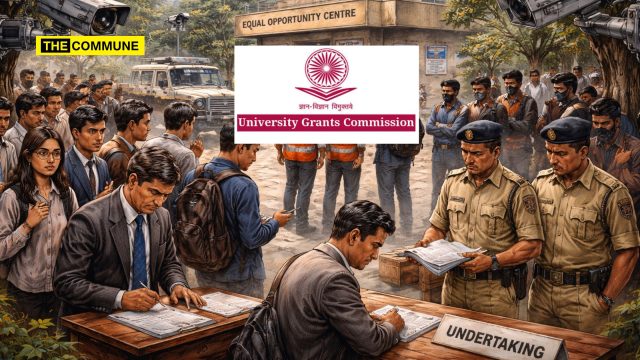
The University Grants Commission has notified the UGC (Promotion of Equity in Higher Education Institutions) Regulations, 2026, triggering sharp criticism that the framework risks chilling campus life and undermining institutional autonomy.
The regulations, published in the Gazette of India on 13 January 2026, are binding on all universities and colleges across the country and replace the 2012 anti-discrimination regulations. They were issued following directions from the Supreme Court to update the regulatory framework in the aftermath of cases such as Rohith Vemula and Payal Tadvi. While the stated objective is to prevent caste and other forms of discrimination in higher education institutions (HEIs), it is noteworthy that the methods adopted are vague, intrusive, and disproportionate.
Key Provisions of the Regulations
Under the new framework, every HEI is required to establish an Equal Opportunity Centre (EOC) and an Equity Committee with representation from Scheduled Castes, Scheduled Tribes, Other Backward Classes, women, and persons with disabilities. Institutions must also constitute mobile “Equity Squads” tasked with maintaining vigilance against discrimination and reporting to the EOC.
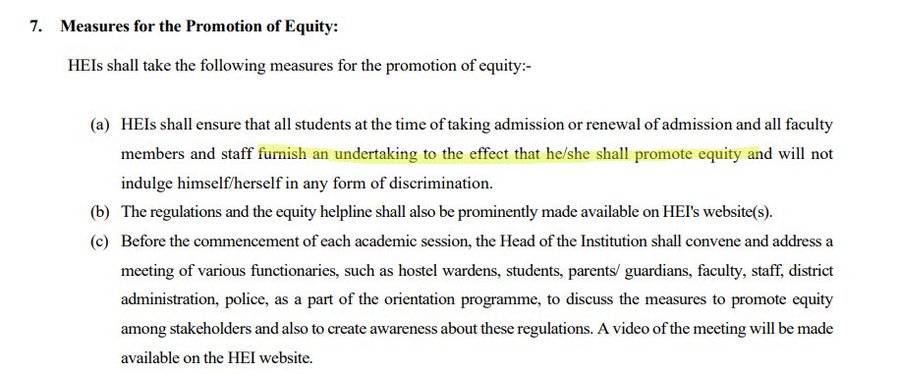
All students, faculty members, and staff are mandated to furnish an undertaking at the time of admission, appointment, or renewal, declaring that they will promote equity and refrain from discrimination. The regulations further require institutions to conduct pre-session orientation meetings involving wardens, parents, district administration, and police, and to maintain equity helplines, awareness campaigns, and counselling mechanisms.
The UGC has also vested itself with sweeping enforcement powers. In cases of non-compliance, institutions may be barred from UGC schemes, prohibited from offering degree, open and distance learning (ODL), or online programmes, and even removed from recognition under Sections 2(f) and 12B of the UGC Act.
Vague Definitions & Scope
Opposition to the regulations has focused on the definitions of “discrimination” and “equity” contained in the gazette. Discrimination is defined to include explicit as well as implicit acts on grounds such as religion, caste, gender, race, disability, or place of birth. The inclusion of “implicit” discrimination renders the term subjective and open-ended, allowing intent to be inferred without clear evidentiary standards.
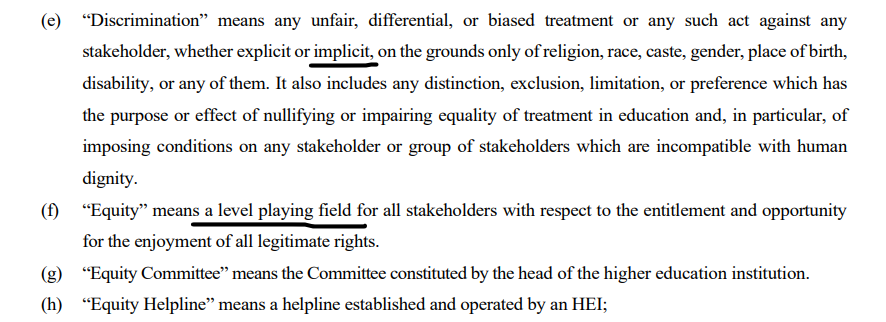
Similarly, “equity” is defined as a “level playing field” for all stakeholders with respect to entitlements and opportunities. One wonders how such a concept would be operationalised, warning that the language borrows heavily from ideological frameworks without laying down objective criteria or safeguards.
Compelled Speech and Surveillance
Clause 7(a), which mandates undertakings from all campus stakeholders to promote equity, has drawn particular criticism. Equity is a contested political concept and that compelling individuals to affirm adherence amounts to ideological compliance rather than behavioural regulation, raising concerns over freedom of thought and expression.
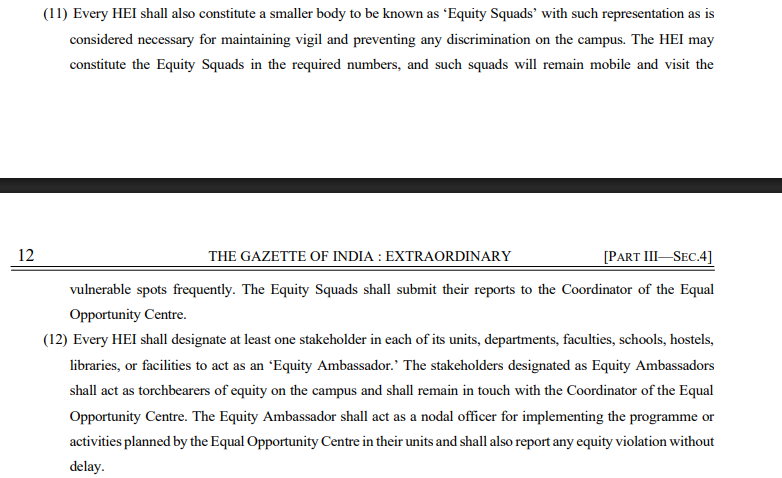
The provisions mandating Equity Squads and designated “Equity Ambassadors” in every department have been described as creating a culture of constant monitoring and peer reporting. Campuses could turn into zones of suspicion, with no clear due-process safeguards outlined for how complaints or reports by these bodies would be assessed.
Another contentious clause requires Equal Opportunity Centres to coordinate with civil society organisations, local media, district administration, police, and non-governmental organisations.
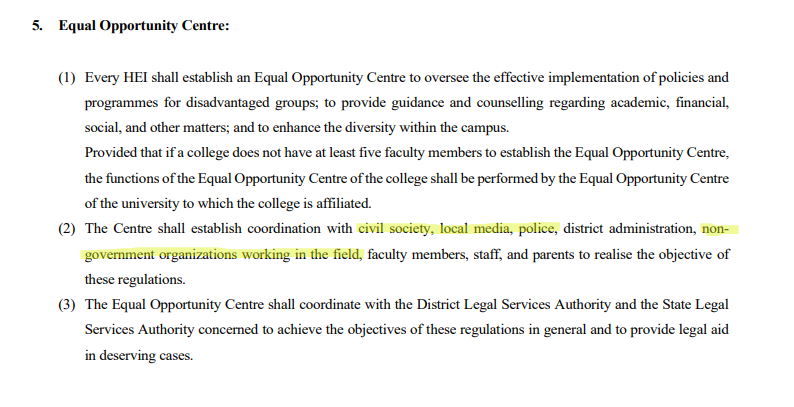
This opens the door for external political actors and law-enforcement agencies to enter academic spaces, eroding the principle of universities as self-regulating knowledge institutions.
The penalty structure under the regulations is also problematic
Even procedural non-compliance could invite severe sanctions, with no graded or proportional penalty mechanism specified. Such powers could be exercised selectively, threatening the very survival of institutions rather than correcting specific lapses.
While the Supreme Court had asked the UGC to strengthen anti-discrimination safeguards, the court did not mandate the expansive definitions, compulsory undertakings, or enforcement mechanisms now introduced. It is argued that the ministry could have drafted a narrower, rights-based framework instead of one centred on compliance and control.
What the hell is happening at the @EduMinOfIndia? @dpradhanbjp
It has released a very problematic, dystopian gazette on 13th January.
This gazette allegedly seeks to remove discrimination at higher education institutions.
1. In this gazette, discrimination is defined as… pic.twitter.com/Cvc6RnHbzo
— Harshil (હર્ષિલ) (@MehHarshil) January 15, 2026
Subscribe to our channels on Telegram, WhatsApp, and Instagram and get the best stories of the day delivered to you personally.