Religious violence is rarely a failure of faith; it is the desperate survival mechanism of a fading monopoly. For centuries, we have been told that intolerance and blasphemy regimes are the result of “radical” theology. History suggests a colder, more structural truth: Religious violence emerges when faith is fused with state power, and it ends only when that fusion is shattered by technology.
Christianity did not become “peaceful” because it rediscovered its scriptures. It was stripped of its teeth by the Industrial Revolution. The printing press put an end to papacy. Today, Islam is entering its own “stress test”, driven not by steam engines and factories, but by the borderless, decentralized power of the Internet.
I. Christianity: Peace Through Disempowerment
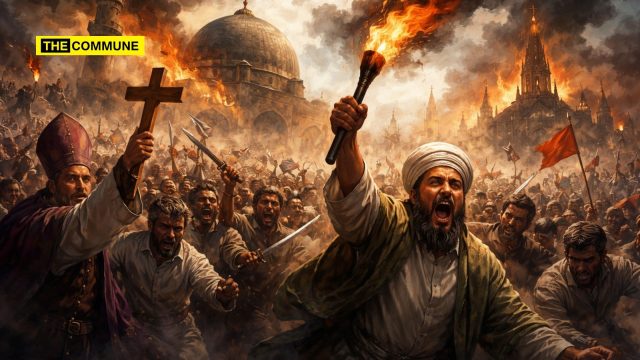
For over a millennium, Christianity was a religion of coercion, expanding not on its theological strength, but on the power of the sword. Once it acquired the Roman state apparatus, it treated dissent as a virus and blasphemy as high treason. The Inquisition, the Crusades, and the burning of heretics were not “misinterpretations” of the Gospel; they were the logical tools of a faith that held a monopoly on the Law.
The Great Emasculation
Christianity’s transition to modern pluralism was not a moral evolution – it was a structural retreat.
- The Westphalian Shift: The state reclaimed the monopoly on violence, turning the Church from a sovereign into a subject.
- The Industrial Catalyst: As the 19th century moved the masses from the parish to the factory, the Church lost its grip on education, social welfare, and the daily survival of the people.
- Scientific Reality: When science replaced scripture as the arbiter of physical truth, the Church’s “absolute” authority was relegated to the realm of personal opinion.
Christianity grew tolerant only when it lost the physical capacity to be intolerant. Its peace is a consequence of its disempowerment.
II. Islam’s Legal Wall
Islam faces a more volatile transition because it is fundamentally Orthopraxic (law-centric) rather than just Orthodoxy-centric (belief-centric). In Islam, the “truth” is not just a theology; it is a legal framework – Sharia. For centuries, this framework was guarded by the Ulama, the clerics, who functioned as the high priests of social and legal order.
Today, that wall is being breached from two directions:
State Realism: In the heart of Sunni Islam, Saudi Arabia is dismantling its religious police and sidelining its clerics. This isn’t a “theological awakening”; it is a cold political pivot. To survive in a post-oil, globalized economy, the state has realized that clerical literalism is an economic liability.
The Digital Siege: The Internet has done to the Ulama what the printing press did to the Papacy; it has destroyed the “black box” of their authority.
III. The Internet: The New Industrial Revolution
The Internet is not just a tool for communication; it is an architecture of disruption. It is doing to Islam what the factory floor did to the 19th-century Church:
- The Death of the Intermediary: When a teenager in Riyadh or Jakarta can access a thousand years of conflicting legal rulings on their smartphone, the local Imam’s “absolute” fatwa becomes just one opinion among many.
- The Rise of “Direct-to-Consumer” Faith: Digital platforms have democratized Ijtihad (legal reasoning). By putting the tools of interpretation into the hands of the laity, the Internet has stripped the clerics of their status as the sole gatekeepers of the Law.
- The Collapse of Fear: Blasphemy laws rely on the isolation of the dissenter. The Internet provides a borderless sanctuary where ideas cannot be executed and dissent cannot be silenced.
I recommend the findings and observations of Gary Bunt, Professor of Islamic Studies, at the University of Wales. In his book, “iMuslims”, he argues that the internet and social media continually impact the presence and place of Islam in the contemporary world. Far from being resistant to digital technology, Muslims around the globe have embraced Facebook, Twitter, and all the other digital suspects that have so massively altered religious communities, interpretations, discourses, and practices. This has its own set of not so peaceful contributions to the society. But it has also demonstrated that you can question without fear, and you’d find yourself among similarly aligned group of people contributing to your inquisitive mind.
IV. Violence As A “Death Rattle”
The “sacred rage” and escalating extremist violence observed today are frequently misread as signs of a religious resurgence; in reality, they are symptoms of a profound systemic collapse. Historically, violence intensifies not when a faith is confident, but when its institutional authority feels its grip slipping. Just as the Inquisition reached its lethal peak while the Church was losing its monopoly on European thought to the printing press, modern blasphemy regimes and radical insurgencies represent the desperate screams of a dying order.
In a borderless digital world, where traditional custodians can no longer enforce compliance through social habit or intellectual isolation, violence becomes a “costly signal” – a brutal attempt to re-establish boundaries through fear because they can no longer be maintained through faith.
This collapse is most visible in the possible “post-theocratic” shifts occurring in places like Iran. The sight of protestors burning hijabs or targeting mosques signifies a total rupture between the citizenry and the clerical class. For many, the mosque has transitioned from a spiritual sanctuary to a symbol of state-enforced monopoly, and the “Maulvies” are viewed not as moral guides, but as agents of an obsolete control mechanism.
As the internet acts as a great secularizer, decentralizing information and exposing the masses to a global market of ideas, the traditional custodians find themselves unable to compete. Their resort to spectacular violence is the ultimate admission of incompetence; it is the final, reflexive lash of a power structure that has lost the intellectual argument and has nothing left but the sword.
They are the last, desperate screams of a monopoly that can no longer enforce compliance through tradition. Violence is the “costly signal” of a dying order trying to re-establish boundaries in a borderless digital world.
Conclusion: The Inevitability Of Choice
Religions do not find “liberal values” in their holy books; they find them when they can no longer afford the alternative.
Christianity was tamed by the laboratory and the factory. Islam is being tamed by the fiber-optic cable and the global marketplace. The transition is uneven, contested, and often bloody, but the structural direction is irreversible. Once a religion loses the power to enforce its law, it must eventually learn to compete in the marketplace of ideas.
Islam is no different.
G Saimukundhan is a Chartered Accountant.
Subscribe to our channels on Telegram, WhatsApp, and Instagram and get the best stories of the day delivered to you personally.