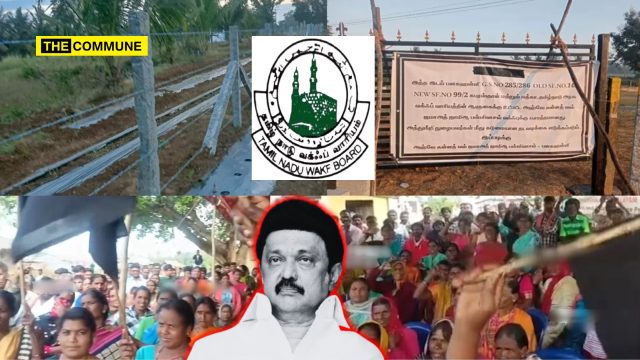
A long-used tribal burial ground in Thalavadi taluk of Erode district has become the centre of a major controversy after the Tamil Nadu Waqf Board fenced off the land, triggering protests, police action, arrests, and an ongoing legal battle.
The burial ground, located between Panagahalli and Palayam villages near the Tamil Nadu-Karnataka border, spans 9.35 acres and has been used by local tribal and village communities for over 200 years. Villagers say the land, classified as government land under Survey No. 99/2, was suddenly brought under Waqf control without inquiry, consultation, or clear demarcation.
Residents say the burial ground has traditionally served more than 3,000 families from both villages. The situation escalated in early December when officials fenced off the entire site with barbed wire, cutting off access to the burial ground and even blocking a long-used public pathway.
“We have been using this burial ground for generations. Now they say it is Waqf land and have sealed it. If someone dies today, there is not even an alternative place to bury the body,” said Rohith, a resident of Thalavadi.
Villagers allege that just days earlier, revenue officials had assured them that the land was government poramboke, prompting them to suspend initial protests. However, on 11 December 2025, over 300 police personnel were deployed and fencing was erected across the entire burial ground.
A signboard at the site now declares that the kabristan and eidgah in Survey No. 99/2 belong to the Panagahalli Ahle Sunnat Jamaat Mosque Waqf, a claim villagers say was never established through a transparent process.
After a joint petition submitted to the Erode District Collector on 12 December 2025 drew no response, a villager named Basavaraj moved the Madras High Court, challenging the Waqf claim and seeking restoration of access to the burial ground.
In his petition, Basavaraj stated that the land has been used as a burial ground since the 1800s, that it is recorded as government land, and that the Waqf Board claimed ownership without producing valid documents or conducting an inquiry. He also alleged that fencing was carried out with police protection, sidelining local objections.
Hearing the matter on 29 December 2025, Justice D Bharatha Chakravarthy directed the Erode District Collector and the Waqf Board Superintendent (Coimbatore) to file responses and adjourned the case to 22 January 2025.
In the interim, the court ordered that if any death occurs in the village, the Thalavadi Tahsildar must be immediately informed and must personally identify a suitable place for burial or cremation, ensuring rites are carried out according to traditional practices.
Protests, Arrests, and Police-Villager Confrontation
Tensions on the ground intensified after protesters allegedly damaged portions of the fencing. Police subsequently summoned seven villagers for inquiry, prompting villagers to accuse the police of arbitrary action.
பழங்குடியின இந்துக்களின் மயானத்தை வக்பு சொத்து எனக்கூறி வேலி அமைத்த காவல்துறை..
ஈரோடு மாவட்டம் தாளவாடியில்… இரண்டாவது நாளாக நீதி கேட்டு பழங்குடியின மக்கள் போராட்டம்..#Erode #HindusGraveYard #WaqfBoard #TNPolice #HinduMunnani pic.twitter.com/2iHy9zkUsy
— Hindu Munnani (@hindumunnani_tn) January 3, 2026
According to local accounts, villagers detained a police inspector in protest, waved black flags, and accused authorities of siding with the Waqf Board without evidence.
Later that night, unidentified persons allegedly broke the fencing again and vandalised CCTV cameras. In response, Thalavadi police arrested seven residents from Panagahalli village around midnight, further escalating tensions.
When police returned to summon additional villagers, residents blocked police vehicles and again detained the inspector, leading to heated arguments. Attempts by revenue officials and police to negotiate failed, and protests continue.
Waqf Board and Officials Defend Move, Villagers Push Back
While the Waqf Board chairman declined to comment, Mujib Khan, Thalavadi Union President of the Tamil Nadu Muslim Munnetra Kazhagam, speaking for the Panagahalli Sunnat Jamaat Mosque, claimed the land was handed over to the Waqf Board in 1956 and alleged villagers were being instigated by encroachers fearing eviction.
Villagers have strongly rejected this claim, insisting they possess documents proving the land is government property and accusing the administration of handing over tribal burial land without justification.
Thalavadi Tahsildar Marimuthu said Survey No. 99/2 appears in the Waqf property register and claimed all documents were examined before fencing was erected. He added that Islamic burials had taken place there and that the site was maintained by the Sunnat Jamaat.
Unresolved Dispute, Rising Political Questions
The dispute remains unresolved as the matter awaits further hearing on January 22, against the backdrop of wider debates over Waqf land claims and the non-implementation of recent Waqf Act amendments in Tamil Nadu.
Villagers have categorically rejected proposals to shift the burial ground to alternative land near forest areas outside the village.
Source: BBC Tamil
Subscribe to our channels on WhatsApp, Telegram, Instagram and YouTube to get the best stories of the day delivered to you personally.