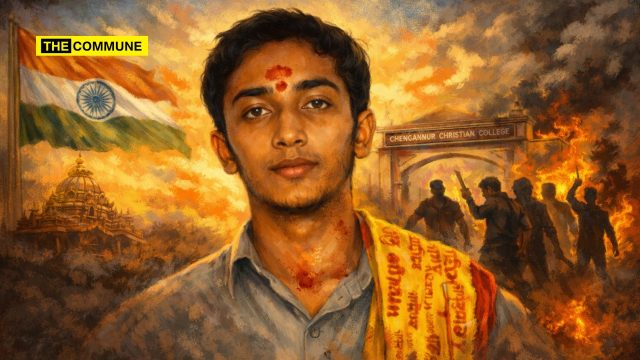
Nearly 13 years after 19-year-old Akhil Bharatiya Vidyarthi Parishad (ABVP) activist Vishal Kumar was stabbed to death in broad daylight on a college campus in Kerala, the criminal justice system has delivered a verdict that has reopened old wounds rather than healed them. It has delivered a verdict that offers neither accountability nor closure. On 30 December 2025, the Additional Sessions Court at Mavelikkara acquitted all 20 adults accused in the 2012 murder, holding that the prosecution had failed to prove its case beyond reasonable doubt.
The judgment, delivered by Judge PP Pooja, does not dispute that Vishal Kumar was murdered. It does not deny the brutality of the attack or the fact that it occurred in a public educational institution. What it ultimately concludes is more unsettling: that after thirteen years of investigation, prosecution, and trial, the State could not legally establish who committed the crime, how it unfolded in evidentiary terms, or how collective criminal liability could be fastened on the accused.
The prosecution has said it will challenge the acquittal in the Kerala High Court. But the judgement itself reads as a post-mortem not merely of a failed case, but of a system that allowed basic investigative lapses to metastasise into irreversible reasonable doubt.
Who Vishal Kumar Was, and Why He Mattered
Vishal Kumar was 19 years old at the time of his death. Born in Saudi Arabia, he completed part of his schooling in the United Kingdom, where his parents had built a stable and comfortable life. Despite this, Vishal insisted on returning to India to continue his education and engage in organisational work linked to the Sangh. His parents initially opposed the decision, but Vishal remained firm, stating that he wished to serve the nation through ideological and organisational work.
He was a first-year BSc student at NSS College, Konni, and had already emerged as a key ABVP organiser in the Chengannur region, serving as the organisation’s Nagar Samiti president. Within a short span, he played a role in strengthening ABVP’s presence, starting new shakhas, and mobilising students. Apart from political activity, Vishal also supported the education of four students from economically weaker backgrounds.
His ideological commitment was strong enough that, by his father’s later admission, Vishal himself reshaped his family’s understanding of the Sangh and its work.
The Murder That Shook a Campus
Vishal Kumar was just 19 when he was attacked on 16 July 2012. On the morning of the incident, student organisations had gathered at Chengannur Christian College in Alappuzha district to welcome first-year undergraduate students. ABVP members, including Vishal, were present as part of that programme. According to the prosecution, the programme was proceeding without incident when a group of men arrived from outside the campus and positioned themselves near the college gate. They allegedly abused ABVP members and made derogatory remarks about Goddess Saraswati. Vishal and other ABVP activists attempted to intervene and defuse the situation.
At that point, the prosecution said, the confrontation escalated suddenly but in a pre-planned manner. The attackers allegedly formed an unlawful assembly and assaulted Vishal and other ABVP members using knives, daggers, and other deadly weapons. Vishal was repeatedly stabbed. Two others, Vishnuprasad and Sreejith, were also injured while trying to resist the attack. Several other ABVP workers were abused and threatened to prevent them from intervening.
The assault took place at around 10.45 AM, outside the college gate, in a politically charged campus atmosphere where numerous students were present.
Vishal’s Medical Struggle and Dying Declaration
Vishal sustained grievous injuries and was first rushed to Chengannur Government Hospital. As his condition deteriorated, he was shifted to Kottayam Medical College Hospital for advanced treatment.
The prosecution placed on record that while Vishal was being taken to the medical college, he told his friend that he had been stabbed by members of the Popular Front of India. This statement was relied upon as a dying declaration—an important piece of evidence reflecting Vishal’s awareness of his attackers even as he fought for life.
Despite medical efforts, Vishal succumbed to his injuries on the night of 17 July 2012.
In criminal law, a dying declaration can carry decisive weight if it is found to be voluntary, clear, and reliable. In this case, while the declaration was part of the prosecution’s narrative, it was not sufficient by itself to overcome the cumulative doubts created by procedural lapses and evidentiary weaknesses identified by the court.
Investigation: From Local Police to Crime Branch
The case was initially registered and investigated by the local police. However, delays in tracing and arresting the accused led to the transfer of the investigation to the Crime Branch. A fresh case was registered, and further investigation was carried out.
Eventually, a chargesheet was filed against 20 adult accused and one juvenile. The prosecution alleged that several accused had gone into hiding after the crime and had taken shelter at various locations, including a Popular Front office in Kayamkulam.
The Crime Branch claimed to have recovered weapons allegedly used in the attack from near Karakkad in Chengannur, based on confessional statements made by the accused. Eyewitness testimonies, weapon recoveries, documentary evidence, and the identity card of one accused were cited as links connecting the accused to the crime.
The Organisations and the Political Context
The prosecution maintained that the attackers were members of Campus Front of India (CFI), the student wing of the Popular Front of India (PFI). Campus Front later functioned under the banner of the Confederation of Indian Muslims, which formed part of the broader Popular Front ecosystem.
PFI was banned by the Union government in September 2022 for its alleged involvement in extremist and terrorist activities.
The accused faced charges under Sections 120B, 143, 144, 147, 148, 212, 302, 307, 324, 323, and 342 read with Section 149 of the Indian Penal Code, covering conspiracy, unlawful assembly, murder, attempted murder, and allied offences.
Bail Proceedings and a Long Judicial Journey
In the months following the murder, several accused approached the Kerala High Court seeking bail. Early bail applications were rejected, with the court citing the seriousness of the offences and the stage of investigation.
As the investigation progressed, a shift occurred. Multiple accused were granted bail on grounds of parity, completion of substantial portions of investigation, and absence of apprehension that they would abscond. Stringent conditions were imposed, including restrictions on movement and warnings against influencing witnesses.
One accused, Afsal, was arrested later and was described by the prosecution as the brain behind the incident. While granting him bail, the High Court made strong observations about the misuse of religion for violence, even as it weighed factors like age and pre-trial detention.
Another accused, Sanuj, was later implicated in a separate criminal case in 2022, leading to the cancellation and subsequent regrant of bail with warnings.
Trial, Evidence, and the Acquittal
During the trial, the prosecution examined 55 witnesses and produced 205 documents. The case passed through multiple investigating officers over the years.
On 30 December 2025, the Sessions Court acquitted all 20 adult accused. The judgment identified several critical failures:
First Information in Doubt: The court held that the first information and connected documents appeared antitimed and possibly antedated, weakening the foundation of the case.
Suppressed Genesis: The prosecution was found to have presented a one-sided story while suppressing the broader context of the confrontation.
Eyewitness Improvements: Injured witnesses made later improvements not reflected in early statements, undermining credibility.
No Reliable Test Identification Parade: Several accused were not identified through proper identification procedures, making dock identification unsafe.
Late Motive Claims: Alleged motives such as opposition to “love jihad” were introduced late and not supported by early statements.
Search and Seizure Lapses: Key officers were not examined, and documentation reached court belatedly.
Weak Forensic Corroboration: Blood and material evidence could not conclusively link accused to the crime.
Conspiracy and Harbouring Not Proved: Without a proven core offence, add-on charges could not survive.
What Remains After Thirteen Years
The prosecution has said it will appeal. The High Court will examine whether the trial court’s conclusions were a plausible view of the evidence and whether legal principles were correctly applied.
For Vishal Kumar’s family, however, the verdict marks the end of a thirteen-year wait that offers no closure. The judgment leaves behind an unbearable truth: a 19-year-old student activist was stabbed to death in public, and more than a decade later, the law says nobody can be punished for it.
Not because the crime did not happen but because the State could not prove who did it.
If this verdict is to mean anything beyond one case, it must be read as a warning about what happens when the fundamentals of criminal investigation, prompt recording, reliable identification, disciplined procedure, and consistent prosecution are not secured from the very first day.
Source: OpIndia
Subscribe to our channels on Telegram, WhatsApp, and Instagram and get the best stories of the day delivered to you personally.