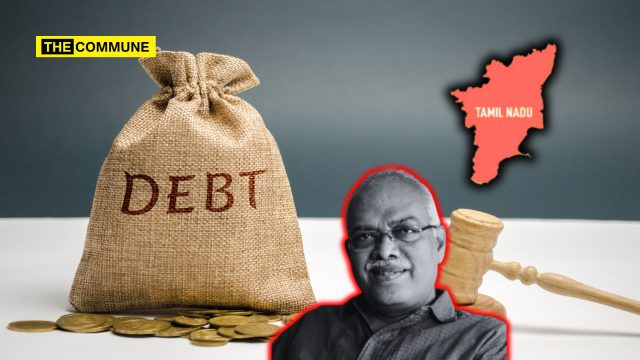
Senior economist and Executive Vice Chairman of the Tamil Nadu State Planning Commission Jeyaranjan has dismissed concerns over the State’s rising debt burden, arguing that government borrowing has no direct connection to ordinary citizens and is part of a routine fiscal process.
In a recent video interview with a YouTube channel, Jeyaranjan responded to repeated questions about Tamil Nadu’s growing loans, including borrowings from institutions such as the World Bank. He questioned the premise itself, saying, “What exactly has to come down? The debt burden? Why should it come down for you? What connection do you have with that? … What connection do I have with it?”
He compared government borrowing to long-term investment, stating that even if a parent had taken a loan, it would not automatically become a problem for the individual. “If your father had taken that loan, or your mother had taken it, even then there is no problem now. … The government borrows. The government is going to repay the loan, right?” he said, adding that political parties in power were irrelevant to repayment. “Today DMK is in power, tomorrow AIADMK may come. Whoever is in power, it does not matter. The government is a separate administration.”
Jeyaranjan explained that the State has continuous income and expenditure, with loan repayments forming one part of regular spending. He said borrowed funds were used for capital projects, noting, “What do they do with that borrowed money? … They construct the Metro and run trains. They buy buses for the PTC. Somewhere they build a dam.” According to him, such loans are repaid over long periods. “You repay it over 30 years… you are taking loans now and making those investments, and you keep paying the repayments for that.”
He also criticised what he described as political messaging around debt, saying, “They say, ‘Tamil Nadu has been brought to a debt trap. Look how much debt they have taken!’ When they say it like that, it registers in people’s minds.” Questioning public anxiety, he asked, “How does it affect you? What is it to you? Is anyone going to catch you by the collar and ask you to pay?”
Addressing limits on borrowing, Jeyaranjan said States could not borrow arbitrarily. “You cannot just borrow as you wish,” he said, explaining that borrowing is linked to the size of the economy and tax revenue. He added that legal provisions cap State borrowing at 3.5% of Gross State Domestic Product (GSDP). “Only up to 3.5% of that GSDP can be borrowed. Beyond that, the RBI will not permit,” he said, stressing that all government income and expenditure must be backed by law.
அவ்வளவு தான் விஷயம்.@DrJeyaranjan Sir has beautifully explained as usual in his trademark style ,
simplyfying in commonmans language.Video courtesy: The Debate. pic.twitter.com/98u6nhTctu
— Dr.Senthilkumar.S (@DrSenthil_MDRD) December 29, 2025
Jeyaranjan’s repeated refrain – “What connection do you have with the debt?” – has triggered sharp backlash precisely because it runs counter to lived economic reality. The assertion that State debt has no bearing on ordinary citizens is being described as not just misleading, but intellectually dishonest.
The truth is that Tamil Nadu’s revenue streams are already stretched thin, with a substantial portion of annual receipts consumed by administrative expenditure, salaries, pensions, interest payments, and welfare schemes. What remains for genuine capital formation – roads, irrigation, dams, public transport, and long-term infrastructure, is limited. When borrowing fills this gap, it is not an abstract accounting exercise; it is a deferred charge imposed on the public.
Debt is not repaid in a vacuum. It is serviced through taxes, user charges, and fee hikes. When borrowings rise, governments inevitably increase electricity tariffs, water charges, milk prices, property taxes, stamp duty, registration costs, and transport fares. In effect, debt functions as a hidden tax on citizens – paid not upfront, but in instalments through rising costs of living.
To suggest that citizens have “no stake” in such loans is to deny this basic fiscal mechanism. A government that takes expensive loans and then executes corrupt or inefficient tenders for road works, dam construction, or urban infrastructure must be questioned. Public borrowing without accountability is not development – it is liability creation.
The argument that “the government will repay the loan, not you” has also been criticised as sophistry. Governments do not generate independent income; they draw revenue from the people. Every rupee repaid, whether today or 30 years later, is repaid from public money. When debt rises, fiscal flexibility shrinks, subsidies are trimmed, and essentials become unaffordable. That is why gas subsidies are cut, power tariffs are raised, and welfare itself comes under strain.
Critics have also pointed out that Tamil Nadu currently runs a revenue deficit of around 1.3% of GSDP, even though the Fiscal Responsibility and Budget Management (FRBM) Act mandates zero revenue deficit or a surplus. This means the State is borrowing not just for capital investment, but to meet day-to-day expenses – a practice widely regarded as fiscally unsound. By contrast, states often caricatured in political discourse, such as Uttar Pradesh, have posted revenue surpluses in recent years.
The manner in which Jeyaranjan dismissed these concerns, by browbeating a young anchor with rhetorical questions rather than offering clear explanations – has further fuelled anger. Observers have questioned how someone, who is not even a regular economics professor at a reputed university, was appointed as Executive Vice Chairman of the State Planning Commission, a body expected to offer rigorous, transparent, and accountable fiscal reasoning.
The controversy has also revived memories of earlier ideological theatrics, such as outrage over the Indian rupee symbol, despite the symbol having been designed by a DMK member, reinforcing the perception that ideology often trumps logic.
At its core, the pushback is simple: when debt rises, taxes rise; when taxes rise, the common man pays. Electricity bills, property tax, fuel costs, and registration charges do not increase by accident. Every citizen, therefore, has not only the right but the obligation to question why loans are taken, how they are spent, and whether they generate real returns.
What citizens expect from the State’s top economic official is not condescension, but clarity. Not rhetorical dismissal, but accountability.
In a democracy, debt is never just a number on paper. It is a claim on the future of its people.
Subscribe to our channels on Telegram, WhatsApp, and Instagram and get the best stories of the day delivered to you personally.