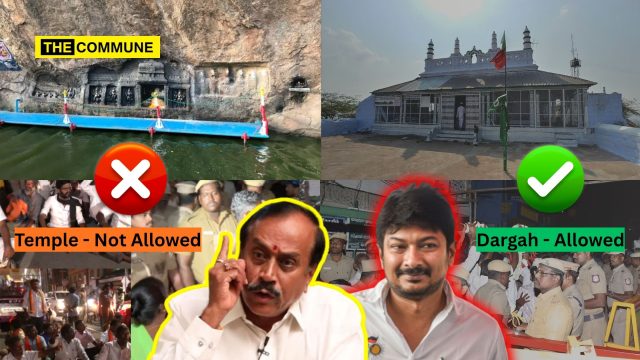
A fresh political and law-and-order flashpoint emerged in Madurai on Wednesday after BJP leader H Raja accused the DMK government of enforcing discriminatory religious restrictions at Thirupparankundram, alleging that Hindus had been barred from worship at the Kasi Vishwanathar Temple for over 20 days while Muslims were granted unrestricted access to the Sikandar Dargah to conduct the Sandhanakoodu festival under full police protection.
View this post on Instagram
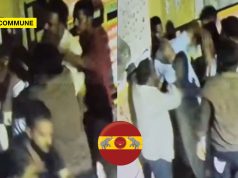
The controversy intensified after police arrested members of the public who had protested against the administration’s decision to permit the Sandhanakoodu event at the hilltop Dargah while denying permission to light the Karthigai Deepam or access Hindu temples on the same hill. The detained protesters were taken to a private marriage hall in Tirunagar, prompting BJP, Hindu Munnani, and other Hindu organisations to gather in large numbers outside the premises.
Speaking at the site, H Raja questioned the police and district administration on the legality and intent behind the restrictions. He asked whether a Chief Minister could claim to represent Hindus if Hindus were prevented from lighting lamps or praying at their own religious sites. He alleged that the Madurai District Administration and the city police had deliberately created what he described as an unnecessary and provocative situation.
Raja stated that he was not unfamiliar with Madurai and recalled visiting and worshipping at the Kasi Vishwanathar Temple on 29 January 2025. He questioned why, if Kandhuri or Sandhanakoodu rituals were permitted at the Dargah, he and other Hindu devotees were being stopped from visiting the Kasi Vishwanathar Temple. He emphasised that he was not seeking any special privilege but was only asserting his right to worship, noting that animal sacrifice had already been prohibited by court order and was not part of his demand.
He further stated that preventing Hindus from worship amounted to overt anti-Hindu conduct and argued that no religion had historically been stopped from practising its rituals by the police. Referring to past legal and historical disputes, he claimed that exclusions and settlements had already been addressed through law and that his present demand was entirely lawful.
Recalling his participation in the Ram Janmabhoomi movement at Ayodhya, Raja said he was not new to protests or public agitation. He stated that repeated suppression of religious practices over long periods had historically resulted in legal and political consequences and warned that current actions were following a similar pattern. He added that idols had been removed and rituals stopped in the past, but that he was now merely seeking to perform worship peacefully.
Raja questioned why he was not even allowed to meet or see those who had been detained, asking publicly whether all of them were safe. He referred to a past incident in another district involving the killing of an individual named Ajith Kumar, alleging police involvement, and asked why families and supporters were being prevented from meeting detainees. He further questioned whether such restrictions would have been imposed if M. K. Stalin himself were visiting the area, recalling that residents had allegedly been confined to their homes during the Chief Minister’s visit to inaugurate a bridge around ten days earlier—an action he described as illegal.
He also questioned the necessity and legality of mass arrests and remand, pointing out that lawyers were among those protesting and asserting that blanket detention was unjustified.
Visuals from the scene showed BJP leaders, Hindu Munnani members, and functionaries of various Hindu organisations assembling outside the marriage hall. Police initially stopped Raja near the Moolakarai area and prevented him from entering Tirunagar, after which he was redirected. Despite the restrictions, Raja later reached the venue. BJP district leaders and South Indian Forward Bloc founder Thirumaran also arrived, with more than 200 people gathering at the site.
According to reporters on the ground, the arrested individuals had been protesting on the basis of a court order permitting the lighting of the Karthigai Deepam at the Deepathoon on the hill, even as the Tamil Nadu government granted multiple permissions for the Sandhanakoodu event at the Dargah. Residents alleged that police demanded Aadhaar cards even from locals attempting to return to their homes in the Kottaivasal area. Despite the subsisting court order, more than 20 women and several men were arrested and confined in the private marriage hall.
Raja questioned why, when permissions had been granted by the government, police, and revenue department for Sandhanakoodu, Hindus were being continuously denied access to the Kasi Vishwanathar Temple, citing the Deepam dispute. He stated that he wanted to visit the temple immediately and asked why police permission was required when the court case related only to lighting the Deepam. He alleged that for over 20 days, devotees had been barred from visiting the temple without any specific judicial prohibition.
Madurai City Police Commissioner Inigo Divyan was present at the location, overseeing extensive security arrangements as Raja engaged in arguments with police officers. Protesters demanded the immediate release of those arrested and insisted that Hindus must be granted the same access to the hilltop temple that Muslims were receiving for Dargah-related rituals. With around 200 people remaining at the site, discussions with police continued amid a tense atmosphere.
Later in the day, speaking to reporters, Raja expanded his criticism to the political leadership of the state. He stated that Hindus had struggled for centuries to secure their religious rights and urged the community not to take extreme steps. He directly targeted Udhayanidhi Stalin, alleging that his past remarks on Sanatana Dharma and Hindu beliefs had made him the principal obstacle for the DMK government.
Raja accused Udhayanidhi of making statements equating Hinduism with diseases and of openly declaring a Christian identity while holding constitutional office. He claimed that such rhetoric amounted to incendiary, anti-Hindu speech and appealed to the Chief Minister to rein in his son, alleging a lack of control within the family, party, and government. He warned that continued mockery of Hindu sentiments, including references to the sacrifice of Poornachandran, would provoke serious backlash from the Hindu community.
He said, “Whether it is Udhayanidhi, or ‘some Nidhi’, or ‘useless Nidhi’—whoever it is, I am saying this openly. He has apparently spoken as if Murugan and Stalin are the same. Be careful. The same Udhayanidhi who said he would destroy Hinduism like dengue and malaria, mosquitoes, that anti-Hindu Udhayanidhi is the real problem. Why? Because what did he say? ‘I am a proud Christian’. You be a proud Christian, why deny Raja to be a proud Hindu? Because of this, Udhayanidhi has become the biggest stumbling block for the Stalin government. It is Udhayanidhi, his openly anti-Hindu, incendiary speeches, that are the reason.
Because of that, I am respectfully requesting the Hon’ble Chief Minister not to let this go too far.”
Pointing to what he described as selective enforcement, Raja noted that while circulars were issued restricting lamp-lighting on the hill, senior members of the DMK leadership, including the Chief Minister and Deputy Chief Minister, had publicly participated in Christmas celebrations in Madurai and Tirunelveli. He stated that celebrating Christmas was not the issue, noting that even the BJP celebrated it annually, but alleged that selectively denying Hindu rituals while permitting others constituted discrimination.
Raja urged the Chief Minister to “come to his senses” and warned that continued opposition to Murugan worship and Hindu practices would invite a political response from Murugan devotees extending beyond the 2026 elections.
During an exchange with police earlier in the day, Raja questioned officers directly on the ground, asking why, if Muslims were allowed to conduct Sandhanakoodu at the Dargah, Hindus were being prevented from visiting and worshipping at the Kasi Vishwanathar Temple. He asserted that he had gathered information before arriving and alleged that police claims of granting permission were contradicted by ground realities.
Subscribe to our channels on WhatsApp, Telegram, Instagram and YouTube to get the best stories of the day delivered to you personally.