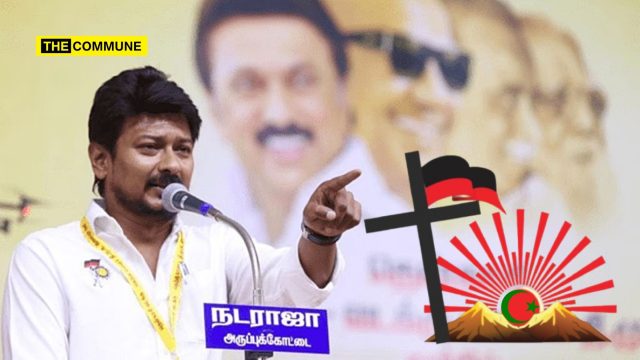
A recent speech by DMK scion Udhayanidhi Stalin at a gathering organised by the party in line with Christmas celebrations, shed light on the range of welfare schemes and financial assistance programmes targeted at various minority communities, especially the Christian and the Muslims.
Let us take a look at all the schemes offered by the DMK government under the Dravidian Model of governance for these minorities.
Christian Community
Educational Scholarships and Student Support
Udhayanidhi Stalin stated in the speech that the state government has provided ₹7 crore in educational scholarships to around one lakh minority students, including Christians, over the past 4.5 years. However, existing documents do not establish this.
In addition, students from families of members of the Christian Priests and Church Employees Welfare Board receive ₹1,000 per month as educational assistance.
Pension and Welfare Board Benefits
The Christian Priests and Church Employees Welfare Board, established in 2022, offers a range of welfare benefits. Old-age pension is provided at ₹1,000 per month. The annual pension amount for church employees who are board members has been enhanced from ₹12,000 to ₹15,000, as mentioned by Udhayanidhi Stalin, however, there is no proof of this increment.
Assistance for natural death has been increased to ₹30,000 as claimed by Udhayanidhi Stalin, while compensation for accidental death goes up to ₹1,00,000. The claim of ₹30,000 is available to landless agricultural workers and not Christians specifically.
The board also provides:
- Educational assistance for children of members (₹1,000–₹1,750 for school students and ₹1,500–₹8,000 for college students depending on the course),
- Marriage assistance (₹3,000 for men and ₹5,000 for women),
- Maternity assistance of ₹6,000 (₹1,000 per month for six months),
- Funeral assistance of ₹5,000, and
- Medical reimbursement of ₹500 for spectacles.
Pilgrimage and Religious Travel
Christian pilgrims are eligible for a ₹37,000 subsidy for pilgrimages to Jerusalem. Nuns and sisters receive enhanced assistance of ₹60,000. The scheme covers 600 pilgrims annually, with 50 seats reserved for nuns and sisters.
Institutional Recognition and Infrastructure
The government has granted permanent recognition to all minority educational institutions, including Christian institutions. Funding for church renovation has been substantially increased under revised guidelines:
- Churches aged 10–15 years: ₹10 lakh (earlier ₹2 lakh),
- Churches aged 15–20 years: ₹15 lakh (earlier ₹4 lakh),
- Churches over 20 years old: ₹20 lakh (earlier ₹6 lakh).
Currently, 44 churches are undergoing renovation at an estimated cost of ₹3 crore.
Muslim Community
The Muslim community has been the recipient of several welfare measures of the Tamil Nadu government.
Educational Support
After the Union government discontinued pre-matric scholarships for classes 1–8 in 2022–23, the Tamil Nadu government stepped in to provide scholarships to Muslim girl students in classes 1–8 through the Tamil Nadu Waqf Board, benefiting around 1,26,256 students. Minority students are also eligible for educational loans up to ₹5 lakh through cooperative banks.
The Pudhumai Penn scheme, which provides ₹1,000 per month to support girls’ higher education, has been extended to government-aided minority schools, benefiting Muslim girls as well.
Ulema and Religious Worker Welfare Board
The Ulema and Religious Worker Welfare Board, established in 2009 and reconstituted in 2024, covers Aalims, Pesh-Imams, Arabic teachers, Mothinars, Bilals, Mujawars and other mosque and madrasa employees. The board has 14,696 registered members.
Benefits include:
- Accident relief: ₹1,25,000 for death and ₹10,000–₹1,00,000 for disability,
- Natural death assistance: ₹30,000,
- Funeral expenses: ₹5,000,
- Scholarships ranging from ₹1,000 to ₹8,000 depending on course level,
- Marriage assistance: ₹3,000 for men and ₹5,000 for women,
- Maternity assistance: ₹6,000 (₹1,000 per month for six months),
- Old-age pension: ₹1,000 per month,
- Two-wheeler subsidy of ₹25,000 or 50% of the cost, whichever is less.
For 2024–25, ₹78.76 lakh has been allocated to this board.
Ulema Pension Scheme
A separate pension scheme, in place since 1981, provides ₹3,000 per month (enhanced from ₹1,500) to retired Pesh-Imams, Mothinars, Arabic teachers and Mujawars aged 60 and above with 20 years of service, or aged 40 and above with 10 years of service in the case of differently abled beneficiaries. Around 1,461 Ulemas receive this pension, with a 2024–25 allocation of ₹540 lakh.
Pilgrimage Subsidy
For the Haj pilgrimage, the state government provides a ₹25,000 subsidy per first-time pilgrim. In 2025, ₹14.12 crore was allocated to support 5,650 first-time Haj pilgrims.
Muslim Women Aid Societies
The government supports 43 Muslim Women Aid Societies across districts, which assist destitute widows and elderly women. Matching grants of up to ₹20 lakh per society per year are provided. In 2023–24, ₹658.99 lakh was sanctioned for these societies.
Waqf Board and Property Rights
The government has granted 30-year lease permissions to the Waqf Board to promote educational, medical and social initiatives. A Waqf Tribunal has also been established in Madurai to handle disputes related to Waqf properties.
Hindu Community
The DMK government maintains that it has implemented various schemes for the Hindu majority, though these are structured differently from religion-specific minority schemes. The benefits are largely disbursed reportedly based on caste.
In its 2021 election manifesto, the DMK promised ₹1,000 crore for temple renovation. However, actual allocations have been significantly lower. For 2024–25, the state budget earmarked ₹100 crore for the renovation of ancient temples.
Pension/Wedding Benefits
Since assuming office, Chief Minister MK Stalin has rolled out a series of welfare and incentive schemes aimed at temple priests.
In September 2021, he launched an incentive scheme under which 12,959 archakas and bhattachariars were provided a monthly honorarium of ₹1,000.
In January 2022, the Chief Minister unveiled a further set of welfare measures, including marriage assistance with 8-gram gold coins for women and an enhanced pension for retired temple priests.
This was followed in January 2022 by the formal launch of the enhanced pension scheme, which was extended even to retired priests not under the control of the Hindu Religious and Charitable Endowments (HR&CE) Department, benefiting a total of 1,904 retired priests across the State.
In May 2022, the State government issued a standard operating procedure (SOP) for archakas, stating that 60% of the archanai ticket fare collected in temples administered by the HR&CE Department would be paid to priests performing archanai in Tamil, a move announced in the name of promoting Tamil in temple rituals.
Religious Tourism Fund
The 2021 manifesto also promised to support up to one lakh Hindu devotees annually with ₹25,000 per person for pilgrimages to major temples such as Rameswaram, Kasi, Kedarnath, Badrinath and Tirupati. The current status of implementation and disbursement figures for this scheme remain unclear.
The scheme has since been expanded to include Buddhist, Jain and Sikh pilgrims, who receive ₹10,000 each.
Together, these measures reflect the DMK government’s approach to welfare and financial assistance especially towards minority communities, with distinct schemes, allocations and implementation mechanisms tailored to the two main groups.
Subscribe to our channels on WhatsApp, Telegram, Instagram and YouTube to get the best stories of the day delivered to you personally.