An article published by The Wire titled “Modi’s Own Invisible Man: Hiren Joshi’s Rise and Retreat”, authored by Srishti Jaswal on 18 December 2025, reads more like a fiction that relies on gossip, anonymous quotes, off the record statements, rather than a piece of journalism.
The absence of documentary corroboration for a series of serious allegations made against Hiren Joshi, an officer on special duty in the Prime Minister’s Office (PMO), makes it just a gossip column or Jaswal, the author ‘mistakenly’ sent her tabloid (yellow journal) article to The Wire!
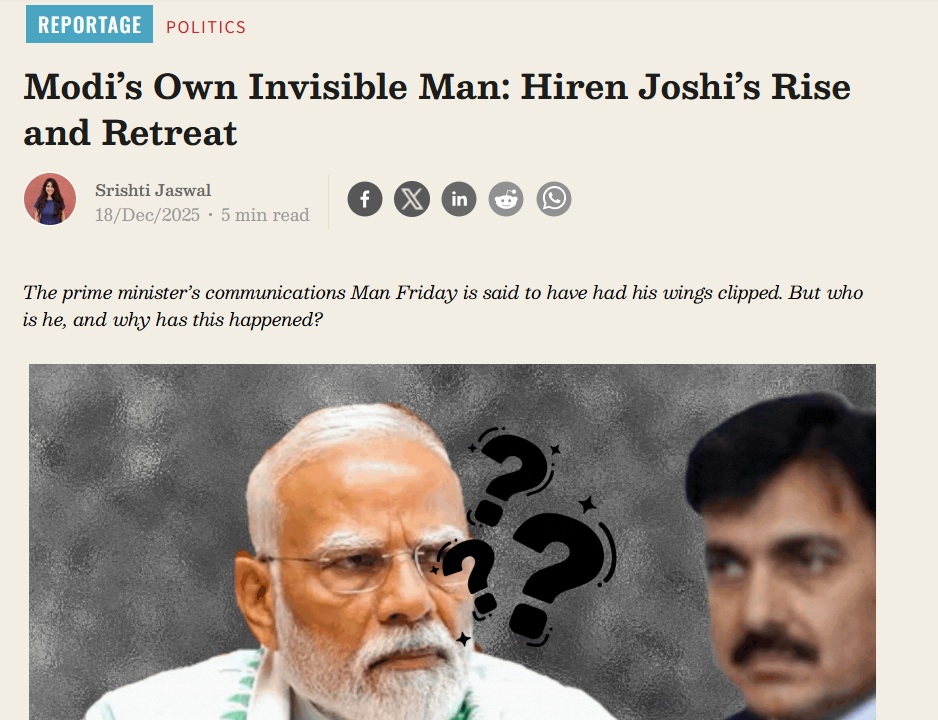
The article constructs a detailed account of Joshi’s alleged rise as a powerful media and digital strategist within the PMO and a subsequent “retreat” or curtailment of influence. However, a closer look at the sources and ‘logic’ of the piece raises concerns about evidentiary standards, narrative framing, and the conflation of verified facts with conjecture.
Heavy Reliance on Anonymous Sources and Political Gossip
A substantial portion of the article’s central claims is attributed to unnamed individuals described variously as a “politician,” “former journalist,” “senior editor,” or “senior political consultant.” These anonymous sources are cited for assertions including that
- “things went south after Operation Sindoor”,
- that Prime Minister Narendra Modi “blamed” Joshi for media handling failures,
- that Joshi was to be sent back to Gujarat or accommodated in the Rajya Sabha,
- that Navneet Sehgal resigned to signal availability for a larger PMO role,
- that jealousy within the PMO drove internal factional conflict,
- and that Joshi orchestrated media narratives around the Tablighi Jamaat episode and the Rhea Chakraborty case.
None of these claims are supported by documentary evidence such as official orders, internal communications, emails, or on-the-record confirmations. Toward the end of the article, the author acknowledges that “someone leaked information…to create pressure” and that Joshi may still be in position, undercutting earlier suggestions that his exit or demotion was imminent. This acknowledgment suggests that large portions of the narrative do rest on speculation rather than verified developments.
Use of Unverified Mahadev App Allegations
The article prominently references unverified viral claims linking Joshi to the Mahadev betting app network, an illegal online gambling operation under investigation by enforcement agencies. While noting that these claims are unverified, the article devotes considerable space to political statements by Congress spokesperson Pawan Khera and to questions raised about alleged proximity between the PMO and unnamed individuals.
No FIR, Enforcement Directorate document, Central Bureau of Investigation reference, financial trail, or official inquiry is cited linking Joshi to the betting app. The article also points out that The Print briefly reported Khera’s allegations before removing the story, suggesting media pressure, but does not consider the alternative explanation that the allegations lacked legal or factual substantiation.
As a result, a serious reputational allegation is introduced and sustained through political rhetoric and social-media chatter without independent verification.
Operation Sindoor and Causal Speculation
The article asserts that Joshi’s alleged decline stemmed from the handling of information during Operation Sindoor and former US President Donald Trump’s claim that he brokered peace between India and Pakistan. This causal link is based entirely on an anonymous political source and is not supported by:
- any internal PMO communication,
- any public assignment of responsibility,
- or any evidence that Joshi formally handled wartime information strategy.
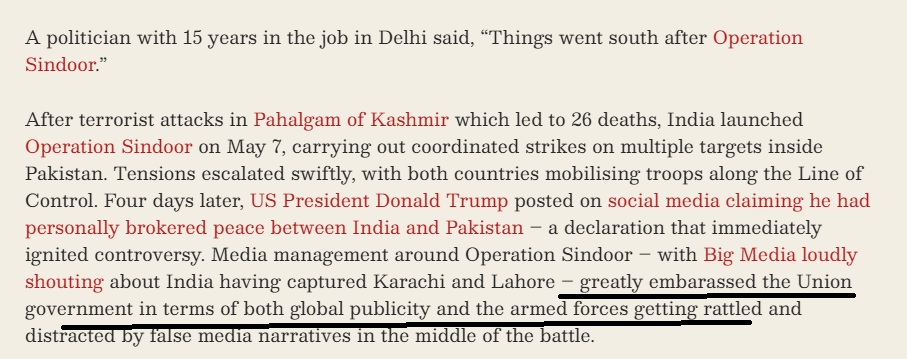
Jaswal, as expected of an India hater, assumes that India and the Modi government were ’embarassed’ by the narrative about the army having captured Karachi and Lahore. Any mildly educated person would know how such narratives help build pressure on the enemy – did it not have any impact on Pakistan during Op Sindoor? Well, Jaswal is clearly sleeping when things escalated and changed the way the enemy responded.
One-Sided Depiction of Alleged Media Control
Jaswal presents a wide-ranging portrait of Joshi as exercising control over television debate agendas, editorial decision-making, BJP IT Cell operations, troll networks, Big Tech personnel decisions, and coverage of sensitive communal and criminal cases.
These claims are primarily attributed to anonymous editors or commentators and to journalist Paranjoy Guha Thakurta – well, we know how credible his information is! To jog your memory, Thakurta’s website had received a gag order for publishing defamatory pieces on Adani. If he can write so on his website, surely he can write in his book too. And for Jaswal to rely on that as gospel truth, speaks more about her intelligence and researching abilities.
The article also does not include countervailing perspectives from editors or journalists who rejected such influence, nor does it present documentary proof such as messages, directives, or instructions. It also does not acknowledge the commercial incentives that drive sensational coverage independently of political influence.
Mixing Verified Facts With Conjecture
The article interweaves established facts, such as Joshi’s role in managing Modi’s social media presence, was OSD; has long‑standing relationships with tech strategists; is mentioned in books by Rajdeep Sardesai and others; that Tavleen Singh couldn’t get him to respond regarding Aatish Taseer with conjectural claims presented in a similar narrative tone. Assertions about dossier-keeping, troll-army control, and responsibility for geopolitical perception failures are not clearly distinguished from documented information, potentially leading readers to conflate speculation with fact.
Thin Sourcing on Military and International Claims
Descriptions of Operation Sindoor, casualty figures, claims of territorial capture, and the impact of Trump’s mediation statements are treated as settled background facts, despite being contested or requiring high evidentiary standards. The article does not cite independent defence sources or official military briefings to substantiate these elements, even as they form a foundation for evaluating Joshi’s alleged failures.
Srishti Jaswal & Her Past
The fact that Jaswal wrote such a piece is not surprising, given her past and her dislike for the non-left and anything Hindu.
In 2020, Srishti Jaswal made an explicitly derisive tweet about Lord Krishna as a “womanizer, fuckboi, commitment phobic maniac”, which led to a complaint and her suspension from Hindustan Times; her later apology insisted it referred to a Netflix character, despite the tweet explicitly invoking Krishna and “I’m a Hindu and I’ve read mythology.”
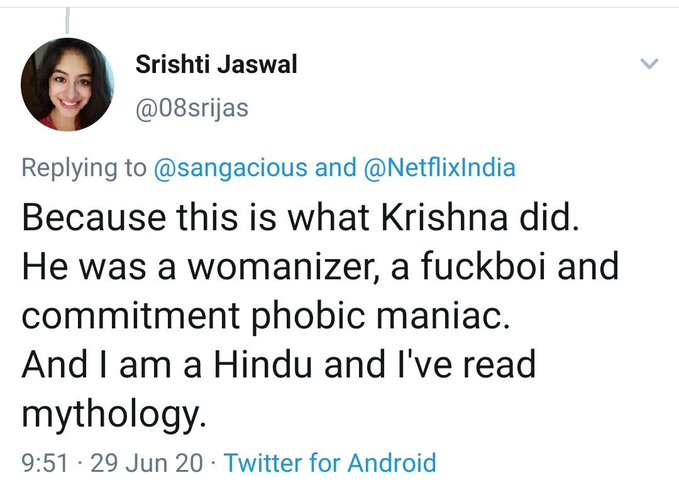
While past controversies do not automatically discredit subsequent reporting, media analysts note that when an article relies heavily on anonymous allegations and strong moral framing, an author’s record of inflammatory commentary becomes relevant to how readers assess tone, balance, and interpretive judgment.
Put together, The Wire article by Srishti Jaswal aggregates publicly available material about Hiren Joshi’s career and influence but blends it with extensive anonymous claims, speculative causation, and ideologically charged framing. The absence of clear demarcation between verified facts, political allegations, and narrative inference raises questions about evidentiary rigor. Combined with the author’s prior record of controversial public statements, the piece has prompted calls for heightened scepticism and demand for documentary proof before accepting its most serious claims.
Subscribe to our channels on WhatsApp, Telegram, Instagram and YouTube to get the best stories of the day delivered to you personally.