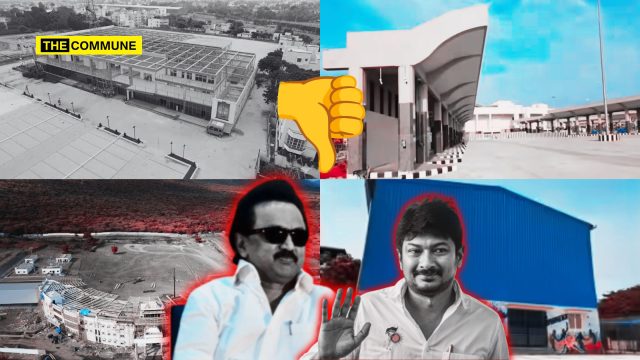
A series of high-budget public infrastructure projects inaugurated by the DMK government over the last two years are facing severe underutilisation, poor occupancy, or complete abandonment raising concerns about planning gaps, stakeholder consultation failures and mounting public expenditure that is not yielding intended outcomes.
From the ₹53.5-crore Kolathur Ornamental Fish Trade Centre to the ₹42-crore Mudichur Omni Bus Terminus, and the ₹50-crore Kalaignar Centenary Bus Terminal (KCBT) at Kilambakkam, several marquee projects have remained deserted or drastically underused months after their inauguration.
The pattern repeats across sectors: food parks, transport hubs, markets, and eco-restoration projects, many of which were showcased as flagship DMK achievements, but today stand as stark reminders of mismatched planning and real-world adoption.
Kolathur Ornamental Fish Trade Centre: 188 Shops, Only Two Operational
Inaugurated by Chief Minister MK Stalin in October 2025, the two-storey Kolathur Ornamental Fish Trade Centre was billed as a modernised hub for Chennai’s thriving aquarium trade. Months later, the complex remains almost entirely deserted, with only two shops functioning — both belonging to State-run fisheries corporations, and neither open on Sundays.
Key details:
- Capacity: 188 shops
- Shops functioning: 2
- Shops with name boards: 6–7
- Second floor: Almost fully vacant
Rent:
- Front-facing shops: ₹70/sq ft (~₹15,000/month + GST)
- Ground-floor interiors: ₹50/sq ft
- Second floor: ₹40/sq ft
Problems cited by the traders include high relocation and setup costs (≈₹80,000 minimum), loss of footfall compared to the iconic West Mada Street market, lack of storage/godown facilities crucial for fish wholesalers, and they also point to a reluctance to move into a “mall-like” structure unsuited to the trade.
As a result, the ₹53.5-crore facility sits largely unused, with families visiting on weekends finding corridors of shuttered shops and empty aisles.
Mudichur Omni Bus Stand: A ₹42-Crore Terminal With Just 15 Buses
The Mudichur Omni Bus Stand, inaugurated in November 2024 and operationalised in December 2024, remains almost completely deserted despite a year of operation.
- Design capacity: 150 buses
- Actual utilisation: ~15 buses (10%)
- Daily private omnibuses needed: ~1,000
- Operators who relocated: None of the major operators
Reasons cited by operators:
- Passengers will not travel to Kilambakkam/Mudichur; demand exists in inner Chennai.
- Poor connectivity, making it impractical for commuters from Ambattur, Anna Nagar, North Chennai.
Business logic: Operators get 10–18 bookings from city locations, but only 3–4 from Kilambakkam.
Historic resistance: It took 20 years for operators to shift from Egmore to Koyambedu.
Court orders ignored: Madras High Court’s February 2024 directive to relocate remains unimplemented.
Despite spending ₹42 crore, the facility manager (RR Agency) maintains the bus stand at a loss, paying staff to run an empty depot.
Police continue to allow illegal loading/unloading in the city, undermining the purpose of relocation.
This bus stand is a fully built but empty terminal – a classic case of infrastructure without stakeholder buy-in.
Kilambakkam KCBT: Operational, But Creates More Problems Than It Solves
The Kalaignar Centenary Bus Terminal (KCBT) was launched as a major decongestion initiative for Chennai, intended to shift long-distance outbound buses away from Koyambedu.
But by 2025, it remains underutilised, inaccessible and poorly designed, according to urban planners, commuters and bus operators.
Key issues:
- Omni bus bays: 77
- Omnibuses departing daily: ~800
Overflow: 723 buses have no place to park; they wait on GST Road, worsening traffic congestion
Distance from city: 25–35 km
Connectivity: No metro link; railway station delayed again to July 2025
Infrastructure problems:
- Limited facilities for disabled passengers
- Poor booking systems
- Traffic gridlock at Perungalathur and Kilambakkam
Experts from CPPR argue the terminal was a politically driven project lacking practical ground assessment. They also recommend allowing Koyambedu and Kilambakkam to operate in parallel until a realistic migration plan is built.
This bus stand is operational but failing – creating new bottlenecks at new places instead of easing traffic burden.
Tholkappia Poonga (Adyar Eco Park): Revamped At ₹42.45 Crore, Now Overrun And Ecologically Compromised
Reopened in October 2025 after extensive “eco-restoration” works, the park intended as a controlled ecological learning space has been transformed, unintentionally into a mass tourism hotspot.
Problems flagged by ecologists and visitors:
- Mangroves uprooted to widen pathways
- Rain trees cut for entrance arches
- Cafes introduced, bringing rodents and litter
- Photography allowed despite restrictions
Visitor explosion: 1,400 people entered on opening weekend despite a 100-person-per-day limit
Elderly visitors complain no battery vehicles despite website claims
What was meant to preserve the Adyar estuary ecosystem is now criticised for ecological damage and mismanagement.
Mega Food Parks In Theni & Tindivanam: Large Spaces, Small Occupancy
Two mega food parks inaugurated virtually by the Chief Minister on 13 October 2025 are witnessing tepid uptake.
Tindivanam Mega Food Park (₹120 crore)
- Land: 157.91 acres
- Factories allotted: 3 units (36 acres)
- Jobs created: 350
- Unallotted land: 55.59 acres + 27.34 acres for new units
Theni Mega Food Park (₹70 crore)
- Land: 123.49 acres
- Factories allotted: 11 units (45 acres)
- Jobs created: 700
- Majority of park still unoccupied
Despite the ribbon-cuttings, utilisation remains below 40%, with large sections awaiting industries.
Jallikattu Stadium: Spectacular Failure Of ₹63 Crores With No Spectators
The Kalaignar Centenary Jallikattu Stadium near Alanganallur in Madurai, inaugurated in early 2024 by Chief Minister MK Stalin at a cost of ₹63 crore, has remained largely underutilized since its opening. Despite its state-of-the-art facilities—including a three-tier seating arrangement for over 4,500 spectators, modern vadivasal for bull release, veterinary hospital, and supporting infrastructure—no Jallikattu events were held there initially, prompting the tourism department to repurpose it for adventure activities like a hot air balloon festival in January 2025 and proposals for zip-lining and other tourism ventures during off-seasons.
Local advocates, including the Jallikattu Peravai, have criticized the lack of regular events, noting that over 60 nearby village traditions could be centralized here for revenue but are not, leading to maintenance concerns and calls for at least three monthly events to justify the investment. While Jallikattu 2026 occurred in traditional venues like Avaniyapuram and Alanganallur grounds as of January 2026, the stadium’s primary purpose appears sidelined.
VOC Park Stadium In Erode: Another Wasted Facility
VOC Park Stadium in Erode, renovated in 2024 at a cost of ₹7.5 crore and inaugurated by Minister Udhayanidhi Stalin, has largely failed to achieve sustained utilization despite its modern upgrades like a new synthetic athletic track. The facility, managed by the Sports Development Authority of Tamil Nadu (SDAT) within the VOC Park complex, was intended to nurture local athletes with features including a 400m track, football ground, basketball, and volleyball courts, yet it mirrors broader patterns of Tamil Nadu’s underused sports infrastructure. No specific reports confirm regular events or high usage post-renovation as of early 2026; instead, the park’s history shows maintenance lapses, such as the closure of its mini-zoo in 2007 due to poor upkeep, raising concerns that the stadium risks becoming another “white elephant” without dedicated programming or community engagement.
A Pattern Of Disconnect
A clear pattern emerges from these projects: massive financial outlays followed by minimal stakeholder buy-in. What was the need for a Jallikattu stadium when there are going to be balloons instead of bulls? Be it bus operators, fish traders, or industries, the intended users have been reluctant to shift, often due to valid concerns over connectivity, cost, and commercial viability that were not adequately addressed in the planning stages.
While the state government completed 31% of 3,350 announced between 2021-2023 finished as of August 2023, the operational success and utilization of these large infrastructure projects remain a significant challenge. The fate of these complexes, whether they will gain momentum or remain white elephants, is a story still unfolding.
Subscribe to our channels on WhatsApp, Telegram, Instagram and YouTube to get the best stories of the day delivered to you personally.