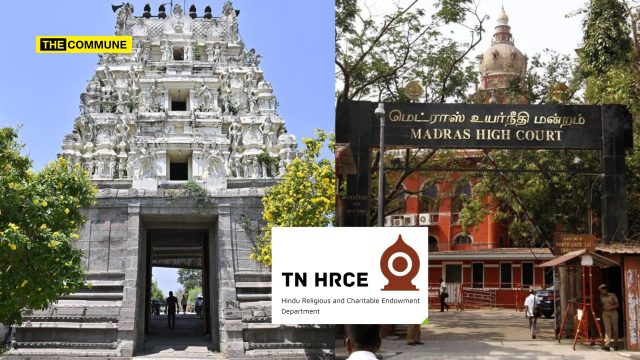
The Madras High Court has held that the Hindu Religious and Charitable Endowment (HR&CE) Department is empowered to inquire into allegations of maladministration in a temple when public donations are involved, even if the temple has not been formally notified as a public religious institution.
A division bench of Justice SM Subramaniam and Justice P Dhanabal delivered the ruling while hearing a writ appeal connected to Arulmigu Vembiamman Thirukovil. The matter arose from a plea filed by the hereditary trustee seeking a direction to the District Collector to consider his representation and restrain private parties, now the appellants, from interfering in the temple’s administration.
While disposing of that petition earlier, the single judge had instructed the appellants not to interfere with the temple’s administration and had also directed the HR&CE Department to examine issues raised and take appropriate action after hearing all sides. The appellants challenged the maintainability of the original writ petition and argued that the single judge travelled beyond the scope of the prayer by issuing directions to the department.
In its judgment, the division bench held that the nature of the temple and its funding placed it within the State’s regulatory ambit. It observed, “When public contributions/donations have been accepted, temple assumes the character of a public institution. If public contributions are involved, State can intervene in case of maladministration or misappropriation of funds, following the procedure as outlined in the Act and Rules, and take necessary actions. Right to administer the temple would not include maladministration. Therefore, power of State is not confined only in respect of notified public religious institutions, since the definition of temple would include temple used as a place of public religious worship and dedicated to, and Joint Commissioner and Deputy Commissioner is empowered to decide issues relating to characteristic of a religious institution.”
The bench noted that the temple stood on Grama Natham land, belonged historically to the villagers, and that the entire village community worshipped the deity and contributed to daily poojas, festivals, and temple functions. This collective participation, the court said, affirmed the temple’s public character.
At the same time, the bench drew a clear line between administrative oversight and religious autonomy. It clarified that while the HR&CE Department can proceed against illegalities, it cannot meddle with rituals or customs, “Therefore, in the event of maladministration, illegality or irregularity in dealing with the properties of the temple, the HR & CE department is bound to step in and initiate all appropriate actions. However, department has no power to interfere with the religious practices or performance of poojas in the temple, which is to be done as per the custom and practice prevailing amongst the villagers and adopted in the temple.”
Responding to the argument that the writ court exceeded its scope, the bench held that Article 226 gives High Courts wide discretion to mould relief depending on circumstances.
The judges observed that the power of judicial review “does not confine itself to the relief sought for” and that courts are empowered to expand the scope of the petition when necessary to address the underlying issues.
Finding no reason to interfere with the earlier order, the bench dismissed the appeal and upheld the directions issued by the single judge, thereby confirming HR&CE’s authority to inquire into maladministration while protecting religious practices from State interference.
Source: LiveLaw
Subscribe to our channels on WhatsApp, Telegram, Instagram and YouTube to get the best stories of the day delivered to you personally.