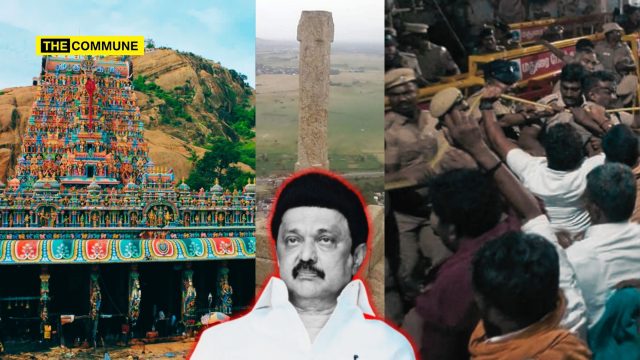
The saga at Thirupparankundram Hill in Madurai represents far more than a dispute over where a lamp should be lit during the Karthigai Deepam festival. It is a textbook case of how a self-proclaimed ‘secular’ government can systematically dismantle constitutional governance, weaponize state machinery against one community and orchestrate defiance of judicial orders in the name of “communal harmony” and “secularism”, all while parading itself as protector of pluralism.
The Court’s Clear Mandate
On 1 December 2025, Justice GR Swaminathan of the Madras High Court issued an unambiguous order: the Karthigai Deepam ritual must be performed at the ancient Deepathoon (stone pillar) atop Thirupparankundram Hill, not at the Uchipillaiyar temple mandapam where the DMK-aligned temple administration had attempted to confine it.
The judge’s reasoning was legally sound and grounded in documented history: a 1923 civil decree affirmed the temple’s title over the hill, upheld subsequently by the Privy Council. Justice Swaminathan observed that the Deepathoon stood on unoccupied temple property, outside the dargah precinct, and that not allowing the lighting would render hollow the ritual rights and heritage-linked property of the temple and its devotees.
Defiance As System
When the temple administration and state officials refused to comply by 3 December 2025, the actual date of Karthigai Deepam, Justice Swaminathan escalated appropriately. He issued a contempt order permitting the petitioner, Rama Ravikumar, to ascend the hill with ten others and light the lamp, directing the Central Industrial Security Force (CISF) attached to the Madurai Bench to provide protection.
This was a judicial acknowledgment that the state’s own police machinery had been compromised by political direction to obstruct a Hindu religious practice mandated by the courts.
The response? The DMK government moved heaven and earth, literally and legislatively, to thwart this order. Madurai District Collector issued a Section 144 prohibitory order under the Criminal Procedure Code (now Section 163 of the Bharatiya Nyaya Sanhita), citing “law and order concerns.” The state filed a letter patent appeal before a Division Bench, alleging that allowing Hindus to perform their ritual would incite communal violence. The HR&CE Department, theoretically responsible for managing Hindu temples, worked openly to prevent compliance with the court order.
When the Division Bench dismissed this appeal on 4 December 2025, finding that the state had “wilfully decided” not to implement the judicial direction, it was scathing in its observation. The judges noted that the state’s appeal appeared to have been filed “as a pre-emptive step” to avoid contempt proceedings rather than to contest factual or legal issues.
Worse still, the court suggested that the prohibitory orders had either been passed beforehand or “manipulated after this Court called for the original file.” In other words: the government was manufacturing orders to justify its predetermined political outcome.indianexpress
The DMK’s Playbook: Minority Appeasement Over Constitutional Duty
Throughout this entire episode, the DMK’s position has been consistent: that permitting Hindus to perform an ancient ritual at a heritage site would somehow endanger “communal harmony” and the “600-year-old mosque” on the hill. This framing is a masterclass in weaponized secularism.
Consider the logical structure of this claim:
The court has ruled the site belongs to the Hindu temple.
The court has ordered a Hindu ritual to be performed there.
The DMK government says allowing this would endanger minorities.
The implicit message is inescapable: Hindu rights must be sacrificed to protect Muslim sensibilities, even when courts have ruled against those Muslim claims. This is not pluralism. This is institutionalized Hindu subjugation masquerading as secular governance.
They claimed they were safeguarding a century-old practice of lighting the lamp at the Uchipillaiyar temple, a practice that, as Justice Swaminathan himself noted, has no historical or religious basis superior to the original Deepathoon location, which has far deeper antiquity and religious significance.
The Contempt Of Democracy
What happened next crystallizes the fundamental assault on democratic governance. Despite a Division Bench judgment, despite a fresh contempt order from Justice Swaminathan, despite CISF personnel being readied to provide protection, the Deepam was not lit at Deepathoon on 3 December 2025. Police continued to prevent devotees from ascending the hill even on 4 December 2025 despite another order by the judge that day. Till the time of publishing this article, nobody is even allowed to go the Kasi Viswanathar temple at the top to pray.
The state then moved the Supreme Court challenging even the Division Bench’s dismissal of its appeal.
This sequence of events demonstrates something unprecedented in independent India’s judicial history: a state government systematically violating not one, not two, but multiple High Court orders to prevent Hindus access to their own heritage and religious practice.
The DMK did not merely appeal; it obstructed implementation while appeals were pending. It did not accept adverse judicial orders; it went to delay and deny the right of Hindus by taking the matter to the Supreme Court. It did not respect judicial authority; it weaponized administrative machinery to circumvent it.
During the hearing, the HR&CE Department is said to have submitted multiple letters from priests to argue that the Deepam ritual cannot be performed on any date other than Karthigai Deepam.
Among the documents was one attributed to Sivasri Pitchai Gurukkal, which claimed that “Sivagamams” prescribe the lighting of the Deepam exclusively on the Karthigai Deepam day.
But once this so-called letter began appearing in the media, Pitchai Gurukkal released a note asserting that he had never made such a statement. He accused the department of misusing his name and position, saying that details he never provided were submitted as if they came from him.
The DMK’s actions have triggered a full-blown constitutional crisis, pitting the executive against the judiciary by deploying the District Collector to misuse Section 163 and sidestep a clear court order. In doing so, the DMK government has not just defied the law — it has blatantly disrespected the judiciary itself.
It has murdered democracy at the Deepathoon for its votebank politics.
And throughout, it framed this contempt as “protecting communal harmony” and blamed external “Hindu outfits” for attempting to “disrupt public unity” and “stoke communal tensions.”
The Anti-Hindu Administrative Machinery
This episode must be understood within the DMK’s broader institutional pattern. The HR&CE Department, which manages Hindu temples across Tamil Nadu, has systematically deprioritized Hindu concerns while granting accommodations to Muslim claims over temple properties.
For a second one wondered if they are HR&CE or MR&CE – as its actions reflect like they’re a fully owned subsidiary of the Waqf Board.
The police administration operates under implicit political direction to prioritize “minority sentiments” over constitutional rights. The bureaucracy coordinates to manufacture legal justifications for political outcomes decided in advance.
The Thirupparankundram episode is not an aberration; it is the system functioning exactly as designed.
When HR&CE Minister P.K. Sekarbabu declared that “people of Thirupparankundram have lived in total harmony,” he was not describing a conflict, he was describing a hierarchy. That hierarchy places Hindu ritual subordinate to Muslim sensibilities, Hindu property claims secondary to Muslim occupation, and Hindu constitutional rights tertiary to electoral calculations about “minority appeasement.”
The same DMK government that never saw a “law and order problem” when Islamist groups consumed non-veg food at the foothills of a sacred Hindu hill, and the very same regime that eagerly razed down temples claiming it was simply obeying court directions, is now suddenly allergic to following a court order that allows Hindus to light a traditional lamp at their own sacred site. The irony couldn’t be more stark: court orders are invoked to demolish temples, but conveniently ignored when they protect Hindu practices.
Judicial Resistance And Its Limits
To the judiciary’s credit, at least the Madras High Court has resisted. Justice Swaminathan’s orders have been consistent, unambiguous, and grounded in law. He has explicitly rejected the temple administration’s claim that allowing the Deepam at Deepathoon would endanger “communal harmony.” He has held that a court cannot allow religious rights to be rendered hollow by executive non-compliance.
He has directed CISF to file detailed reports on the state’s obstruction. As of 5 December 2025, the counsel for the contempt petitioner told the court that despite complying with its December 3 order, police blocked their ascent to the hill, surrounded them with nearly 200 personnel, and detained or arrested several devotees in violation of the court’s directions. Justice GR Swaminathan sought a report from the CISF commandant but deferred the matter to Tuesday, noting that the State’s writ appeals and its SLP before the Supreme Court were already listed for hearing.
But the judiciary’s reach has limits when the executive refuses to cooperate. The DMK government’s strategy is calculated: delay, appeal, obstruct, and rely on the fact that by the time courts exhaust all remedies, the Karthigai Deepam festival season will have passed for another year. The ritual cannot be performed six months later. The government need only hold out until December 25th or so, long enough for the moment to be lost, the political storm to pass, and the narrative to shift.
The DMK is holding democracy and the Constitution in hostage for its votebank politics
The Supreme Court’s Next Move
The Supreme Court now must decide whether Indian federalism permits state governments to systematically violate High Court orders regarding religious practices and minority rights. The political stakes could not be higher. The irony, of course, is bitter: if the “minority” in question were Muslim, Christian, or Sikh, no secular government would dream of using “communal harmony” as justification for preventing them from accessing their religious sites or performing their rituals. The exception carved out for Hindus reveals the hollow core of India’s secular-appeasement apparatus.
DMK: A Party That Is A Menace To People And Constitution
Thirupparankundram is no longer a ritual dispute or an archaeological quibble. It has become the clearest, most alarming demonstration of what happens when a ruling party decides that court orders matter less than its vote-bank arithmetic. It is a referendum on whether “secularism” in Tamil Nadu is still a promise of equal religious rights or a political weapon deployed selectively to keep Hindus in a state of permanent compliance.
The DMK government has delivered its verdict: law is optional, court orders are negotiable, and Hindu rights are expendable. Every action on the hill, from suppressing a lawful religious practice to manipulating prohibitory orders, reveals a regime willing to bulldoze constitutional equality the moment it clashes with its project of minority appeasement.
What the DMK government is doing is systematically hollowing out democracy, wrapped in the language of secularism and executed through a bureaucracy that has forgotten its allegiance to the Constitution.
In the coming days, India’s courts will not merely decide on a lamp at Deepathoon, they will decide whether a state government can openly defy judicial authority, sabotage religious freedoms, and still claim the legitimacy of constitutional rule. If courts do not draw a line now, they may never draw one again.
The Deepam at Thirupparankundram remains unlit. But what should alarm every citizen is this: the DMK has already snuffed out the flame of Hindu constitutional rights and it did so with full political intent and zero accountability.
Vallavaraayan is a political writer.
Subscribe to our channels on WhatsApp, Telegram, Instagram and YouTube to get the best stories of the day delivered to you personally.