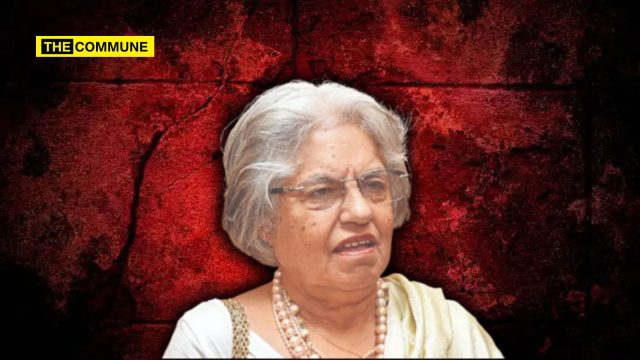
The Supreme Court’s recent decision to acquit Surendra Koli in the last pending Nithari case has not only reopened debate about India’s criminal justice system but also brought renewed focus on one of the case’s most prominent lawyers: senior advocate Indira Jaising.
Jaising, whose midnight intervention in 2014 halted Koli’s execution hours before he was to be hanged, is today being hailed by some as vindicated and criticised by others as part of a broader pattern of intervening in favour of convicts in heinous crimes and terrorism cases. Her legal work, from the Nithari killings and the Yakub Memon hearing to the Nirbhaya controversy and the push to lower the age of consent has become the subject of intense political and ideological contestation.
Nithari: Midnight Stay, and an Acquittal 11 Years Later
On the night of 8 September 2014, as jail authorities in Meerut prepared to hang Surendra Koli, Jaising rushed to the residence of the then Chief Justice–designate H.L. Dattu seeking an urgent stay of execution. A special late-night hearing was convened, and the Supreme Court stayed Koli’s hanging pending a review of his death sentence.
At the time, Koli had been convicted in multiple cases arising out of the Nithari killings in Noida and described as a “serial killer” by the Court itself. Over the next decade, however, the evidentiary foundations of those convictions were gradually dismantled.
In October 2023, the Allahabad High Court acquitted Koli in 12 Nithari cases, finding that his 2007 “confession” was neither voluntary nor reliable and that recoveries of skulls and bones could not be legally linked to him.
On 10 November 2025, ruling on a curative petition in the final case, relating to the murder of a minor girl, the Supreme Court reached a similar conclusion. It held that the same “structural infirmities” infected the confession and recoveries across all Nithari prosecutions and that conflicting outcomes on identical evidence would amount to a “manifest miscarriage of justice”. The Court recalled its own earlier order upholding his conviction and ordered Koli’s acquittal and immediate release.
Reacting to the verdict, Jaising told The Times of India that investigations in the case were “flawed as a whole” and reiterated her long-held position that no execution should take place until every legal remedy, including curative review has been fully exhausted.
Yakub Memon: The 3 AM Hearing
Less than a year after the Koli stay, Jaising appeared again in a dramatic late-night death penalty matter’ this time in the 2015 case of Yakub Memon, convicted in the 1993 Mumbai serial blasts.
On the night of 29-30 July 2015, as Memon’s execution approached, a group of senior lawyers including Indira Jaising, Prashant Bhushan, Anand Grover and Vrinda Grover went to the Chief Justice’s residence seeking an urgent hearing. A three-judge bench of the Supreme Court assembled around 3:20 AM to hear their plea that Memon be granted 14 days after the rejection of his mercy petition before any execution, in line with earlier precedent.
The bench ultimately rejected the plea around dawn, and Memon was hanged later that morning as scheduled. Still, the intervention reinforced Jaising’s public image as one of the country’s most visible and persistent death-penalty opponents.
Nirbhaya: “Forgive the Rapists” Tweet Sparks Outrage
In January 2020, as the four men convicted in the 2012 Delhi gang-rape and murder (the Nirbhaya case) came close to execution, Jaising again courted controversy; this time outside the courtroom.
In a publicly shared tweet, she said she fully identified with the pain of Nirbhaya’s mother, Asha Devi, but urged her to “follow the example of Sonia Gandhi who forgave Nalini and said she didn’t want the death penalty for her,” adding that “we are with you but against the death penalty.”
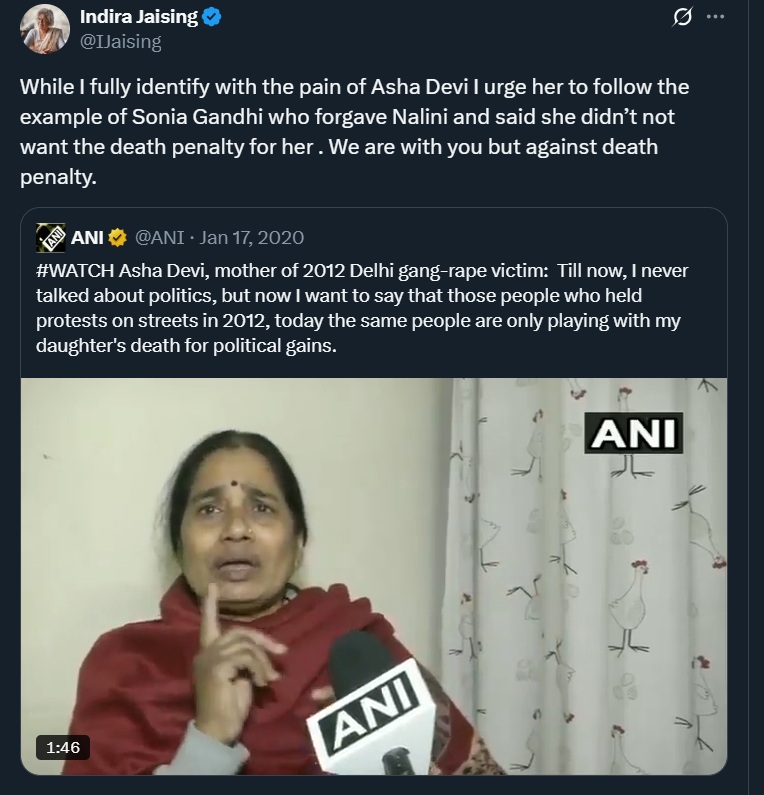
Asha Devi reacted sharply, telling the media she was shocked by the suggestion and asking, “Who is Indira Jaising to give me such a suggestion?” She accused “people like her” of helping rapists and obstructing justice for victims.
The episode again highlighted Jaising’s abolitionist stance and triggered a broader debate on whether public advocacy against capital punishment in such cases is principled or insensitive to victims’ families.
Afzal Guru Case: Questions Over Legal Defence and a Push for Curative Review
Another prominent intervention by Indira Jaising came in the highly sensitive Parliament Attack case, involving Mohammad Afzal Guru, who was convicted for his role in the 2001 terror strike on India’s Parliament and sentenced to death.
Guru’s conviction and sentence were upheld by the Supreme Court in 2005, and his mercy petition was rejected by the President in 2013. However, in the years preceding the execution, a segment of civil-society activists and lawyers, including Jaising, mounted a sustained campaign questioning aspects of his trial.
As per court records and contemporary reporting, Jaising issued a legal certificate allowing Afzal Guru to file a curative petition, the final judicial remedy available after the dismissal of review petitions. She argued that Guru had been denied adequate legal representation at crucial stages of the trial and that there existed a “constitutional error” requiring judicial correction.
Her steps formed part of a wider legal and activist push that claimed procedural deficiencies in the case. Critics, however, viewed the move as an attempt to delay or derail the execution of a convict held guilty by both the trial court and the Supreme Court in a high-profile terror case.
Although the curative petition was ultimately dismissed, the episode added to Jaising’s profile as one of India’s most active lawyers challenging death-penalty cases including those involving individuals convicted of terrorism.
The Age-of-Consent Debate: Redrawing the Line at 16
Most recently, Jaising’s role as amicus curiae in a batch of petitions concerning the Protection of Children from Sexual Offences (POCSO) Act has stirred fresh controversy.
In July 2025, she urged the Supreme Court to effectively lower the statutory age of consent from 18 to 16 in cases of consensual sexual activity between adolescents close in age. She argued that the present framework “criminalises consensual sexual activity between children in the age group of 16–18 years” and violates their right to autonomy and privacy.
The Union government strongly opposed any change, warning that reducing the age of consent would dilute child protection and could be misused by sexual predators. Child-rights groups and several commentators have similarly argued that grooming and exploitation risks are high in this age bracket and that POCSO’s safeguards should not be weakened.
Pattern Or Principle?
Taken together, these episodes have led some political commentators and critics to notice a “pattern” in Jaising’s interventions: they point to her role in securing a midnight stay for Koli, seeking procedural delays for Yakub Memon, publicly appealing for mercy for the Nirbhaya convicts, and pushing to lower the age of consent, and it is noteworthy that her activism tends to benefit convicts in grave crimes or potentially weakens protections for minors.
She seems to be a part of a broader ecosystem of lawyers who frequently challenge death sentences, oppose stringent security laws and advocate reforms that, in their view, favour accused persons over victims.
However, Jaising and her supporters frame the same record very differently. In interviews and written pieces, she has consistently described herself as a human-rights and constitutional lawyer whose opposition is not to victims but to what she sees as irreversible punishments, flawed investigations and laws that criminalise adolescents’ consensual relationships.
In the wake of Koli’s acquittal, she argued that the case exposed “flawed” investigative processes and reinforced the need to ensure that no one is executed before all legal remedies are exhausted—especially where confessions and recoveries are later found unreliable.
On POCSO and the age of consent, she has maintained that her concern is with teenage couples being pulled into the criminal system due to parental or social pressure and has called for a narrow “close-in-age” exception rather than a blanket dilution of child-protection law.
Indira Jaising – A Polarising Figure in India’s Justice Debates
As India continues to grapple with questions of how to balance victims’ rights, due process, child protection and the death penalty, Indira Jaising has become one of the most polarising figures in that debate.
The Supreme Court’s reversal in the final Nithari case has now added a new layer to that story. For some, it strengthens her long-standing argument that the justice system can make catastrophic mistakes. For others, it does little to change their unease over a lawyer whose most visible battles have been fought on behalf of those the public already believes guilty.
Either way, as the country revisits the Nithari case and debates the future of death penalty and child-protection laws, Indira Jaising’s courtroom interventions and the questions they raise will exist as long as the ecosystem that supports her exists.
Subscribe to our channels on WhatsApp, Telegram, Instagram and YouTube to get the best stories of the day delivered to you personally.