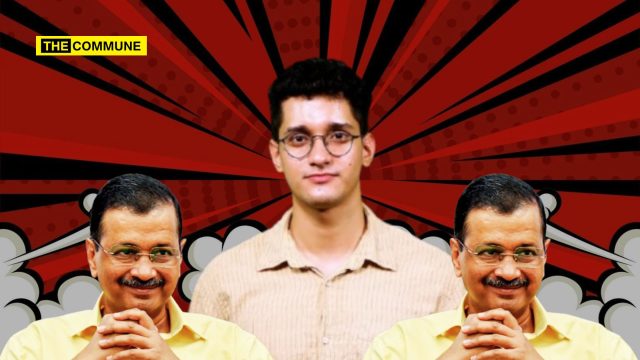
A few days ago, leftist ‘journalist’ whose propaganda pieces are published in portals such as Frontline, Article 14 shared a lengthy thread on X. Interestingly, it was reshared by none other than former Delhi CM, liquor scam accused Arvind Kejriwal.
Is this true? V v explosive https://t.co/hzQp6y3HPe
— Arvind Kejriwal (@ArvindKejriwal) April 9, 2026
What Did Saurav Das Post?
In a lengthy post, Saurav Das made some ‘shocking’ allegations but one glance at the post tells us that he is framing his opinions as facts.
Saurav begins by raising a series of allegations and concerns about possible bias, conflict of interest, and institutional credibility in the handling of the Delhi liquor policy case, particularly focusing on Justice Swarana Kanta Sharma of the Delhi High Court. But essentially, he is building a case against Justice Swarana Kanta Sharma, with not with hard he constructs an argument from selective facts and biased interpretation.
He begins with the discharge of Arvind Kejriwal and others, the CBI’s challenge, and the fact that Justice Sharma is hearing the matter. He also cites court records, listing patterns, and past judgments. However, the moment he moves from describing these facts to assigning meaning to them, the argument becomes subjective.
For instance, he claims the judge showed “unusual speed” in this case compared to others. But speed, by itself, does not indicate bias – courts frequently fast-track politically sensitive or high-stakes matters. Without proving that such urgency violated procedure or was selectively applied with intent, the claim remains speculative.
He also argues that the judge’s previous orders in related cases show a pattern of alignment with the prosecution. This is again an interpretation. Judges often make prima facie observations at stages like bail or interim hearings, and strong language in such orders does not automatically establish prejudice. In fact, many such observations are routinely revisited or overturned at later stages — that is part of the judicial process, not evidence of bias.
Saurav further attempts to show inconsistency by comparing the judge’s approach in cases involving opposition leaders with another case involving a BJP leader. But this comparison ignores a basic legal reality: no two cases are identical. Differences in evidence, charges, and procedural posture can justify different outcomes. Presenting this as selective treatment is, again, an inference, not a fact.
The most serious insinuation relates to the empanelment of the judge’s children as government lawyers. Here, Saurav stops short of alleging wrongdoing but strongly suggests a conflict of interest. However, he provides no evidence of any direct link between these appointments and the judge’s decisions. Government panel appointments, while open to debate, are not illegal, and without proof of influence, this line of argument rests entirely on perception, not substance.
Ultimately, his central claim, that there is a “reasonable apprehension of bias”, is itself an opinion, not an established conclusion. It depends entirely on how one chooses to interpret the same set of facts. A different observer could look at the same material and see nothing unusual at all.
In essence, Saurav is presenting a prosecutorial-style narrative against the judge, stitching together disparate facts to suggest a pattern. But the leap from pattern to bias is not proven – it is argued. That distinction is crucial.
#ImportantNews: The controversy over the alleged Delhi liquor-scam case before Justice Swarana Kanta Sharma is no longer confined to courtroom conduct alone. Now more troubling questions of proximity, patronage, conflict-of-interest, and the appearance of bias have come to light.… pic.twitter.com/cQbYjqRxoS
— Saurav Das (@SauravDassss) April 9, 2026
In this lengthy post, he adds links to judgements, how own tirade, and what not – but they prove nothing – no link between this specific judge and such appointments, no wrongdoing by Swarana Kanta Sharma nor any connection between her decisions and her children’s positions. It is entirely how he wants to perceive the issue and how he wants the public to perceive the judge.
So, Saurav Das tries to build a case against the judge to create a favourable media narrative for his favourite Arvind Kejriwal and the post is also shared by the same Kejriwal – was it to win brownie points and prove his loyalty to the accused?
Let us take a look at the love Saurav Das has for Arvind Kejriwal and how it manifests.
Delhi’s pollution levels were spiking last year, thanks to stubble burning. And people are upset, rightly so. But are they calling out the true perpetrators? The stubble burners? A section of the public instigated by “influencers” went out to protest in Delhi without permission and have been detained.
Why did they protest? For clean air, yes clean air is every citizen’s right. No doubt about that. But are the people who are instigating them, pointing to the actual culprits?
No, they all blame the present BJP government. Among them is Saurav Das – a self-proclaimed ‘investigative journalist’ who has often been seen peddling propaganda laced in fine language.
Das, who recently amplified calls for urgent action on Delhi’s deteriorating air quality under the new BJP-led administration, has been accused by several social media users of remaining silent on the issue during AAP’s tenure in Delhi and Punjab.
🇮🇳🇮🇳🇮🇳 pic.twitter.com/d50S5nmo8E
— Saurav Das (@SauravDassss) November 9, 2025
While he routinely commented on national governance and investigative matters, he avoided public criticism of Delhi Chief Minister Arvind Kejriwal or the Punjab government over their handling of pollution and stubble burning.
This is just unacceptable. After 8 years, Delhi govt says there is no official data on what is causing pollution in Delhi. Was 8 years not enough to put a system in place, despite Delhi having all the top institutes/eminent persons? One excuse before AAP won Punjab was that the… https://t.co/lr6ImQPc8r
— Saurav Das (@SauravDassss) October 26, 2023
Saurav Das routinely writes for leftist publications like Article 14, Frontline, The Caravan magazine, Al Jazeera, The Wire, The Hindu etc.
While Das has not demanded or protested so vehemently about Delhi’s polluted air in the past, this time around since the BJP is in power, he wants clean air instantly. Nor did he protest the “unclean” Yamuna River at that time!
However, following the recent change of government at the Centre, he has begun sharing and supporting protests demanding immediate solutions to Delhi’s air crisis.
Das’s detractors argue that this shift amounts to “performative activism” and question why similar pressure was not applied to the AAP government during its tenure. They have also pointed out his continued social media criticism of Uttar Pradesh Chief Minister Yogi Adityanath’s advertising expenditure, contrasting it with his silence when the then-Delhi CM spent significant amounts on publicity campaigns rather than pollution control measures.
Meet @SauravDassss !!
– A certified Kejriwal Paglu
– Was dick Riding Lavnasur for last 5 Years
– 0 Protests against Kejriwal on Yamuna and Air Pollution in the last 5 Years
– No word on Punjab Govt against Stubble Burning
– Questions Yogi on Ads but kept mum when Kejriwal… https://t.co/Dd2RE2y2vB pic.twitter.com/jcqLqg7OFx— Rohit (@Iam_Rohit_G) November 9, 2025
Das has earlier faced scrutiny for funding links to foreign and non-governmental foundations. A 2023 exposé by The Pamphlet showed that he received support from the Thakur Family Foundation for public health reporting, though his published articles reportedly extended to political topics beyond health policy.
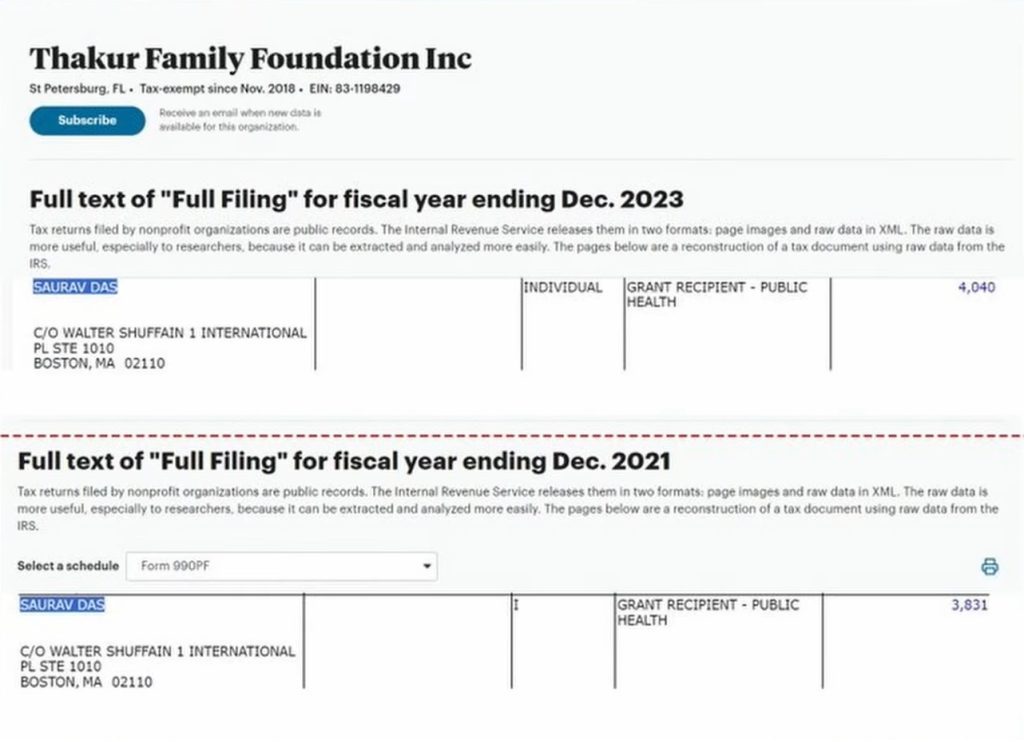
The Thakur Family Foundation (TFF), which presents itself as an organisation promoting “public health and civil liberties,” has funded multiple Indian media outlets and journalists, including individuals associated with Alt News, The Wire, and Moneylife Foundation, under the banner of health-related reporting. These grants coincided with the publication of articles critical of India’s pharmaceutical industry, traditional medicine systems, and domestic COVID-19 response, while appearing to favour Western vaccine and corporate narratives.
TFF has also been linked to the US-based testing firm Valisure, which released reports questioning the quality of Indian-made drugs. The pattern of financial support, editorial influence, and timing of campaigns indicates an organised effort to erode confidence in Indian generics and Ayurveda. During the COVID-19 pandemic, TFF-funded content appeared in The Wire and Alt News, amplifying narratives that portrayed India’s pandemic management and indigenous pharmaceutical initiatives in a negative light.
Saurav Das who seems to write on “public health” only wrote articles that were critical of the government policies in this space and not otherwise.
Additionally, when India banned anti-Hindu website Hindutva Watch, Saurav Das published a propaganda piece in Article 14 about India’s ‘censorship rules’.
Subscribe to our channels on WhatsApp, Telegram, Instagram and YouTube to get the best stories of the day delivered to you personally.