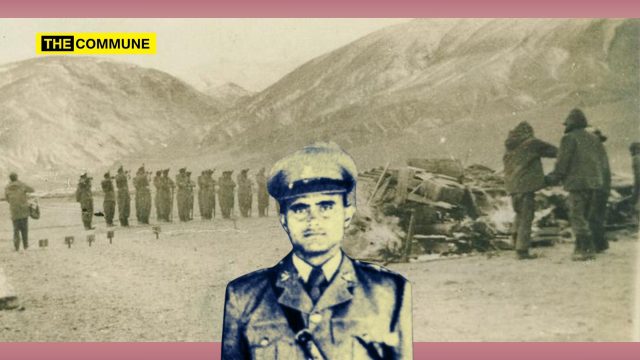
The trailer of 120 Bahadur, a Bollywood film based on the 1962 India-China war, has been released. Among the many stories from that conflict, one of the most remembered is that of Major Shaitan Singh, who, along with his men, fought to the last breath against a vastly larger Chinese force. Despite being severely under-equipped and undersupplied by the then Nehru government, which continued to promote the slogan “Hindi-Chini bhai bhai”, Major Singh and his troop displayed extraordinary courage in the face of impossible odds.
Nearly six decades after Major Shaitan Singh Bhati, a Param Vir Chakra awardee, laid down his life in the 1962 India-China war, his family continues to fight a prolonged legal battle to receive the full pension and gratuity owed to them.
After the officer’s death in the Battle of Rezang La on 18 November 1962, his wife Sugan Kanwari was sanctioned only the normal family pension, even though she was entitled to the special family pension, which amounts to 60% of the deceased soldier’s salary.
According to records, Sugan Kanwari was first paid ₹1,392 in December 1963, implying that she had been sanctioned a monthly pension of only ₹116 despite her husband’s death in combat.
In 1963, the government granted a gratuity of ₹4,000, but the amount was recovered from her pension the following year. Even after the revision of pension rules in 1972, which introduced the liberalised family pension applicable to the next of kin of battle casualties, Sugan Kanwari continued to receive the older, lower pension rate.
Under the revised scheme, she was entitled to 60% of Major Singh’s last drawn salary as special pension and a family gratuity of ₹9,500, but she did not receive these benefits until 1996, and arrears for the period 1972 to 1995 were not paid.
Despite multiple representations, the dues remained unsettled, forcing the family to approach the Armed Forces Tribunal (AFT) in Jaipur. However, the matter continues to remain pending.
Advocate Colonel S.B. Singh (Retd.), representing the family before the AFT, told The Times of India, “In a normal pension, the next of kin is given 30% of the salary while in a special pension it is 60%. In a liberalised pension it is 100% (of the salary). However, Sugan Kanwari, wife of Major Shaitan Singh, was given only the normal pension. Moreover, she was entitled to family gratuity of ₹9,500 as per the announcement made in 1972. But it was not paid to her till her death, or later to her son.”
Sugan Kanwari passed away in 2015, still receiving the older pension rate. Her son, Narpat Singh, who was a teenager when his father was killed, has continued the legal fight to obtain the arrears and gratuity.
Col Singh said that Sugan Kanwari was unaware she was being underpaid until an official from the Sainik Kalyan Board visited her. “The deceased Major’s wife did not realise that she was being given lesser dues than that has been authorised until an official of the Sainik Kalyan Board visited her. In 1996, she started receiving the liberalised pension. The current case is for arrears from 1972 to 1995 as well as the gratuity amount. After her death in 2015, her son should have been given the arrears. But there is no judge in Jaipur AFT since 2016 due to which the case is pending.”
Narpat Singh said, “We did not know anything about the financial aspects. I was very young. We only came to know later and, now, I am waiting for the court’s decision.”
Major Shaitan Singh was initially commissioned into the Jodhpur State Forces on 1 August 1949, after completing training at the Officers Training School (OTS), Pune, from August 26, 1947, to July 31, 1949. He was later granted a Short Service Regular Commission on 1 April 1951, and a Permanent Regular Commission on 25 May 1954, with the Kumaon Regiment.
During the 1962 war, Major Singh commanded a company of the 13 Kumaon Regiment at Rezang La in eastern Ladakh, where he and his 123 soldiers fought against overwhelming Chinese forces. Major Singh and 114 of his men were killed in action after a fierce defence that remains one of the most celebrated episodes in Indian military history.
He was posthumously awarded the Param Vir Chakra, India’s highest gallantry award, for his leadership and bravery.
However, despite his supreme sacrifice, the legal process to settle his family’s dues remains unresolved. With no judge appointed to the AFT Jaipur since 2016, the case continues to be delayed as of 2021, leaving the war hero’s family still waiting for justice after nearly 60 years.
(Source: Times of India)
Subscribe to our channels on WhatsApp, Telegram, Instagram and YouTube to get the best stories of the day delivered to you personally.