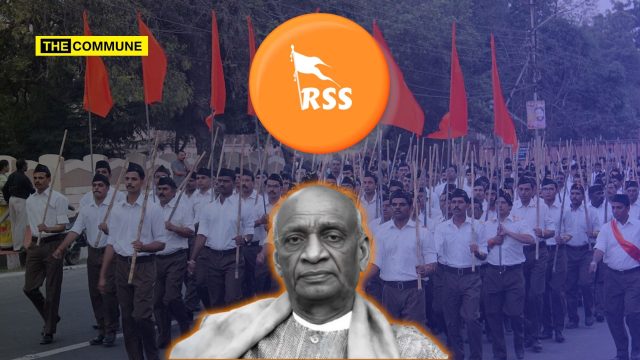
Archival government documents and public statements from 1949 confirm that the ban imposed on the Rashtriya Swayamsevak Sangh (RSS) following Mahatma Gandhi’s assassination was lifted unconditionally in July 1949. The decision came after months of communication between the Government of India, led by Home Minister Sardar Vallabhbhai Patel, and the RSS leadership under M.S. Golwalkar.
Imposition and Withdrawal of Ban
The RSS was banned in February 1948, shortly after Gandhi’s assassination, amid allegations that its members had fostered an atmosphere of communal hatred. Following sustained public agitation and legal representations, negotiations were initiated in mid-1949 to review the ban.
On 11 July 1949, the Government of India released an official communiqué announcing the withdrawal of the ban. The press note cited “discussions between Sardar Patel and the RSS leaders” and outlined four expectations from the organization:
- The RSS would function under a written and published constitution.
- Its activities would be confined to the cultural sphere.
- It would renounce violence and secrecy.
- It would pledge loyalty to the Indian Constitution and National Flag.
The statement clarified that RSS chief M.S. Golwalkar had submitted a draft constitution incorporating the government’s suggestions, providing assurances that convinced the authorities to allow it to resume functioning.
Mediator’s Role: T.R.V. Shastri
T.R.V. Shastri, a respected lawyer and mediator, played a crucial role in the early dialogue between the government and the RSS. In a statement published in The Hindu on 13 July 1949, Shastri explained that he had initially drafted the RSS constitution at Golwalkar’s request and acted as intermediary during negotiations. However, the government later insisted that Golwalkar correspond directly through the provincial administration of CP and Berar.
Shastri defended the RSS against certain government criticisms, including objections to the lifetime tenure of the Sarsanghchalak and the participation of minors, describing these as practices within the norms of private voluntary organizations.
Golwalkar’s Statements After the Ban
On 22 July 1949, soon after the ban’s withdrawal, Golwalkar addressed a press conference in Madras. When asked whether the RSS had made any compromises, he replied: “We have given up nothing that is fundamental to us. People may call it clarification.”
He reiterated that formalizing the Sangh’s constitution merely put into writing what had always been its guiding principles.
Addressing a public meeting in Nagpur on 1 August 1949, Golwalkar reaffirmed: “No compromise has been made. No promise of any kind has been given to the government.”
He added that agreeing to draft a constitution was done “out of respect” for T.R.V. Shastri rather than as a concession to government conditions.
Official Confirmation of Unconditional Revocation
The unconditional nature of the government’s action was officially affirmed in the Bombay Legislative Assembly on 14 October 1949. During the session, MLA Lallubhai Makanji Patel questioned the Home Department on the matter. The official replies, recorded in the Assembly proceedings, were as follows:
(a) Was the ban lifted? Yes.
(b) What were the reasons? It was no longer considered necessary to continue it.
(c) Was it conditional or unconditional? Unconditional.
(d) If conditional, what were the conditions? Does not arise.
(e) Did the RSS leader give any undertaking? No.
This record conclusively established that the lifting of the ban carried no formal conditions or undertakings from the RSS.
Correspondence Between Patel and Shastri
In a letter dated July 16, 1949, Patel wrote to T.R. Venkatarama Shastri expressing satisfaction at the outcome, stating he had been “keen to remove the ban at the earliest opportunity.” Patel reiterated his earlier advice to the RSS that if it felt Congress was “on the wrong path,” it should attempt reform “from within.”
The exchange demonstrated Patel’s preference for reconciliation and reintegration over confrontation.
Aftermath and Broader Context
Following the lifting of the ban, Golwalkar resumed public activity and launched an extensive nationwide tour beginning in August 1949. His massive reception in Delhi on August 23 was reported internationally, including by the BBC, which remarked that “Golwalkar is a shining star that has arisen on the Indian firmament.”
Subsequent records published in the Collected Correspondence of Sardar Vallabhbhai Patel, Volume 10 (July 1949), confirm Patel’s personal satisfaction at the decision, writing: “Only the people near me know how happy I was when the ban on the Sangh was lifted.”
Conclusion
The full documentary record including government communiqués, Assembly proceedings, press statements, and private letters establishes that the lifting of the RSS ban in 1949 was unconditional.
Sardar Patel’s correspondence and official testimonies confirm that the decision was driven by the government’s assessment that continuing the ban was unnecessary and counterproductive.
(Source: Arise Bharat)
Subscribe to our channels on WhatsApp, Telegram, Instagram and YouTube to get the best stories of the day delivered to you personally.