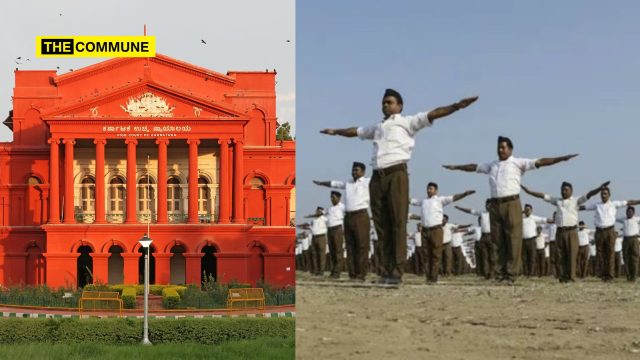
The Karnataka High Court on 28 October 2025 stayed the State government’s recent order restricting gatherings of ten or more people on public properties such as roads, parks, and playgrounds without prior permission. The Court observed that the order “on the face of it is violative of Article 13(2) of the Constitution of India.”
“Prima facie the Government Order [GO] of October 18, 2025, has taken away the right conferred upon a citizen or citizens under Chapter-III [fundamental rights] of the Constitution of India, that is Article 19(1) (a) and (b), which gives freedom of speech and expression and right for congregation and free movement,” the Court said.
The interim order was passed by Justice M. Nagaprasanna of the Dharwad Bench on a petition filed by several NGOs and individuals from Hubballi and Dharwad, including Punashchetana Seva Samsthe, We Care Foundation, Rajeev Malhar Patil Kulkarni, and Uma Satyajit Chavan. The Court also stayed all consequential orders, notifications, or circulars, if any, issued by the government.
“If this GO is left to be operational during the pendency of the petition, it would in effect be violative of Article 13(2) of the Constitution of India, which indicates that law conferred under fundamental rights can be abridged only by a law,” the Court observed.
The Government Order stated that a gathering of ten or more persons in any public place — including streets, roads, parks, playgrounds, and water bodies — without prior permission would be treated as an “unlawful assembly.” The Court noted that the regulation of assemblies and processions is already governed under the provisions of the Karnataka Police (KP) Act, which regulates the conduct and behaviour of persons in public spaces. Therefore, it held that the October 18 order “can have any semblance of effect of taking away the fundamental rights conferred upon a citizen or citizens under the Constitution.”
Senior advocate Ashok Haranahalli, appearing for the petitioners, argued that the GO was in violation of the KP Act and amounted to curbing fundamental rights through an executive order. He pointed out that “going by the nature and restriction imposed in the GO, it would mean even having a laughter club session or walking in a group in a park would become an ‘unlawful assembly’ if no prior permission was taken.”
Although the order did not explicitly name any organisation, it was widely interpreted as a move to curb the activities of the Rashtriya Swayamsevak Sangh (RSS) on public properties. The speculation arose after Karnataka’s IT-BT Minister Priyank Kharge wrote to Chief Minister Siddaramaiah seeking a ban on RSS activities in government schools, colleges, and other public spaces. The Cabinet approved the issuance of the order shortly thereafter.
The GO had further directed that police register cases — either upon receiving complaints or suo motu — under the provisions of the Bharatiya Nyaya Sanhita against gatherings violating the order.
(Source: The Hindu)
Subscribe to our channels on WhatsApp, Telegram, Instagram and YouTube to get the best stories of the day delivered to you personally.