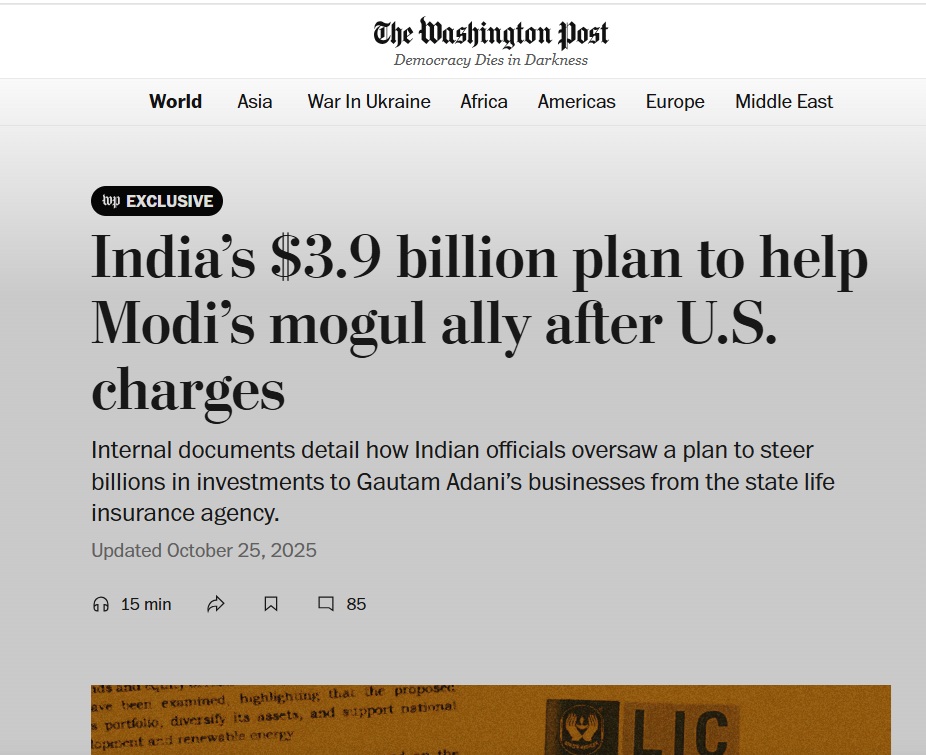
In the wake of The Washington Post’s 24 October 2025 report titled “India’s $3.9 billion plan to help Modi’s mogul ally after U.S. charges,” political and media circles in India have raised questions about the publication’s credibility and its pattern of negative coverage on Indian affairs. The report alleged that the Indian government orchestrated a ₹33,000 crore ($3.9 billion) Life Insurance Corporation (LIC) bailout for the Adani Group, a claim swiftly rejected by both LIC and government officials as baseless.
Former LIC Chairman Siddhartha Mohanty described the report as “a misleading narrative,” asserting that LIC’s investment decisions are governed by the LIC Act and by SEBI and IRDAI regulations that ensure independence from political influence. Officials have reiterated that LIC’s investments are guided by rigorous risk assessment and policyholder safety, not by political considerations.
Contrary to the Washington Post’s claims, LIC’s financial data show robust health. Its equity portfolio rose from ₹2.55 lakh crore in 2013–14 to ₹13.01 lakh crore in 2024–25, delivering record profits of ₹48,151 crore in FY 2024–25, an 18% year-on-year increase. LIC’s annual investment outlay exceeds ₹5.5 lakh crore, while its holdings in the Adani Group comprise only about 4.5% of its total equity and less than 2% of Adani’s debt exposure. Officials have clarified that the alleged ₹5,000 crore “bailout” was in fact a routine bond subscription, backed by AAA ratings and market-standard yields.
The Adani Group, which faced extensive scrutiny after the 2023 Hindenburg report, was cleared of systemic wrongdoing by SEBI. Since then, it has attracted substantial global investment, including a $1 billion qualified institutional placement oversubscribed by international firms such as Goldman Sachs and Nomura. LIC, meanwhile, has recorded net gains on its Adani-linked investments.
Pattern Of Anti-India Reporting
Critics of the Washington Post report argue that it fits into a recurring pattern of anti-India coverage by the U.S. outlet. Observers have noted that every finalist from The Washington Post in the 2024 Pulitzer Prize International Reporting category centered on negative portrayals of India. The series, which accused Prime Minister Narendra Modi’s government of undermining democracy and pressuring U.S. tech firms, was shortlisted for its reports such as “Inside the vast digital campaign by Hindu nationalists to inflame India,” “How India tamed Twitter and set a global standard for online censorship,” and “India targets Apple over its phone hacking notifications.”
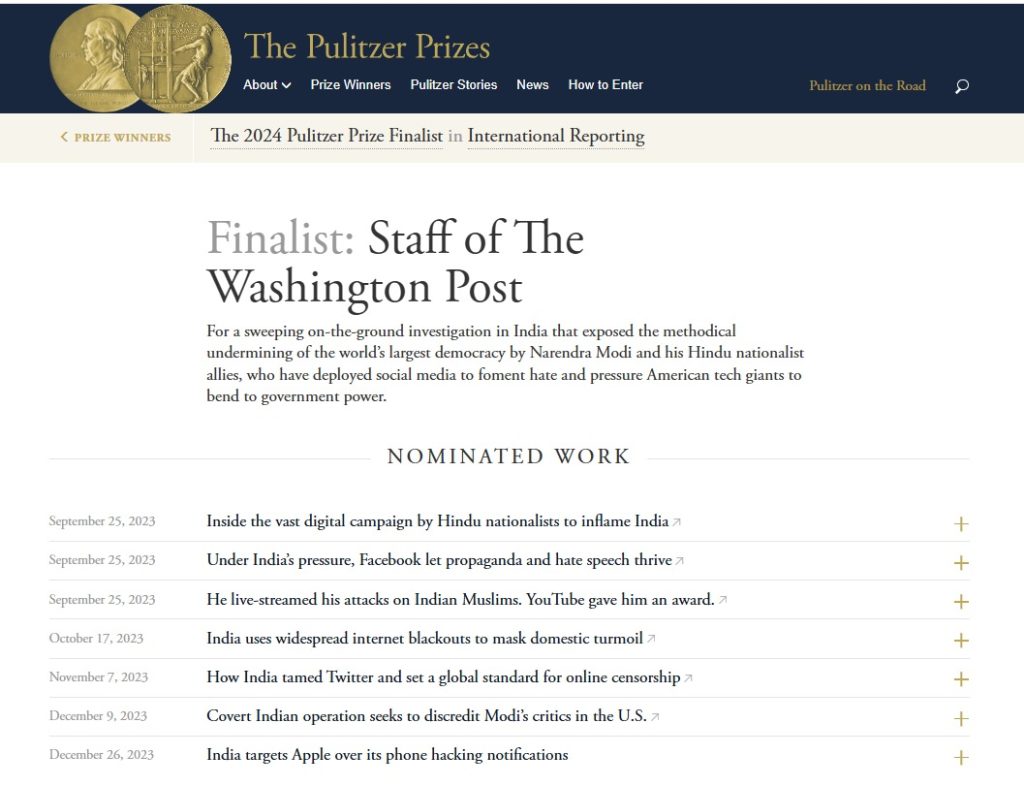
Among the reporters credited was Pranshu Verma, who also authored the latest Adani-LIC story.
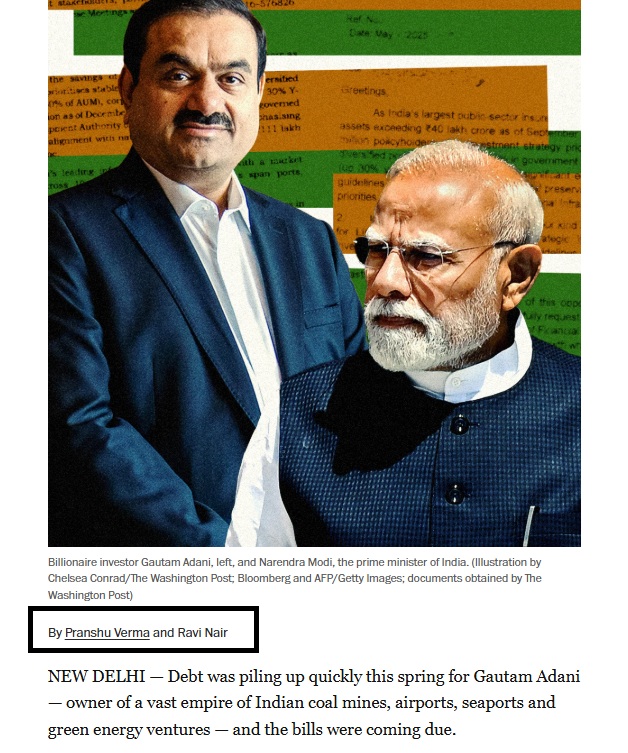
Verma’s earlier work, “Rising India, Toxic Tech,” was celebrated by Western media but criticized in India for what detractors described as “neo-colonial framing.”
proud to have worked on the “Rising India, Toxic Tech” series that was named a @PulitzerPrizes finalist in international reporting with @gerryshih, @josephmenn, @karishma__m__, @AnantGuptaAG, @ccemorse, with editing by @AlanSipress https://t.co/iJGZ47GWzo
— Pranshu Verma (@pranshuverma_) May 7, 2024
This latest report marks the third major story in recent years from U.S. outlets alleging impropriety involving Adani, after a string of Washington Post articles in 2023 that drew on Hindenburg’s short-seller claims. Those reports ceased following Hindenburg’s shutdown in January 2025.
Critics suggest that the fake Adani narrative serves as a proxy for a larger geopolitical agenda, portraying India’s economic independence as a threat to Western influence. They point to a broader trend in which American media and institutions, including the Pulitzer committee, appear to reward coverage that paints India’s rise in negative light.
All Pulitzer finalists in the International category from The Washington Post this year are on India and every single one is negative.
It looks like both the Pulitzer and The Washington Post are targeting something far beyond journalism.
For years, WaPo has maintained an… https://t.co/0HA0QRpgAL pic.twitter.com/JT598FKGNq
— Anurag (@Jhunjhunuwala_) October 25, 2025
Indians argue that The Washington Post’s October 2025 story is part of a coordinated campaign to discredit India’s growth trajectory and its leading enterprises. They contend that LIC’s financial resilience and the transparency of its investment practices refute allegations of cronyism. The Ministry of Finance has not ruled out seeking clarification from the publication regarding its sourcing and verification methods.
Subscribe to our channels on WhatsApp, Telegram, Instagram and YouTube to get the best stories of the day delivered to you personally.