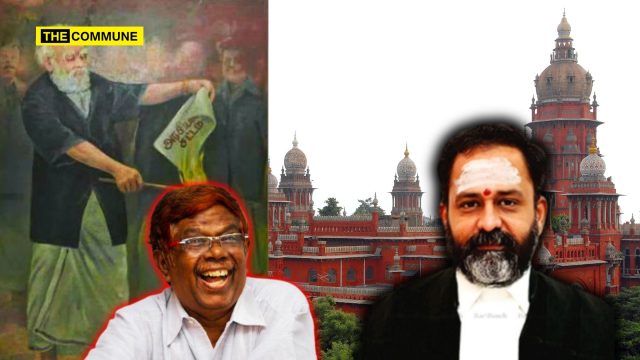
Justice K. Chandru has again taken the public pulpit—this time at Valluvar Kottam, Chennai—to accuse Justice G.R. Swaminathan (GRSJ) of “betraying” his judicial oath by speaking “against the Constitution” at an RSS event. The report places the speech on October 22, 2025, names the organisers (VCK Advocates’ Wing and Samathuva Vazkarinyar Sangam), and records the core charge: that GRSJ called India’s Constitution a “copied” product of the 1935 Act.
Before the moral thunder, the facts. There is a verified instance of GRSJ making a continuity claim: at a Think India symposium on January 5, 2025, he said “70% of the Constitution was based on the Government of India Act, 1935.” That phrasing is overbroad, but it is not invented and it came in a talk where he also stressed judicial fidelity to the constitutional text.
Now the paradox that refuses to go away. Chandru venerates Periyar – the Dravidian patriarch whose movement literature openly celebrates a Constitution-burning agitation. That is the movement’s own description: “Constitution Burning Movement was one of the landmark movements led by Thanthai Periyar in Tamil Nadu,” a unique protest where the text itself was torched to dramatise grievance. Later accounts even quote Periyar’s declared willingness “to burn the Constitution” if caste-entrenching practices continued.
So what exactly is the standard? If a judge’s hard (even crude) historical claim about colonial lineage amounts to “betrayal,” where does public, performative constitution-burning sit on that moral scale – heroism or heresy? It cannot be both at once. Dravidian political ecosystem continues to place Periyar on a pedestal.
On substance, the “copy of 1935” line is inaccurate if taken literally. India did carry forward administrative scaffolding from the Government of India Act, 1935 – legislative lists, gubernatorial machinery, PSC/CAG lineage yet it broke decisively on first principles: sovereignty grounded in “We, the People,” justiciable fundamental rights, universal adult franchise, and judicial review. That is why B.R. Ambedkar answered the “you copied 1935” taunt without apology: “I make no apologies… There is nothing to be ashamed of in borrowing… What I am sorry about is that the provisions taken… relate mostly to the details of administration.” (Constituent Assembly, November 4, 1948.) The fair rendering, then, is simple: continuity of machinery; transformation of the state’s soul. By that yardstick, GRSJ’s “70%” is an overstatement, not apostasy.
There is also the elementary question of forum and tone. Judges speak through judgments; retirees, if they must speak, ought to lower the temperature. The spectacle of post-retirement political evangelism has drawn public censure far beyond this episode; Law Commission member Hitesh Jain’s warning “more and more retired judges are openly behaving like political activists” captures the concern. Chandru’s latest broadside exemplifies the problem: a retired judge, garlanded by an ecosystem that canonises Periyar’s bonfires, branding a sitting judge a traitor for a contestable reading of constitutional history.
Set aside the biopic (Jai Bhim movie)-fuelled celebrity and state patronage: none of that licenses partisan thunder. When a retired judge brands a sitting judge a “betrayer,” the burden is to argue on facts and principle—not to sermonise from a Periyar-praising pulpit. The obligation is even-handedness; the record here is selective indignation.
Shailendar Karthikeyan is the Editor of Nyayavimarsha.
Subscribe to our channels on WhatsApp, Telegram, Instagram and YouTube to get the best stories of the day delivered to you personally.