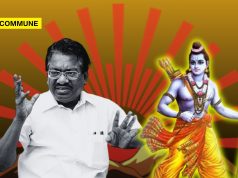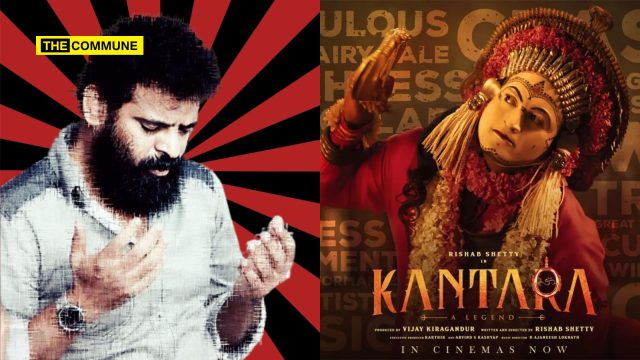
In a provocative speech at the Bison Success Meet, director Ameer Sultan—currently under investigation over drug trafficking allegations linked to the Jaffer Sadiq case—sparked controversy for his pointed remarks on religious and supernatural cinema, seemingly mocking films like Kantara.
During his address, Ameer Sultan challenged journalists who questioned the social impact of director Mari Selvaraj’s hard-hitting films. He scoffed at critics who accused such works of creating divisions in society, calling the notion absurd. Ameer pointed out society’s double standards: while movies about invisible gods and non-existent ghosts (alluding to spiritual blockbusters like Kantara) are celebrated, films about caste—the harsh, visible reality that torments millions—face backlash.
“Nobody has seen god, but if you make a film about it, people celebrate. Ghosts don’t even exist, but humans are worse than ghosts. Ghosts flee in daylight, afraid of humans,” he quipped. Ameer questioned why movies confronting real-life pain and caste injustice should be suppressed, while fantastical narratives receive the public’s adulation.
Given how Kantara became a cultural phenomenon for its rooted portrayal of bhakti, Bhoota Kola, and the spiritual connection between man and nature, Ameer’s comment was viewed as a typical Dravidianist swipe — mocking India’s indigenous belief systems while glorifying divisive identity politics.
This is what Ameer Sultan spoke at the Bison Success Meet: “These journalists are asking Mari one question repeated – Why are you making these kind of films? They say that you’re trying to create problems within in society. I saw how ridiculous such questions were. A God who is invisible, and a ghost that never exists – many films are coming about them and is achieving victory. Nobody has seen god. But if you take a film about it, people are celebrating. Ghost, it doesn’t even exist. I think man is worse than a ghost. That’s why you see that these ghosts come at night. Because during the day it is afraid of humans. Films are being made on these. But the caste that we see in front of our eyes, its ill effects, pain and torture, and someone saying that such films should not be taken is what I feel absurd.”
Who Is Ameer?
Ameer Sultan, a Tamil filmmaker known for his Islamist-Dravidianist leanings, has faced growing scrutiny over his close ties with Jaffer Sadiq, a former DMK NRI Wing official accused of running an international drug-trafficking network. Dubbed Sadiq’s “bestie,” Ameer was named in an ED chargesheet alleging money laundering through films and was summoned by the NCB in April 2024 in connection with the smuggling of pseudoephedrine worth ₹2,000 crore. In October 2024, a special court summoned both Ameer and Sadiq as part of the ongoing money-laundering case. More recently, Ameer was accused of participating in a coordinated smear campaign against Justice G. R. Swaminathan, aligning with the DMK’s broader ideological ecosystem.
At a forum hosted by the Dravidianist YouTube channel “The Debate,” filmmaker Ameer attacked Sanatana Dharma and Brahmins, claiming as a Muslim he stood outside the caste system. He accused “Aryans” of creating caste, linked honor killings to Hindu epics, and praised DMK as Tamil Nadu’s positive force. His comments included sweeping generalizations, targeting practices like Vinayagar Chaturthi as dominated by “intermediate castes” while alleging Brahmins remain aloof. He also quoted EV Ramasamy Naicker (hailed as ‘Periyar’ by his followers) saying “Islam is the best medicine to eliminate racial discrimination.”
Subscribe to our channels on WhatsApp, Telegram, Instagram and YouTube to get the best stories of the day delivered to you personally.