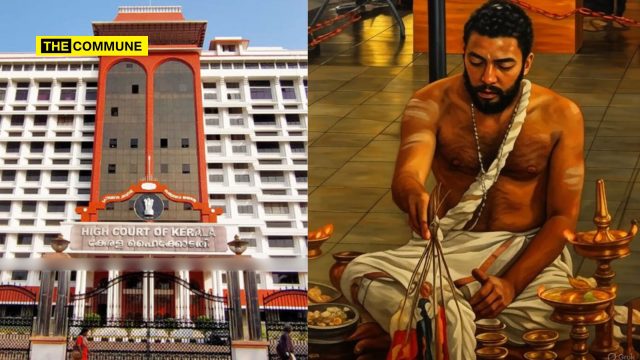
The Kerala High Court has ruled that appointments of temple priests (Santhis) cannot be restricted to members of any particular caste or lineage, holding that such requirements do not constitute an essential religious practice protected under the Constitution of India.
A Division Bench of Justice Raja Vijayaraghavan V and Justice KV Jayakumar delivered the judgment while upholding the decision of the Travancore Devaswom Board (TDB) and the Kerala Devaswom Recruitment Board (KDRB) to recognize experience certificates issued by Thanthra Vidyalayas for the recruitment of part-time temple priests.
The ruling came in a petition filed by the Akhila Kerala Thanthri Samajam, a society comprising around 300 traditional Thanthri families in Kerala, and its president, Easanan Namboodiripad. The petition challenged the recruitment process of temple priests through Thanthra Vidyalayas.
The Petition and Arguments
At the center of the case was Qualification No. 2(ii) under Rule 6(1)(b) of the Travancore Devaswom Board Officers’ and Servants’ Service Rules, 2022. The rule, framed under the Travancore-Cochin Hindu Religious Institutions Act, 1950 and the Kerala Devaswom Recruitment Board Act, 2015, stated that eligibility for appointment as a part-time temple priest required “a certificate in Santhi Course from any Thantic Vidya Peedams or any such reputed institutions approved by TDB/KDRB.”
The petitioners argued that neither the TDB nor the KDRB had the authority to prescribe such qualifications and that the recognition of certain Thanthra Vidyalayas lacked legal backing. They contended that these institutions did not provide proper Thanthric education, thereby diluting traditional practices and bypassing the long-standing system of certification by temple Thanthris.
They also claimed that the appointment of Santhis in accordance with religious texts and authorities such as the Agamas and Thanthrasamuchayam constituted an essential religious practice protected under Articles 25 and 26 of the Constitution.
Court’s Findings
The Bench rejected the petitioners’ arguments, noting that the Supreme Court’s 1972 ruling in Seshammal v. State of Tamil Nadu had already held that the appointment of Archakas (temple priests) was a secular function performed by a trustee, even though the priest’s duties themselves were sacred.
“The contention of the petitioners that the appointment of Santhis shall be made in accordance with the religious texts and authorities, such as the Agamas and Tantrasamuchayam, as it constitutes an essential religious practice, cannot be accepted,” the Court said.
The Court noted that the petitioners’ claim effectively sought to perpetuate caste and lineage-based privilege, pointing out that the Samajam restricted its membership to Brahmin families who had performed Thanthric rituals for at least seven generations.
Addressing such concerns, the Bench observed, “To insist that a person must belong to a particular caste or lineage to be eligible for appointment cannot, in our considered view, be construed as an insistence upon an essential religious practice, rite, or mode of worship. No factual or legal foundation has been established to justify such a claim in the present case. The contention that individuals unconnected with spiritual functions are being considered for such posts and that this infringes the fundamental rights of the petitioners guaranteed under Articles 25 and 26 of the Constitution of India is untenable.”
The Court emphasized that no custom or usage, even if traceable to pre-constitutional times, could be recognized if it violated human rights, dignity, or constitutional principles of social equality.
“Any custom or practice that is oppressive, pernicious, contrary to public policy, or in derogation of the law of the land cannot receive recognition or protection from courts exercising jurisdiction under the Constitution,” the judgment stated.
On the Thanthra Vidyalaya System
The Court also took note of the Thanthra Vidyalaya system, observing that it appeared to be a comprehensive process for certifying candidates for temple priesthood.
“Students who successfully complete the course are also subjected to initiation ceremonies, signifying their preparedness to undertake temple duties. Moreover, even among such qualified candidates, the final selection is made strictly on merit by a duly constituted Committee which, apart from learned scholars, includes a reputed Thanthri. The competence, merit, and eligibility of each candidate to perform religious rites and observances are thus tested once again before appointment,” the Bench noted.
The Court further found that the rules framed by the TDB and KDRB were issued only after inviting objections and in compliance with all procedural safeguards.
Denial of Denominational Status
The Bench also dismissed the Samajam’s claim that it qualified as a religious denomination under Article 26 of the Constitution, observing that it had failed to establish a distinct faith, belief system, or organizational structure necessary for such recognition.
Finding no merit in the petition, the Kerala High Court dismissed it.
Advocate KR Raj Kumar appeared for the petitioners, while standing counsel G. Biju represented the Travancore Devaswom Board and standing counsel V.V. Nandagopal represented the Kerala Devaswom Recruitment Board.
(Source: Bar and Bench)
Subscribe to our channels on Telegram, Instagram and YouTube to get the best stories of the day delivered to you personally.