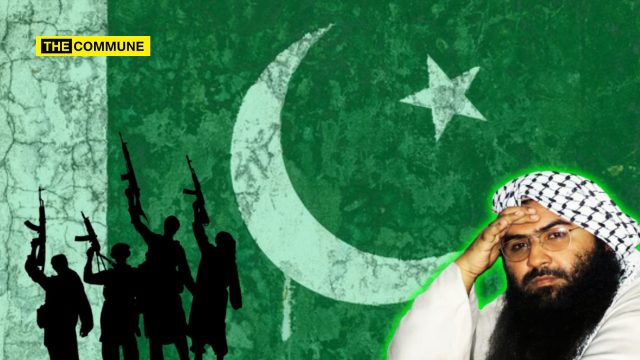
On 8 October 2025, Masood Azhar, chief of Jaish-e-Mohammad, announced the launch of the group’s first women’s wing, Jamaat-ul-Mominaat, to be led by his sister Sadiya Azhar. Her husband, Yusuf Azhar, was killed during Operation Sindoor. The wing is reportedly aimed at expanding the organization’s outreach and recruiting women through social media platforms and madrasas.
From 2001 to 2025, Jaish-e-Mohammed (JeM) chief Masood Azhar has been a central figure in cross-border terrorism against India, with his activities revealing a complex web of support from Pakistan and diplomatic protection from China.
This report details 16 key incidents that illustrate Azhar’s alleged role in major attacks, the backing he received, and India’s multifaceted response, which has ranged from diplomatic campaigns to military strikes.
Masood Azhar’s Actions Against India
#1 JeM Forms First Women’s Wing
On 8 October 2025, Jaish-e-Mohammed chief Masood Azhar announced the formation of the group’s first women’s wing, ‘Jamaat-ul-Mominaat’. Led by his sister, Sadiya Azhar, the unit aims to recruit women through social media and madrasas, marking a significant tactical shift for the previously male-dominated terror outfit. The move is seen as a response to India’s Operation Sindoor, which targeted JeM’s headquarters. The wing was said tofocus on propaganda and targeting wives of members and economically disadvantaged women for recruitment, expanding the group’s operational reach.
#2 Commander Confirms Azhar’s Role in Major Attacks
On 17 September 2025, a JeM commander, Masood Ilyas Kashmiri, admitted in a video confession that Masood Azhar planned major terror attacks in India, including the 2001 Parliament attack and the 2008 Mumbai attacks, from his base in Balakot, Pakistan. The statement directly contradicted Pakistan’s long-standing denials of harbouring terrorists and confirmed Indian intelligence assessments that Azhar operated with the support of Pakistan’s military-security establishment, providing a rare, explicit link between the terrorist and the planning of these high-profile assaults.
#3 Mastermind of the 2019 Pulwama Attack
On 25 August 2020, Indian investigative agencies formally named Jaish-e-Mohammed chief Masood Azhar as the mastermind of the February 2019 Pulwama suicide bombing that killed 40 CRPF personnel. The findings concluded that Azhar, operating from Pakistan, used his network and digital communication to plan and direct the attack. This confirmation solidified India’s longstanding accusation against the terror chief and provided the impetus for subsequent diplomatic and military actions aimed at holding him and his organisation accountable for the devastating attack.
#4 Handlers of the Pathankot Airbase Attack
On 7 January 2016, Indian agencies identified Pakistan-based Jaish-e-Mohammad operatives, including Masood Azhar, as the handlers of the terror attack on the Pathankot Air Force base. Six JeM terrorists had crossed the border, leading to a three-day gun battle that killed seven Indian security personnel. India shared specific evidence with Pakistan, demanding the arrest of the perpetrators. This incident highlighted the continued use of Pakistani soil to launch attacks on critical Indian infrastructure and the challenges in securing meaningful cooperation from Islamabad.
#5 2001 Jammu & Kashmir Assembly Attack
On 1 October 2001, Jaish-e-Mohammad, led by Masood Azhar, carried out a suicide car bomb attack on the Jammu & Kashmir State Legislative Assembly in Srinagar. A vehicle laden with explosives rammed the main gate, killing 38 people, including civilians, while the attackers were killed in the ensuing gunfire. The brazen assault on a democratic institution was one of the deadliest attacks in the region at the time, firmly establishing JeM’s operational presence and Azhar’s role in orchestrating high-casualty terrorism in India.
How Pakistan Helped Masood Azhar
#6 Bilawal Bhutto Exposes Pakistan’s Double Stance
On 7 July 2025, Pakistan’s former Foreign Minister Bilawal Bhutto stated that the extradition of terrorists like Masood Azhar and Hafiz Saeed depended on India’s cooperation. This remark exposed Pakistan’s contradictory stance, suggesting an inability to act despite admitting the presence of UN-designated terrorists on its soil. The statement highlighted Pakistan’s long-standing policy of denial and inaction against individuals linked to major attacks in India, undermining its claims of being a committed partner in the global fight against terrorism.
#7 Pakistan’s Compensation for Azhar’s Family
On 14 May 2025, Pakistan’s Prime Minister announced a compensation of ₹1 crore for each person killed in India’s Operation Sindoor airstrikes in Bahawalpur. Since the strikes killed 14 of JeM chief Masood Azhar’s family members, this policy meant Azhar was in line to receive approximately ₹14 crore from the state. This move was widely condemned as a direct state endorsement of a designated terrorist and his organisation, blurring the lines between victim and perpetrator in the context of counter-terrorism operations.
#8 Azhar’s First Live Speech in 21 Years
On 3 December 2024, Masood Azhar delivered his first live public speech in over two decades, raising serious concerns over Pakistan’s support for terrorism. India promptly demanded that Pakistan abandon its dual policy and take decisive action against the JeM chief. The public appearance exposed the hypocrisy of Pakistan’s repeated denials of his presence and freedom of operation within the country, leading India’s External Affairs Ministry to assert that Azhar must be brought to justice for his role in cross-border terror attacks.
#9 Pakistan Admits Azhar is on its Soil
On 1 March 2019, Pakistan’s Foreign Minister officially acknowledged that Jaish-e-Mohammed leader Masood Azhar was in Pakistan, confirming India’s longstanding claims. The minister stated that Azhar was “very unwell” and mostly confined to his home. The admission came amid intense international scrutiny following the Pulwama attack, which was claimed by JeM. This belated acknowledgement was seen as a tactical move to deflect pressure, but it fundamentally undermined Pakistan’s previous denials about harbouring UN-designated terrorists.
China Helped Masood Azhar
#10 China Blocks UN Designation Post-Pulwama
On 13 March 2019, China blocked a proposal at the UN Security Council to designate Jaish-e-Mohammed chief Masood Azhar as a global terrorist. The move, initiated by France, the UK, and the US in the aftermath of the Pulwama attack, sought to impose a sanctions regime including an asset freeze and travel ban. By placing a “technical hold,” China prevented a consensus, marking the fourth time it had single-handedly shielded the Pakistan-based terrorist from international sanctions, drawing strong criticism from India and its allies.
#11 China Blocks UN Bid for Fourth Time
On 2 November 2017, China again placed a “technical hold” on a United Nations proposal to designate Masood Azhar as a global terrorist, marking the fourth time it blocked such efforts. India expressed deep disappointment, arguing that the move was a direct hindrance to global counterterrorism efforts. China’s repeated use of its UNSC veto power to protect a individual with a well-documented history of orchestrating terror attacks against India raised serious questions about its commitment to a unified international front against terrorism.
#12 India Calls China’s Hold “Counter-Productive”
On 2 August 2017, India labelled China’s decision to extend its hold on the UN listing of Masood Azhar as “short-sighted and counter productive.” China’s technical hold on the proposal, which alleged Azhar was the mastermind of the Pathankot terror attack, effectively stalled his designation as a global terrorist. India argued that such actions undermined the credibility of the UN’s sanctions regime and provided a safe haven for terrorists, thereby perpetuating the threat of cross-border violence and impeding justice for victims of terror.
#13 China Extends Hold on UN Listing
On 1 October 2016, China extended its technical hold on India’s bid to list Jaish-e-Mohammed chief Masood Azhar as a UN-designated terrorist. The six-month extension on the proposal, which was originally set to lapse, allowed for more deliberation within the 1267 Sanctions Committee. China remained the sole Security Council member opposing the move, while the other 14 members supported it, highlighting a significant diplomatic impasse and China’s persistent role as the primary obstacle to international consensus on sanctioning the JeM leader.
India’s Action Against Masood Azhar
#14 India Demands Extradition of Azhar and Saeed
On 30 May 2025, India’s Defence Minister Rajnath Singh demanded that Pakistan extradite terrorists Masood Azhar and Hafiz Saeed. In a speech in New Delhi, he accused Pakistan of continuing its “game of terrorism” and reiterated India’s zero-tolerance policy. Singh cited Operation Sindoor as a “frontal assault” that destroyed terror bases and warned that India would respond decisively to any threats. He urged Pakistan to dismantle its terrorism networks or face further action, signalling a continued hardline stance on state-sponsored cross-border terrorism.
#15 India’s “Operation Sindoor” Strikes JeM
On 7 May 2025, India carried out “Operation Sindoor,” conducting airstrikes on a Jaish-e-Mohammad training centre in Pakistan’s Bahawalpur district. The operation was launched in response to the April 2025 Pahalgam terror attack that killed 26 people. The strikes resulted in the deaths of 10 family members and 4 close aides of JeM chief Masood Azhar. This direct military action demonstrated India’s willingness to conduct counter-terror operations inside Pakistani territory to preempt threats and degrade the capabilities of terror groups targeting it.
#16 Azhar Declared Global Terrorist at UN
On 1 May 2019, in a significant diplomatic victory for India, the UN Security Council designated Masood Azhar, chief of Jaish-e-Mohammed, as a global terrorist. The listing imposed a sanctions regime including an asset freeze, travel ban, and arms embargo. India hailed the decision as a validation of its persistent stance against cross-border terrorism. The breakthrough came after years of diplomatic efforts and followed China’s decision to lift its hold on the proposal, finally bringing a measure of international accountability upon the notorious terror leader.
Subscribe to our channels on Telegram, Instagram and YouTube to get the best stories of the day delivered to you personally.