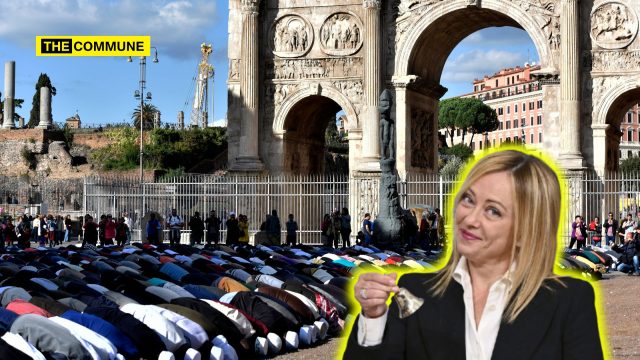
On 8 October 2025, the Italian government, led by Prime Minister Giorgia Meloni, proposed a nationwide ban on burqas and niqabs in public spaces. The new bill aims to address what the government terms “Islamic and cultural separatism.” Under the draft legislation, individuals found violating the ban could face fines ranging from €300 to €3,000.
In this report, we look at 7 actions taken by Italian governments over the years against Islamic practices.
#1 Italy’s Legislative Action Against Islamic Face Coverings
In October 2025, Prime Minister Giorgia Meloni’s government proposed nationwide legislation to ban burqas and niqabs in all public spaces, including educational institutions and businesses. The draft bill, aimed at countering “Islamic and cultural separation,” stipulates fines from £300 to £3,000 for violations. Additionally, the legislation includes measures to enforce transparency in mosque funding and restrict foreign financial contributions to religious institutions. This move represents a significant step in Italy’s efforts to assert cultural and legal norms, sparking debate over religious freedom and national identity.
#2 New Law to Criminalize Coerced Marital Unions
On 9 October 2025, Italy’s ruling Brothers of Italy party advanced a bill criminalizing forced marriages. The legislation specifically targets marriages conducted under threat, coercion, or religious pressure. This initiative forms part of a broader governmental effort to protect women’s rights and strengthen national security frameworks. By establishing legal consequences for forced matrimony, the administration aims to safeguard individual autonomy while addressing concerns about certain cultural practices conflicting with Italian legal standards.
#3 Expulsion of Radical Cleric on Security Grounds
In October 2024, Italian authorities ordered the expulsion of Pakistani imam Zulfiqar Khan, citing radicalization and security threats. The 54-year-old cleric, residing in Italy since 1995, had publicly endorsed Hamas and disseminated anti-Western, antisemitic, and anti-Italy rhetoric. His sermons encouraged tax evasion among Muslims and advocated reserving national resources exclusively for Islamic communities. The Meloni government signed his expulsion documents, removing him for promoting ideologies deemed incompatible with public safety and social cohesion.
#4 Municipal Ban on Islamic Prayer Gatherings
Monfalcone’s mayor imposed a ban on Muslim prayers in two cultural centers in May 2024, invoking urban planning regulations. Mayor Anna Cisint defended the prohibition, emphasizing her secular duty to enforce laws rather than accommodate religious spaces. With Monfalcone experiencing demographic shifts due to Muslim migration, the policy has faced legal challenges. The mayor maintained that the growing demand for religious facilities presented urban management challenges that existing regulations are designed to address.
#5 Controversy Over Modest Swimwear at Public Beach
In July 2023, Monfalcone’s mayor publicly criticized Muslim visitors for swimming fully clothed at Marina Julia beach, deeming the practice a breach of local decorum. Anna Cisint issued an open letter insisting that all residents adhere to Italian customs, specifically regarding beach attire. She characterized clothed swimming as an unacceptable form of “Islamisation” threatening community standards.
#6 Cancellation of Women-Only Pool Event
A privately organized pool party for Muslim women in Limbiate was canceled in July 2023 following criticism from Lega MEP Isabella Tovaglieri. The politician labeled the event a “female segregation party” and raised concerns about security arrangements. The cancellation reflected broader debates about religious accommodation versus integration, with opponents arguing such gender-segregated events contradict principles of social inclusion, while supporters viewed it as respecting cultural preferences.
#7 Restrictions on Islamic Worship Spaces
In June 2023, the ruling Brothers of Italy (FdI) party, led by Prime Minister Giorgia Meloni, introduced a draft bill proposing amendments to Italy’s urban planning laws. The legislation aimed to prevent industrial garages and warehouses from being converted into mosques or prayer facilities and to impose regulations on outdoor prayers. The bill, sponsored by FdI group leader Tommaso Foti, was under discussion in the Chamber’s Environment Commission for Islamic communities and has faced significant opposition.
Subscribe to our channels on Telegram, WhatsApp, and Instagram and get the best stories of the day delivered to you personally.