Tamil Nadu, once hailed as a pioneer in infrastructure development and governance innovation, stands today as a case study in unfulfilled potential. Despite decades of Dravidian political dominance and claims of the “Dravidian Model” being a beacon for other states, the reality on the ground tells a starkly different story of mounting debts, crumbling infrastructure, and misplaced priorities.
Highway Dreams, Expressway Reality
Tamil Nadu was indeed an early pioneer in highway development, with the East Coast Road being the first project implemented by Tamil Nadu Road Development Company in 2002. However, the state’s expressway ambitions have remained largely on paper. The much-touted Chennai Port-Maduravoyal Expressway, announced with great fanfare in 2007, has been mired in delays and cost escalations. What began as a ₹1,468 crore project has now ballooned to ₹5,770 crore, with construction repeatedly stalled due to government interference and bureaucratic hurdles and has been put on hold.
The state’s first claimed “10-lane expressway” – the Chennai Peripheral Ring Road – is expected to open only by January 2026 at a cost of ₹12,301 crore. Meanwhile, states like Gujarat and Maharashtra have built extensive expressway networks, leaving Tamil Nadu lagging behind despite its early start.
Transport Corporations: A Financial Catastrophe
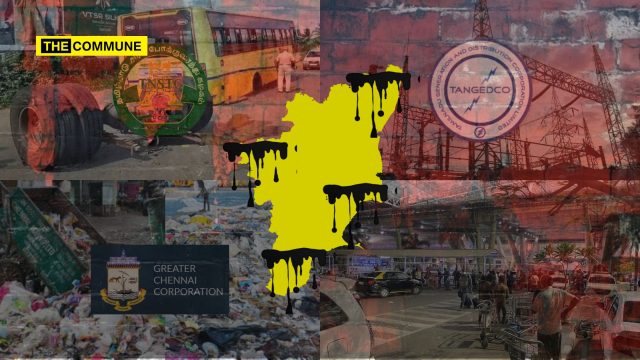
The state transport sector exemplifies the failures of the Dravidian model. Tamil Nadu’s eight transport corporations are drowning in debt that has tripled from ₹6,467 crore in 2017 to ₹21,980 crore currently. The monthly deficit has reached ₹566 crore, with accumulated losses doubling from ₹24,718 crore in 2018 to ₹48,478 crore by 2022.
The CAG report reveals a damning picture: over 1,000 government buses are discarded annually, but only one-third are replaced, reducing the fleet size to 20,600 by 2022. Despite employing 1.2 lakh drivers and conductors whose salaries exceed those in neighboring Karnataka, inefficiency and underutilization plague the system. The government’s response has been to pour more money into a failing system rather than addressing structural issues.
Power Sector: The TANGEDCO Disaster
Perhaps nowhere is the failure of the Dravidian model more evident than in the power sector. TANGEDCO, with accumulated losses of ₹1.62 lakh crore as of 2022-23, holds the dubious distinction of recording the highest accumulated losses among all state power distribution companies in India. The utility’s debt has tripled from ₹43,493 crore in 2011-12 to ₹1,59,823 crore by 2022.
The cross-subsidy model, where industrial and commercial consumers subsidize domestic and agricultural users, has reached unsustainable levels. Over 8.62 lakh consumers owe more than ₹5,132 crore in unpaid bills, yet the government continues to provide free power to farmers and heavily subsidized electricity to domestic consumers. The interest payment alone on TANGEDCO’s loans increased by 259% from ₹4,588 crore in 2011-12 to ₹16,511 crore in 2021-22.
Aviation: From Pioneer to Laggard
Tamil Nadu’s aviation sector, despite its rich history dating back to 1911, has failed to keep pace with modern demands. Chennai Airport operates like a “bus stand,” plagued by inadequate infrastructure, insufficient aerobridges, and poor design. The airport has only four aerobridges at the international terminal, forcing airlines to use remote bays and shuttle buses, creating operational nightmares.
The long-promised Parandur second airport faces environmental challenges and local opposition, while the Hosur airport remains stuck in bureaucratic processes with BIAL’s objections and defense clearance issues. Meanwhile, Bangalore has leveraged its superior airport infrastructure to attract more international flights and business.
IT Industry: The Lost Leadership
Tamil Nadu’s IT sector decline is particularly telling. Once the second-largest IT hub after Bangalore, Chennai has now fallen behind Pune and Hyderabad. Microsoft closed its Chennai office, and many companies are moving operations to Bangalore or Hyderabad due to better infrastructure, talent availability, and business environment.
The reasons are systemic: poor urban infrastructure, inadequate water supply in IT corridors like OMR, conservative social environment, and limited entertainment options compared to Bangalore and Hyderabad. The state government’s focus on manufacturing over services has contributed to this decline.
Urban Infrastructure: Drainage and Roads Crisis
Chennai’s drainage system, despite investments of over ₹1,387 crore in stormwater drains, continues to fail during heavy rains. The 2015 floods exposed the inadequacy of urban planning, and subsequent flooding events have shown little improvement. Only 65% of the city’s road length has drainage networks, leaving expanded areas vulnerable.
Road infrastructure across the state remains abysmal. In Coimbatore, despite ₹400 crore allocation for road repairs, large portions remain broken with potholes and trenches making daily commutes hazardous. The Chennai-Bangalore highway is particularly notorious for its poor condition, forcing travelers to seek alternative routes.
The Great Distraction: Symbolism Over Substance
While Chennai’s drains choke under 40 cm of rain and its roads disintegrate, what dominates political debate? The abolition of surnames and the relentless courting of film personalities.
This is not to say social justice is unimportant. The Dravidian movement was built on a powerful and necessary agenda of social emancipation. But that agenda has been hollowed out. It has been reduced to a political tool, a convenient smokescreen to distract from a comprehensive administrative failure. True social justice is not just about identity; it is about access to quality jobs, reliable infrastructure, clean water, and a government that is accountable for delivering basic services.
The people of Tamil Nadu are not asking for the moon. They are asking for working hand pumps that don’t spew sewage, for roads that aren’t death traps, for an economy that retains its best minds, and for a government that spends more time fixing drains than handing out awards.
The “Dravidian Model”, in its current form, has pushed the state behind. It has traded a legacy of bold, tangible achievement for a present of fiscal decay and infrastructural stagnation. Until we shift the political conversation back to these pressing developmental issues, until we demand answers and accountability, we risk remaining stuck in the past, talking about the glories of a century ago while our future slips away.
Subscribe to our channels on Telegram, WhatsApp, and Instagram and get the best stories of the day delivered to you personally.