Recently, Mohammed Zubair, the co-founder of ‘fact-checking portal’ Alt News, shared a video clip targeting right-wing commentators Ajeet Bharti, Kaushlesh Rai, and Anupam Singh. He accused them of “inciting people to attack the CJI” a week before a shoe-hurling incident. The clip showed a discussion where, while contrasting the “meek” nature of Hindus with Islamists, Kaushlesh Rai made inflammatory hypothetical remarks about Justice Gavai, including suggesting someone “hit him hard against the wall” and questioning the maximum punishment for spitting on him.
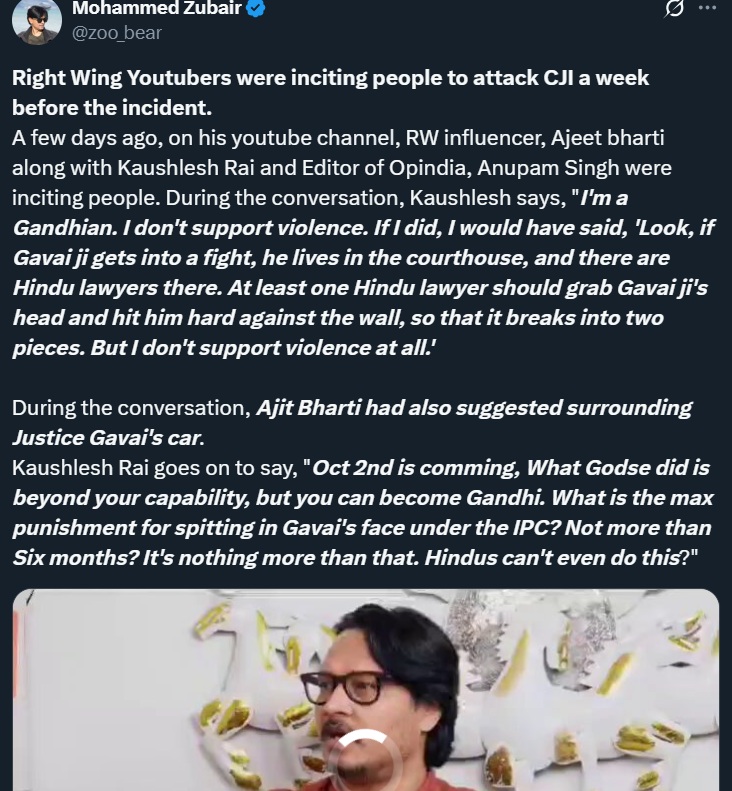
For Zubair, this was a clear-cut case of incitement. Yet, a thorough examination of his own extensive record reveals a career defined by a far more effective, dangerous, and consequential pattern of dog-whistling, instigation, and providing justifications for mob violence, often with fatal results. The case against the “right-wing Youtubers” pales in comparison to the trail of real-world consequences left by Zubair’s own actions.
The Nupur Sharma Episode: Clip Cutting And Instigating A Mob
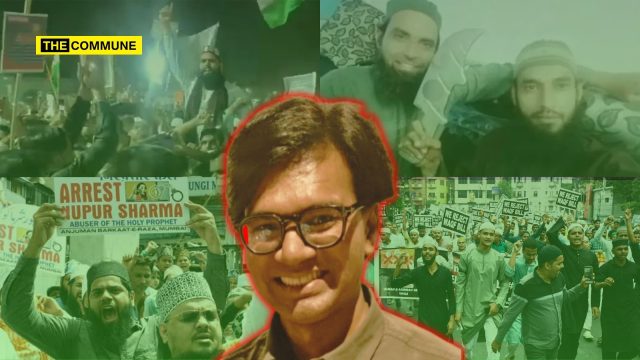
The template was set with the Nupur Sharma case. Zubair did not merely fact-check; he weaponized an edited clip of a news panel discussion. By isolating Sharma’s remarks and amplifying them across social media without the provocative context from other panelists, he single-handedly painted a target on her back.
The result was not a debate but a fatwa. Islamist groups across India and the world issued death and gang-rape threats, forcing Sharma into permanent hiding. Effigies were burnt, and global terror organizations put a bounty on her head. The “fact-check” had morphed into a deadly incitement notice. This act of digital targeting directly set the stage for the next, more brutal consequence.
From Incitement To Execution: The Brutal Beheading Of Kanhaiyalal
The chain of events Zubair helped initiate did not stop at threats. The barbaric beheading of Kanhaiyalal, an innocent tailor in Udaipur, was carried out by Islamists who explicitly cited the defence of the prophet as their motive, a fire lit by the very controversy Zubair amplified.
While Nupur Sharma was forced into hiding and Kanhaiyalal was brutally murdered, Tasleem Rahmani, the individual who originally abused the Shivlinga found in the Gyanvapi mosque, provoking Sharma’s response faced no such threats and continues to appear on national television. The selective amplification and the resulting violence revealed a clear and disturbing pattern: Zubair’s “fact-checking” consistently served to inflame one side while providing the narrative fuel for real-world violence against the other.
The Judiciary Takes Note: Courts Call Out His Motives
Zubair’s methods have not gone unnoticed by the judiciary. In December 2024, the Allahabad High Court delivered a scathing critique of his actions related to his posts on Yati Narsinghanand. The court questioned why he chose to use social media instead of legal channels, accusing him of inciting “social disharmony.”
Justice Siddhartha Varma remarked, “Come to the court. Why create social disharmony through social media? A glance at your tweet shows you are inciting unrest.” The court was unconvinced by his defence of free speech, with the judge pointedly asking, “Is there any law that permits someone to use Twitter instead of approaching the court?”
The Uttar Pradesh government argued that Zubair had distorted Narsinghanand’s remarks to provoke unrest. The seriousness of his actions is reflected in the charges filed against him, which now include Section 152 of the Bharatiya Nyaya Sanhita (BNS) for acts that endanger India’s sovereignty, unity, and integrity. An FIR accused him, along with Asaduddin Owaisi and Arshad Madani, of inciting violent protests at the Dasna Devi Mandir, with a lookout notice issued against him.
Justifying A Murder: The Tragic Case Of Gopal Mishra
Perhaps the most chilling aspect of Zubair’s modus operandi is his attempt to justify murder. In October 2024, a 22-year-old Hindu man, Ram Gopal Mishra, was shot 20 times during a communal clash in Bahraich, Uttar Pradesh, that began over objections to a Durga immersion procession.
Instead of condemning the horrific killing, Zubair swiftly circulated a video showing Mishra removing a green flag and replacing it with a saffron one. His tweet, “A video of Gopal Mishra in the Bahraich violence has surfaced. He is seen forcefully removing a Green flag… Gopal was shot dead later,” was a clear attempt to rationalize the murder by portraying the victim as the aggressor.
This narrative deliberately ignored the context of stone-pelting and the fact that Mishra was dragged into a house and executed. It was a blatant act of providing moral cover for a lynching.al-world implications for how violence is justified or normalized.
The Badaun Double Child-Murder Narrative Play And Police Rebuttal
In April 2024, Zubair suggested that authorities concealed the motive behind the gruesome murder of two Hindu children in Badaun by implying a link to an unrelated arson case allegedly involving the victims’ father. Police issued legal warnings against spreading inflammatory misinformation, and the family itself clarified there was no dispute with the accused; police later confirmed a planned murder by Sajid, with Javed being pursued. Zubair deleted the post, but the episode exposed a persistent tendency: opportunistic insinuation and misleading linkage to redirect blame and dilute public focus on perpetrators and their
The Anand Ranganathan Episode: Misframing A Security Doctrine As “Call For Genocide”
In June 2024, JNU professor Anand Ranganathan advocated an “Israel-like solution” for Kashmir – meaning settlements, rehabilitation of victims, counter-terror operations, and border security. Zubair reframed this as an “open call for genocide of Kashmiris,” equating a hardline counter-terror/rehabilitation doctrine with extermination – a serious and inflammatory mischaracterization. Ranganathan publicly clarified that he opposed genocide and called for preventing “another genocide” by safeguarding victims and fighting terror. The episode fits the pattern: compress complex policy into a moral smear line to mobilize outrage.
Shielding An Ecosystem: The OpIndia Case And DMK’s Xenophobia
In March 2023, Zubair’s role as a partisan actor was further exposed during the migrant worker crisis in Tamil Nadu. When reports emerged of Hindi-speaking migrants feeling unsafe and leaving the state, OpIndia reported on the situation based on Dainik Bhaskar’s report, leading to an FIR against them based on a complaint by a DMK IT Wing member – a complaint that directly referenced Zubair’s tweets.
While Zubair eagerly targeted OpIndia, he completely whitewashed the pervasive xenophobic rhetoric from DMK leaders and their allies, who have routinely used slurs like ‘Vadakkan’ and ‘Paani Puri wala’ and openly incited hatred against North Indians. His “fact-checking” was selectively deployed to shield a friendly political ecosystem from accountability, demonstrating that his mission is not truth, but narrative control.
“Serial Fake News Peddler” – Criticisms, Prior Arrests
Zubair’s detractors note multiple instances of peddling manipulated content, targeting Hindu groups or leaders, and massaging context to produce a volatile, one-sided moral narrative. In June 2022, he was arrested by Delhi Police under IPC 153 and 295 following old posts that stoked religious animosity and for allegedly fueling online hate ecosystems. Police said he was evasive and uncooperative during the probe; the episode framed him not as dispassionate fact-checker but as a political actor wielding virality to target ideological opponents.
The Serial Instigator In A Fact-Checker’s Disguise
Zubair’s operating system thrives on curated clips and moral panic. The judicial concern is not abstract: when a user with vast reach consistently frames targets as bigots and villains, volatile crowds respond.
Across all the above episodes, the pattern is unmistakable: selective posting, incendiary framing, and weaponized virality that courts have flagged as creating social disharmony and proximate triggers to violence. This is not being neutral or doing verification work. It is politico-religious agitation by clip, and it normalizes vigilantism and communal mobilization while providing semantic cover as “fact-checking.”
Subscribe to our channels on Telegram, WhatsApp, and Instagram and get the best stories of the day delivered to you personally.