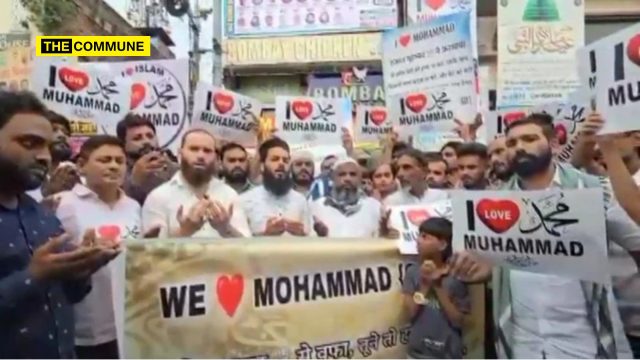
India has in recent weeks been rocked by violence triggered by the so-called “I Love Muhammad” campaign, which, far from being a spontaneous show of religious devotion, has revealed itself to be a calculated attempt to create communal fissures across multiple states.
What began as a small poster in Kanpur has mushroomed into riots, arson, and stone-pelting in Gujarat, Uttarakhand, Uttar Pradesh, and beyond. The evidence shows that this is not an isolated flare-up of sentiment but a coordinated Islamist effort, politically backed by certain opposition parties, to destabilize Hindu-majority states and embarrass the Indian state on the global stage.
How It Started
The playbook was first exposed in Kanpur, Uttar Pradesh, on 4 September 2025. During Barawafat celebrations, an “I Love Muhammad” light board was installed not in a neutral space, but deliberately opposite the traditional route of a Hindu Ram Navami procession in Syed Nagar, an area with a long-established history of Hindu religious events. This was not an innocent act of faith; it was a calculated provocation, a “new tradition” imposed without any community consultation, designed to test and breach local sensitivities.
As police rightly intervened to maintain order, the instigators pivoted to a well-rehearsed second act: victimhood.
The very next day, unidentified Muslim youths attacked a Hindu locality in Rawatpur, damaging religious posters. Yet, when an FIR was filed for promoting communal hatred and vandalism, not for the slogan itself, a massive, coordinated disinformation campaign was launched
Gujarat Clashes: The Fault Line Explodes
The latest eruption came on 24 September 2025 in Bahiyal village, Gandhinagar district, Gujarat. A Hindu youth uploaded a WhatsApp status saying “I Love Mahadev” in response to the circulating “I Love Muhammad” trend. This ordinary expression of faith was enough to trigger violence. A Muslim mob vandalized his shop, attacked Garba celebrations, hurled stones, set vehicles on fire, and even damaged police jeeps. More than 200 were involved, 60 were arrested, and an entire village was thrown into panic.
The Spread of a Manufactured Campaign
The roots of this campaign lie in Kanpur, Uttar Pradesh, where on 4 September 2025, during the Barawafat procession, organizers installed a giant light board with “I Love Muhammad” written on it in Syed Nagar. This was not a traditional practice; it was a unilateral innovation placed directly in the path of the Ram Navami procession route. Police quickly removed and relocated the board, but the damage was done. The next day, Muslim youths vandalized Hindu religious posters, and on September 10, cases were filed under IPC Section 153A for promoting communal hatred.
Instead of respecting the law, Islamist groups reframed the incident as an “attack on Muslims” and flooded social media with the hashtag #ILoveMuhammad. AIMIM chief Asaduddin Owaisi, along with other leaders, amplified the narrative that Muslims were being criminalized simply for expressing love for their Prophet, deliberately concealing the violence that had taken place.
From there, the unrest spread:
- Kashipur, Uttarakhand: 500 Muslims, mobilized by Samajwadi Party leaders Nadeem Akhtar, Anis Gandhi, and Danish Chowdhury, took out an unauthorized procession. Police were attacked, chased, and beaten; vehicles vandalized; seven arrested.
- Kaushambi, UP: Children were caught chanting “Sar Tan Se Juda,” the jihadist slogan calling for beheading, during an “I Love Muhammad” march. Video evidence showed minors brandishing placards and chanting hatred.
- Bareilly, UP: Over 1,000 Muslims gathered near Islamia Ground. What began as a rally turned into stone-pelting, vandalism, and even gunfire. Police resorted to lathicharge and tear gas; 10 policemen were injured.
- Nagpur, Maharashtra: Congress minority leader Vaseem Khan led demonstrations in Mominpura, openly politicizing the slogan.
- Hyderabad, Telangana: AIMIM workers staged protests framing the FIRs as “anti-Muslim persecution.”
Political Linkages and Subversive Strategy
The controversy has exposed direct political involvement. In Kanpur, police arrested Zubair Ahmed Khan, a dismissed constable turned Samajwadi Party worker, for circulating a provocative audio clip after Friday prayers, designed to mobilize mobs. His photos with senior SP leaders quickly went viral, giving the agitation a clear partisan shade.
If we analyze the sequence of the protests, we can identify six deliberate steps in this Islamist playbook:
- Create an emotional slogan – “I Love Muhammad” – seemingly harmless but loaded with identity politics.
- Mobilize through WhatsApp/social media – ensure mobs assemble instantly after Friday prayers.
- Confront police – provoke action, record videos of clashes.
- Internationalize the narrative – feed visuals to Amnesty, Human Rights Watch, and hostile foreign think tanks.
- Frame Hindus as oppressors – through critical race theory-style interpretations that cast minorities as “blacks” and Hindus as “whites.”
- Globalize Hinduphobia – present India as “Islamophobic” to UN forums, US Congress, and Western academia.
This is a classic case of weaponized narrative warfare, with Islamist networks, opposition parties, and foreign powers in sync.
A Threat to Indian Social Fabric
At its core, this campaign undermines India’s pluralistic balance. Expressing love for the Prophet is not the issue; the danger lies in imposing new traditions in mixed localities, deliberately ignoring sensitivities, vandalizing rival religious symbols, and then playing the victim card.
By chanting “Sar Tan Se Juda,” assaulting police, and vandalizing Hindu shops, the campaign is not about devotion, it is about intimidation. The Islamists behind it are creating something like an “Islamic Gen Z” radicalization wave, inspired by unrest in Nepal, and seeking to transform street protests into a nationwide anti-Hindu, anti-India movement.
Why It Must Be Resisted
The “I Love Muhammad” movement is dangerous because:
- It weaponizes faith as a political tool.
- It imposes unilateral traditions that breed conflict.
- It normalizes extremist slogans like “Sar Tan Se Juda.”
- It seeks international intervention against India.
- It aims to guilt-trip Hindus while concealing violence committed by mobs.
The fact that this campaign has been endorsed by Islamist leaders, amplified by opposition parties, and supported through orchestrated violence proves that it is not a devotional slogan but a deliberate strategy of destabilization.
Last Word
The “I Love Muhammad” campaign is dangerous precisely because it is not about love. It is a political and subversive tool, inspired by global Islamist playbooks, aimed at disrupting India’s religious harmony and also the country’s political stability. It deliberately provokes, then feigns victimhood, and finally unleashes violence when confronted.
To counter this, the state must act firmly against all violence and vandalism, regardless of the perpetrator. But more importantly, the public must see through this charade. If left unchecked, “I Love Muhammad” could become the seed of a larger Islamist insurgency. True devotion never destroys harmony, it builds it. The “I Love Muhammad” campaign, however, has brought only arson, bloodshed, and division.
We must recognize that this is not a debate over religious freedom, but a deliberate and dangerous conspiracy to break India, one communal clash at a time. The stability of the nation depends on seeing this threat for what it is and rejecting its divisive agenda outright.
Subscribe to our channels on Telegram, WhatsApp, and Instagram and get the best stories of the day delivered to you personally.