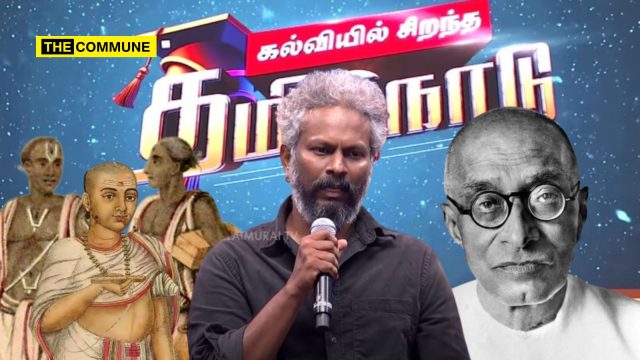
The DMK government’s latest showpiece event, ‘Kalviyil Sirantha Tamil Nadu’ (Tamil Nadu That Excels In Education), held on 25 September 2025 in Chennai, has drawn widespread criticism for being less a platform for serious educational discourse and more a carefully curated propaganda exercise in the run-up to the 2026 Assembly elections. What was billed as a celebration of Tamil Nadu’s educational achievements quickly devolved into a stage-managed spectacle featuring film celebrities showering excessive praise on the Chief Minister and parroting Dravidian ideological soundbites without a single academic, educator, or policy expert given a voice.
Even in what was supposed to be an educational program, Dravidianist elements couldn’t resist injecting their usual dose of anti-Brahmin vitriol. Director Thiagarajan Kumararaja, for example, used his platform not to assess the state’s educational progress, but to regurgitate tired Aryan-vs-Dravidian tropes, dredging up puranas and itihasas and caste grievances to push a divisive narrative. His speech focused almost entirely on alleged Brahminical oppression, turning the event into yet another opportunity to weaponize history against a single community.
Kumararaja went further, insinuating that central government policies are covertly designed to suppress the social mobility of marginalized communities. His remarks lumped together purana/itihasa figures like Dronacharya and Kripacharya with real-life statesman C. Rajagopalachari, branding them all as part of an unbroken chain of Brahminical gatekeeping. He then lauded the DMK as liberators, holding up populist schemes like free bicycles and laptops as revolutionary acts of social justice.
While such rhetoric may please the DMK’s hardcore ideological base, it ultimately trivializes the complex and nuanced challenges facing education today. By reducing everything to a binary of “oppressors vs. the oppressed,” the event foreclosed any meaningful discussion on policy reform, curriculum development, or systemic improvement. What could have been a platform for educational innovation instead became just another echo chamber for political self-congratulation.
The Sangam Era Poem and Education
Director Kumara Raja Thiagarajan begins by quoting a Purananuru poem (Puram 183) by the Sangam-era Pandya king Aariyappadai Kadantha Nedunjeliyan.
The key lines of the poem (last two lines), “Keelpal oruvan karpin, merpal oruvanum avan kan padume,” translate to, “If a person from a lower-status group acquires knowledge, even a person from a higher-status group will seek him out.”
Contrary to Kumara Raja’s Dravidian-lens interpretation, this poem clearly shows that during the Sangam era, all four so-called social statuses (varnas) had access to education, and learned individuals were respected regardless of their social background. This directly contradicts current political rhetoric suggesting that education was historically denied to certain groups in ancient times.
Instead, this suggests that the widespread loss of access to education occurred much later presumably during the last 1,000 years, coinciding with the Mughal invasions and British colonial rule. This stands in opposition to the claims made by Dravidian ideologues like E.V. Ramasamy (Periyar) and Bishop Robert Caldwell.
Dravidian Education vs. ‘Aryan’ Education
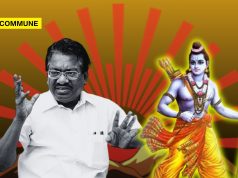
Thiagarajan then introduces a divisive narrative, contrasting “Dravidian Education” with “Aryan Education,” and accuses ancient Acharyas of denying education to the masses following in the footsteps of ideologues who promote blatant anti-Brahmin sentiment. He cites purana/itihasa figures like Dronacharya, Kripacharya, and even former Chief Minister of Tamil Nadu Rajaji (C. Rajagopalachari), accusing them of obstructing public education.
However, these claims are not only baseless but historically flawed.
For example, Kumararaja claims that Guru Dronacharya demanded Ekalavya’s thumb as Guru Dakshina because he was a Brahmin and that this act was to restrict others from learning. But in reality, Dronacharya was teaching Kshatriyas (the Pandavas and Kauravas), not Brahmins. His controversial action, whether right or wrong, was done in favor of the Kshatriyas not the Brahmins undermining the narrative of a Brahmin-led conspiracy to hoard knowledge.
Kumararaja further attacks Rajaji for introducing a skill-based education model in 1953, which the DMK labeled “Kula Kalvi Thittam” (Hereditary Education Scheme), forcing his resignation in 1954. But if the DMK truly opposed Rajaji, why did they later form an alliance with his Swatantra Party in the 1967 elections and win? This reveals a blatant inconsistency in their political stance criticizing when it suits them and partnering when it benefits them.
Moreover, Kumararaja conveniently ignores hereditary politics. He doesn’t seem to object when the same “hereditary system” is followed in political dynasties by birth, such as the Nehru-Gandhi family nationally, or the Karunanidhi family in Tamil Nadu M.K. Stalin, Udhayanidhi, and others.
Despite virtue signaling against caste oppression, Kumararaja never raised his voice during any of the caste-related killings that occurred in Tamil Nadu perhaps he was too busy with film shoots. A classic example of the DMK’s idea of “social justice” and a casteless society is from 2020, when DMK MP Dayanidhi Maran, addressing journalists after a meeting with Chief Secretary K. Shanmugam, said, “Are we third-rate citizens? Oppressed?” using the Tamil term ‘thazthapatavaragala’ to describe themselves as “oppressed.”
Again, in July 2024, senior DMK leader and Organizing Secretary R.S. Bharathi allegedly made a derogatory remark, “If it was not for the alms of the Dravidian movement and communal GO, so many doctors and engineers wouldn’t exist today. When I studied BA, only one person in the town had a degree. Now, everyone has one even a dog gets a BA degree. The Dravidian movement is responsible for this development.”
Is this the quality of education and mindset taught under Dravidian ideology? That’s a question left for Director Kumara Raja to answer.
National Education Policy (NEP) Criticism
While Kumararaja criticizes the NEP and promotes the Dravidian agenda on stage, ironically, a student delivered a fluent speech in Japanese and the audience applauded. The NEP also encourages the study of any third language, Indian, yet the DMK opposes this.
However, Tamil Nadu government schools already teach Japanese, Urdu, Telugu, Malayalam, and French while rejecting a formal three-language policy. Where is the consistency in this argument? Is it that they don’t want students from marginalized backgrounds to enjoy elite benefits like language education?
It seems the DMK prefers a spectacle film stars in the front row, while educated officers and retired judges are pushed to the second seat.
Director Thiagarajan Kumararaja’s Full Speech
Speaking at the event Director Thiagarajan Kumararaja said, “A Pandyan king wrote a poem about education 2,000 years ago. Mr. Balakrishnan has spoken about it in many places. The last four lines are very important, “Vetrumai porunthiya naarpaal ullum, Keelpal oruvan karpin melpal oruvanum avan kan padume.” (Even among the four castes, if a person from a lower caste learns, a person from a higher caste will seek him out)
Education has two qualities. One quality is what he is talking about now, if a person from a lower class gets an education, it will force a person from a higher class to respect and associate with them. This is the first reason. The second thing… What does education do is… mentioned in a song from the book Viveka Chintamani, “It cannot be taken by flood, nor burned by fire, nor taken by kings. It will not decrease when given.”
Why do we study? We study to get a good job, earn money, and take care of our family, parents, and children. If I give away one crore rupees to someone, they can live happily, but I will no longer have that one crore. But with education, when we earn money, the knowledge keeps me wise and also makes the receiver wise. The knowledge I have reaches them and makes them my equal or elevates me to their level. This is why from ancient times until now, people have been prevented from getting an education. This is a very, very important point. We must think about why we, who were so educated, lost our education in the middle.
There are two ideologies regarding education. One is the Dravidian ideology that everyone should be educated, and everyone should be intelligent. From the time of the Pandyan Neduncheliyan to the Bharathiyar in the last century, he also said, “Even though you build a thousand inns and a thousand temples…” and at the end of it he said that a greater virtue, a crore times greater, is to provide education to a poor person. Such a virtuous act is providing education. Now, what happened with the Aryan ideology? A boy who wanted to learn went to a teacher and asked to be taught, but he was asked what caste he belonged to and was refused. But when he taught himself archery and stood before him, the teacher took his thumb. When Karna wanted to learn from him, he asked Karna what caste he was and sent him away. When Karna asked Kripacharya, he lied and said he was from a high-class family to learn from him, but when Kripacharya found out he wasn’t, he cursed him, saying all the knowledge he learned would leave him one day, and he took it away from him.
From Dronacharya and Kripacharya to Rajagopalachariar, they have been preventing us from getting an education. But against this ideology, which says there should not be equality, a party and an ideology that says there should be social justice and equality is in power, and they are putting in place as many schemes as possible to make sure everyone gets an education. They provide morning meals, and there are programs like Naan Mudhalvan and Tamil Pudhalvan. They have a series of schemes to make sure everyone gets an education. They even provide laptops and bicycles to people for free. They want you to get an education and rise up. To prevent this, just as they asked for the thumb and cursed Karna with amnesia, they have now brought in a new education policy to stop you from studying. And because we said we would not accept this, they are refusing to give us the 2150 crores that are rightfully ours.
Now, when a party that we disagree with politically is in power at the union, the Chief Minister has worked hard to save the people of Tamil Nadu, like someone who has been thrown into water with their hands and legs tied yet still manages to swim and save others. I express my heartfelt thanks to this Chief Minister. Thank you.”