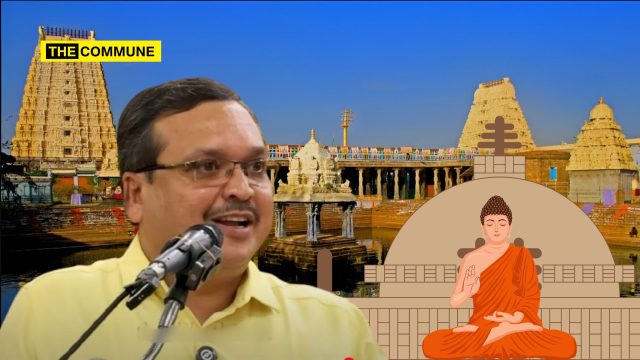
Dravidian sympathiser and archaeologist K. Amarnath Ramakrishna has once again drawn severe criticism from Tamil scholars and historians after attempting to rewrite well-established history of ‘Kanchipuram’. In his latest controversial claim, Ramakrishna asserted that Kanchipuram, a city revered in Sangam literature and celebrated in ancient Tamil poetry was not a Sangam-era city. Instead, he labeled it a later Vedic and Buddhist settlement, pushing yet another narrative to please the Dravidian ideological ecosystem.
His comments were made during a lecture titled “Excavated and Unexcavated” at the centenary symposium on the Indus Valley Civilization, organized by the Tamil Nadu Progressive Writers and Artists Association a group notorious for pushing Dravidianist interpretations of history and the same outfit that hosted a conference with Deputy Chief Minister Udhayanidhi Stalin under the provocative banner, “Eradicate Sanatana Dharma.”
Ramakrishna cited the University of Madras’ excavations at Kanchipuram (1975–1982), claiming that their full report was never published. Referring to Professor Gurumoorthy’s study, he pointed out the absence of Black and Red Ware pottery at the site, a common archaeological marker of Sangam-era settlements. According to Ramakrishna, this absence proves Kanchipuram was not a Sangam city, but a later development celebrated by “Vedic people” as Ghatikasthanam, or a center for Vedic learning. He further claimed that excavations near the Kamakshi Amman Temple uncovered a Buddhist stupa conveniently framing the city as primarily Buddhist, thus aligning with the Dravidianist disdain for Hindu heritage.
Speaking at the conference Amarnath Ramakrishna said, “If you look at the place called Kanchipuram, the University of Madras continuously excavated the site for almost seven years, from 1975 to 1982. But does anyone know what information about Kanchipuram was revealed? Does anyone know what they excavated? Only a handful of information, maybe a para, has emerged, but the full report has not yet been released. The complete excavation report for Kanchipuram has not been published by the University of Madras. No one has ever asked for it. Professor Gurumoorthy, who was part of that excavation team, wrote a book called Ceramic Traditions of South India. In that book, he specifically notes that while Black and Red Ware pottery sherds are found in many parts of India, from the Indus Valley Civilization onwards, and are prevalent in Tamil Nadu, they were not found in Kanchipuram. This is a crucial piece of information.
This significant finding suggests that Kanchipuram is not a city from the Sangam period but a later development. This is why Vedic people celebrate it, because Kanchipuram is referred to as Ghatikasthanam. Ghatikasthanam means a place where a school for Vedic traditions was established. The excavations also suggest that the city of Kanchipuram was built at a later time. If you consider the old Chengalpattu district around Kanchipuram, wherever excavations have been carried out, evidence of Black and Red Ware pottery sherds and megalithic burials are found. However, the Kanchipuram excavations revealed that not a single piece of Black and Red Ware pottery was found. This is a note made by Professor Gurumoorthy. Our history is incomplete because such important information remains unreleased. Similarly, Kanchipuram is also a Buddhist city. The trench for the excavation was dug near the Kamakshi Amman Temple. At that site, a Buddhist stupa was unearthed, indicating that a Buddhist stupa existed in Tamil Nadu and the temple was built on top of it. The excavation report has not properly released information about the site of the Buddhist stupa. Because the report has not been published, this information has not been widely disseminated.”
காஞ்சிபுரத்தை கடிகாஸ்தானம் என்பார்கள்
ஏன் தெரியுமா?அமர்நாத் ராமகிருஷ்ணா, தொல்லியல்துறை இயக்குநர்Full Video : https://t.co/VNGGOkAiCB#Theekkathir | #kanchipuram | #excavation pic.twitter.com/iX1mKQipQS
— Theekkathir (@Theekkathir) September 21, 2025
This narrative, however, has been roundly rejected by credible Tamil historians and scholars who accuse Ramakrishna of bending facts to fit ideological agendas. Critics argue that his theory not only ignores substantial literary evidence but also misrepresents the very nature of the Sangam period which was deeply intertwined with Vedic culture.
Take, for instance, the Sangam classic Perumpāṇāṟṟuppaṭai, which explicitly mentions Kanchipuram and its ruler Thondaiman Ilanthiraiyan, “Onnath Tholvar Ulayvidathu Aarthu Kachiyona Kaivan Thondral,” (ஒன்னாத் தெவ்வர் உலைவிடத்து ஆர்த்துக் கச்சியோனே கைவண் தோன்றல்) which translates to, “He who ruled from Kanchipuram roared in triumph when enemies dared defy him.”
The poem goes on to explain how the city got its name from the abundance of Kanchi trees and refers to it as a “moodhoor” an ancient, prosperous city known for its festivals and cultural richness. These references make it indisputably clear that Kanchipuram was already a flourishing urban center during the Sangam era long before any Buddhist influence.
Even more telling is the poem that describes Karikala Chola, one of the most iconic kings of the Sangam age, halting at Kanchipuram’s Kamakshi temple to offer worship on his expedition to the Himalayas, “Kachi Valaikachi kaamakotangaval mechiyinithirikum meichathan kaichendu kamba kalitraan karikaalperuvalathaan sempon girithiritha sendu” (கச்சி வளைக்கைச்சி காமகோட்டங்காவல் மெச்சியினிதிருக்கும் மெய்ச்சாத்தன் கைச்செண்டு கம்ப களிற்றான் கரிகாற்பெருவளத்தான் செம்பொன் கிரிதிரித்த செண்டு) which translates to, “In Kanchi, at Kamakottam where Kamakshi adorned with bangles dwells, Karikala Chola worshipped her. With the sacred staff of Sastha in hand, he struck the golden peaks of the Himalayas.”
This verse alone shatters Ramakrishna’s attempt to write Kamakshi and Kanchipuram out of the Sangam-era spiritual landscape. It confirms both the temple’s existence and the continuity of goddess worship in the region, directly contradicting the idea that the site was primarily Buddhist.
Additionally, Perumpanatrupadai also praises the Thiruvehka Vishnu Temple, calling it the resting place of Mahavishnu on Adisesha further evidence that Kanchipuram was a vibrant hub of Vedic and Sanatana culture long before the period Ramakrishna suggests, “Kaandhal am silambil kaliru padinthaangu paambanai pali amarnthen aangan,” (காந்தள் அம் சிலம்பில் களிறு படிந்தாங்கு, பாம்பணைப் பள்ளி அமர்ந்தோன் ஆங்கண்) which translates to, “Just as an elephant rests peacefully in the mountain, the one who reclines on the serpent bed (Vishnu) rests there.”
Ramakrishna’s selective quoting, suppression of literary sources, and reliance on unpublished or partial excavation data has led many to accuse him of being less of a scholar and more of a mouthpiece for political propaganda. His eagerness to label everything “non-Vedic” or “Buddhist” while dismissing Tamil Hindu heritage reflects a broader agenda one that seeks to erase or reframe history to fit a Dravidianist narrative.
In trying to paint Kanchipuram as a non-Sangam, non-Hindu city, Ramakrishna isn’t just wrong he’s actively undermining centuries of Tamil history, literature, and identity. And all for what? To gain applause from a political ecosystem that thrives on historical distortion and selective memory.
The ASI officer is factually mistaken once again, in claiming that Kanchipuram was not a Sangam-era city because it was “not Vedic.” Apart from the fact that the Sangam era itself was deeply Vedic in nature, as the Sangam texts contain innumerable references to Vedic culture,… https://t.co/8zuO9i0WYq
— 𑀓𑀺𑀭𑀼𑀱𑁆𑀡𑀷𑁆 🇮🇳 (@tskrishnan) September 22, 2025
Subscribe to our channels on Telegram, WhatsApp, and Instagram and get the best stories of the day delivered to you personally.