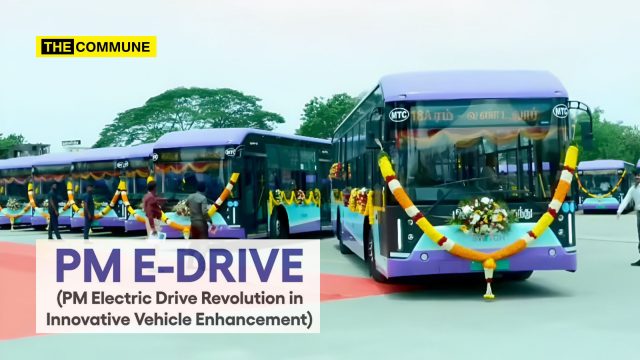
The Tamil Nadu government has opted out of the Central Government’s e-Drive initiative, declining the allocation of 900 buses designated for 11 cities across the state. While several other states have actively embraced the scheme, Tamil Nadu has expressed disinterest, citing concerns over the implementation structure.
The Central Government is currently rolling out two major green mobility initiatives PM e-Bus Sewa and PM Electric Drive aimed at promoting electric public transport as part of its environmental agenda. Announced in 2023, the PM e-Bus Sewa scheme has a total budget of ₹57,613 crore and plans to deploy 10,000 electric buses across 169 cities in two phases.
As per the scheme’s guidelines, cities with populations exceeding 40 lakhs are excluded. Based on the 2011 Census data, cities with populations between 20 and 40 lakhs are to receive 150 buses each, those between 5 and 20 lakhs are allocated 100, and cities below 5 lakh population are to receive 50 buses.
The central government will fund the operational cost of the buses based on a per-kilometer fare model, while the procurement, maintenance, and day-to-day operation are to be handled by private firms selected through a tender process. These firms will operate the buses until 2037. Although the state governments retain control over fare collection and advertising revenue, they are expected to provide the necessary infrastructure, such as charging stations for which the Centre is also offering financial aid.
So far, the scheme has seen strong uptake. The Centre has approved the deployment of 7,293 buses in various states, with tenders floated for 6,518 of them. Additionally, ₹437 crore has already been disbursed to eight states to support infrastructure development, including charging facilities.
Under this scheme, Tamil Nadu was allocated 900 electric buses for 11 cities: Coimbatore (150), Madurai, Trichy, Salem, Erode, and Tiruppur (100 each), and Ambattur, Avadi, Thoothukudi, Tirunelveli, and Vellore (50 each). Despite this, officials from the state government have reportedly declined participation.
According to a central official, Tamil Nadu was allotted 9% of the total buses under the scheme, and formal communication had been sent to the state. However, Tamil Nadu officials responded that no request was received from their end, indicating a lack of interest in participating.
When asked about the rationale behind this decision, Tamil Nadu’s Minister for Transport, S.S. Sivasankar, offered an explanation. Speaking at the Chennai Secretariat, he stated that central government schemes often come with constraints where “only the name is ours, but the funds don’t come as expected.” He clarified that this is why the Tamil Nadu government has decided to implement its own electric bus program independently, rather than relying on the centrally funded scheme.
Meanwhile, Chennai one of India’s major metropolitan areas has also been excluded from the PM e-Bus Sewa due to its population exceeding 40 lakh. Instead, Chennai is eligible under the PM Electric Drive initiative, under which the Centre is supporting the procurement of 14,000 electric buses across cities like Delhi, Mumbai, Bengaluru, Hyderabad, Kolkata, Ahmedabad, Surat, and Pune. However, the Tamil Nadu government has similarly chosen not to avail this opportunity for Chennai.
(With inputs from Maalai Malar)
Subscribe to our channels on Telegram, WhatsApp, and Instagram and get the best stories of the day delivered to you personally.