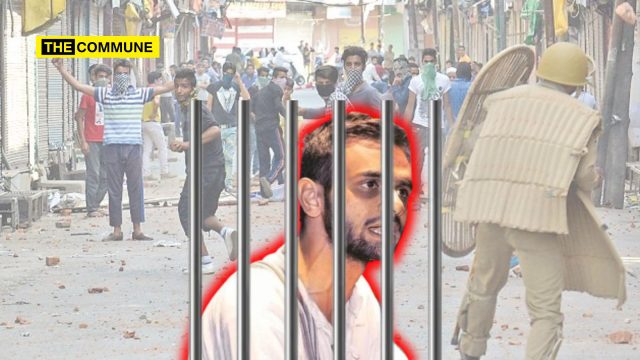
Umar Khalid, one of the main accused in the 2020 Delhi riots case, was denied bail by Delhi High Court yet again. However, the leftists and their media channels portray it as if the problem is with the courts – documents show otherwise – that it was an intentionally engineered tactic to delay facing trial.
His “comrades” have tried to paint Umar Khalid as a victim, a harmless academic persecuted by an authoritarian state. Petitions, op-eds, and international platforms have repeated the same script: Khalid is an “innocent” voice of dissent silenced by the government. But when we step away from the propaganda and examine Khalid’s own speeches, especially his 2016 address on Kashmir, a very different picture emerges.
This is not the voice of an innocent. This is the rhetoric of a man who openly challenges India’s sovereignty, delegitimizes democratic institutions, normalizes violence, and works to unite separatist and insurgent movements under a single banner. In the speech, he makes several secessionist statements, praises the “periyarite” movement, calls stone pelting a form of Gandhian protest, portrays the Army as the villains and others Indians from Kashmir. He also says that there will be peace if we let go of Kashmir. Let’s now take a deeper look at the statements he makes in his 42-minute speech.
Not Free Speech, But Sedition
Khalid’s speech is not an example of free speech, it is a manifesto of sedition. Here are the most damning statements that build an incontrovertible case for why he represents a clear and present danger to the integrity and security of the nation.
Kashmir Is Illegally Occupied By India
In a video that is now viral on social media, he says, “I am against the occupation of Kashmir by the Indian state and I make it very apparent here, I am not from Kashmir.”
“Kashmir is illegally occupied by India” – Umar Khalid
Anybody who supports this man is a potential terr*rist…. pic.twitter.com/pEFMHOQg10
— Mr Sinha (@MrSinha_) September 2, 2025
Explicit Denial of Indian Sovereignty over Kashmir
Khalid does not mince words in his 2016 speech when it comes to his stance on Jammu and Kashmir. He explicitly echoes and endorses the secessionist position while invoking Dravidianist ideologue EV Ramasamy Naicker (Periyar). He says, “Periyar very eloquently and very straightforwardly said that Kashmir neither belongs to India. Kashmir neither belongs to Pakistan. Kashmir belongs only to the people of Kashmir.”
He then bemoans the fact that stating this position in Delhi would incite a “lynch mob,” establishing that he is fully aware that this view is a direct challenge to the constitutional framework of India. He isn’t advocating for a political discussion within the Indian Union; he is advocating for its dissolution in the region.
Advocacy for Plebiscite and Secession
Going beyond a mere opinion, Khalid champions a specific action that is the cornerstone of separatist and Pakistani policy: a plebiscite. Invoking BR Ambedkar, he said, “What Babasaheb Ambedkar said in his last speech after resignation of the cabinet that there should be a plebiscite in Kashmir…”
By championing a plebiscite, an idea India has legally and diplomatically rejected for decades, Khalid aligns himself with forces that seek to break the country apart. His grievance is that he cannot openly call for this division in Delhi without consequence. He speaks the language of self-determination – not within the Indian Union, but outside it.
When someone insists that Kashmir is “occupied” and that India is no different from a colonial oppressor, they are not engaging in democratic debate. They are advancing the very separatist agenda that fuels militancy and terrorism in the Valley.
Moral Equivalence and Sympathy for Terrorists
Perhaps the most grotesque part of Khalid’s speech is his attempt to humanize and rationalize the path of terrorism. Speaking about slain Hizbul Mujahideen commander Burhan Wani, he asks, “Do we go and tell the Kashmiris that many of them who might be thinking of going the same path as Burhan that please don’t pick up the gun. Please participate in the next elections.”
This is an apology. He dismisses democratic participation as futile due to “rigged elections,” thereby implicitly justifying armed insurgency as a logical alternative. He creates a false binary where Kashmiris only have the choice between a “corrupt” election and picking up a gun, completely ignoring the peaceful citizens and the development efforts within the Union Territory.
Siachen Presence Is Troubling Him
What was even more shocking was when he mentioned Siachen and claimed that if we left Siachen, there will be peace. He said, “Why have you posted the army and every year army men are being killed not because of militants’ bullet not because even from a bullet coming from Pakistan but because of the ecological conditions that the ecological conditions such that living there is very difficult. Even Lance Naik Hanumanthappa did not die out of a bullet, Lance Naik Hanumanthappa died out of a natural calamity and that natural calamity the more the army stays that the more these natural calamities will happen, so you please don’t tell us about Lance Naik Hanumanthappa because you have the blood of Lance Naik Hanumanthappa on your hands, not us. At the same time by occupying that glacier of Siachen they’re leading our country and this entire region of South Asia towards an ecological catastrophe; if that glacier melts, where are we headed and what will happen, so for the geopolitical interest of India of the nation states of India and Pakistan they continue to militarize this region, they continue to fool a starving population that it’s in their interest that it’s happening and we keep believing them.”
Normalizing Violent Resistance
Perhaps most dangerously, Khalid’s speech normalizes the turn to arms. He openly entertains the question of whether “revolutionary violence” is justified against state repression. He paints Kashmiri youth taking up the gun as an “inevitable” and “rational” response to India’s presence.
He also justifies stone pelting saying, “Do I tell him that don’t take violent forms of protest because you’re going to die and it’s a self-destructive form of protest, take to some Gandhian form of protest, at the most you can do stone pelting, but don’t do this thing because that person can very well reply to me that I don’t need to be even be a stone pelter to be killed the way CRPF is barging into houses and killing people.”
This is intellectual cover for terrorism. By framing violence as natural and unavoidable, Khalid lends ideological legitimacy to the killing of soldiers, police, and civilians in Kashmir. Under India’s Unlawful Activities (Prevention) Act (UAPA), such justification qualifies as support to terrorism.
Building a Radical Conspiracy
Khalid’s rhetoric does not stop at Kashmir. He draws connections between Kashmir, Bastar (Maoist insurgency), Dalit struggles, Rohith Vemula’s suicide, and even international causes like Balochistan and Palestine. He speaks of “17–18 universities” linked in solidarity networks.
He said, “But there is one place that is becoming very much like Kashmir in our own country and that place is Bastar in terms of militarization in terms of atrocities in terms of no information coming out in terms of attack on civil libertarians in terms of attacks on lawyers. An entire war is being waged once again, and similar news is coming out. It’s very important for us to understand that the same forces which are oppressing the people of Kashmir are oppressing the most oppressed people of this country as well and the people of Kashmir struggle is actually in our favor.”
This is exactly what the Delhi Police and NIA have alleged: a deliberate attempt to build a nationwide radical front that binds together separatists, Maoists, and identity-based grievances into one anti-state movement. Far from being a lone dissenter, Khalid casts himself as an architect of a broader conspiracy.
Country’s Defence Spends Are Unjustified
Khalid then makes a case for lowering defence spends for the army and protection in Kashmir. He says, “At one level this entire argument about taxpayers’ money was given in our country as per one government report, 77% of the people live on less than 20 rupees a day. Many parts of the country are worse than subsaharan Africa. Medical facilities and health are in shambles. Higher education. We all know what higher education what is happening to higher education. In the midst of all of this, our defence expenditure and especially on Kashmir to occupy a piece of land forcefully, to keep so many troops there and to invest so much of money year after year and to keep increasing that money with each unrest and to keep sending more troops in India to Kashmir while there are people dying out of hunger and malnutrition in this country while people are dying at child birth because there are not enough health facilities here That money needs to be spent here. Those who are concerned about taxpayers’ money should ask for demilitarization of Kashmir that money is being wasted there. People who said that we actually by talking about Kashmir we are disrespecting the Indian army. Well, what the Indian army is doing in Kashmir and the kind of things that they have done in Kashmir. Let me not get into that because then can it can become controversial. However, who are you to say that?”
Demonizing the State, Delegitimizing Institutions
Khalid does not merely criticize government policy; he calls India’s democracy a façade. The army is branded as a criminal force of rapists and murderers. His speech is replete with unverified, incendiary anecdotes presented as fact, mirroring Pakistani propaganda designed to incite hatred. He narrates stories such as that of “an 8-year-old boy who went out of his house to buy something or probably just went out of his house. It was curfew. That poor 8-year-old guy boy did not know what curfew is and what to be done and what not to be done. The CRPF gheraoed him from all directions and they beat him to death with bayonets that how dare you come out of this street, how dare you come out of the house.”
He adds one more story saying, “Two women in this place called Shopian in Kashmir. They go out of their house into the apple orchard. They are raped and killed by the army. Probably that’s the blasphemous thing to say today because I don’t know who might be sitting here and who might be recording and where it might be played and what meaning it will be given.”
Parliament and judiciary are portrayed as “Brahmanical tools”. He said, “This was the same government, the same people who after the Kargil war had done corruption even for the coffins of those who were killed in the Kargil war. They are the same people who after the recent Pampore attack, the same kind of Brahmanical forces, after the Pampore attack because the soldiers were lower class in Dalits they refused to even give them a proper funeral.”
Such language is not dissent. It is a systematic attempt to strip the state of all legitimacy, to portray India as a tyrannical occupier undeserving of loyalty or respect. In doing so, Khalid hands rhetorical ammunition to separatist and militant forces.
The Myth of the Innocent Activist
Khalid’s defenders constantly repeat that he is a “scholar,” a “Gandhian,” a “prisoner of conscience.” But his own words shred this façade. A Gandhian does not justify violence. A democrat does not question the very existence of democratic institutions. A constitutional activist does not argue that a part of India is “occupied territory.”
What remains is the truth: Khalid is a polished propagandist whose speeches echo the talking points of separatists and insurgents, giving them legitimacy among urban student circles.
Why Prison Is the Right Place
India is not wrong to jail Umar Khalid. On the contrary, it would be a dereliction of duty to ignore what he represents. His speeches fall squarely under provisions of the UAPA:
- Section 15 & 18: Incitement and conspiracy to commit terrorist acts.
- Section 39: Support, even intellectual or ideological, to terrorist organizations.
To release him on the grounds of “free speech” would be to ignore the lethal consequences of such rhetoric in a country already battling separatism and insurgency.
Umar Khalid is not a martyr. He is not a misunderstood intellectual. He is a man who has chosen to stand with separatism, militancy, and the delegitimization of the Indian state. His words provide ideological fuel for violence and disintegration.
For that, he deserves exactly where he is – in prison. And not a day less.
Subscribe to our channels on Telegram, WhatsApp, and Instagram and get the best stories of the day delivered to you personally.